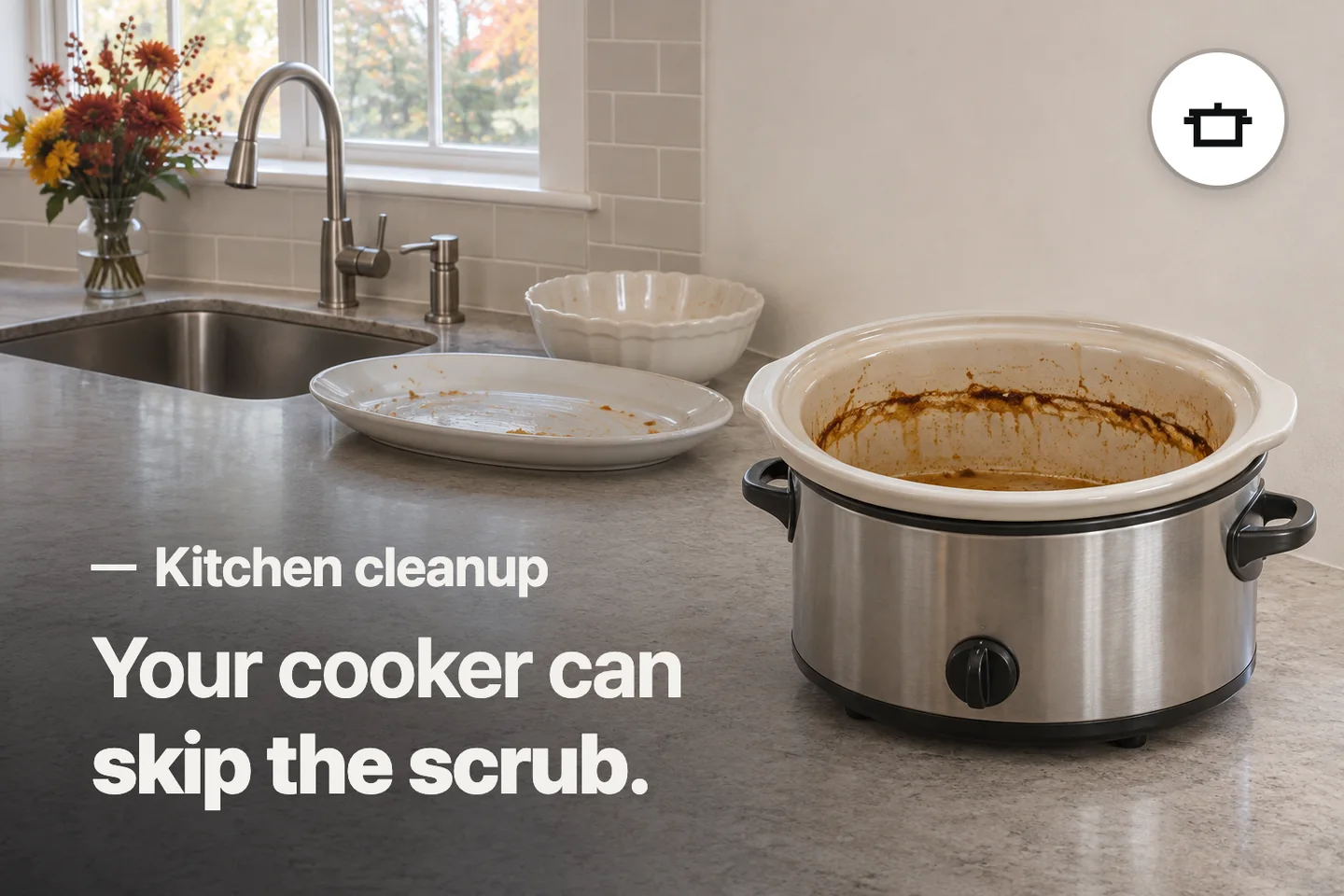
Does the slow cooker that held Thanksgiving gravy and stuffing for your family of five really need a specialty cleaner before December's soup nights? Usually, the sensible starting point is ordinary washing, not another purchase. If you're searching “how to clean slow cooker” because the leftovers are refrigerated but the crock still looks awful, separate stuck food from water spots before spending anything.
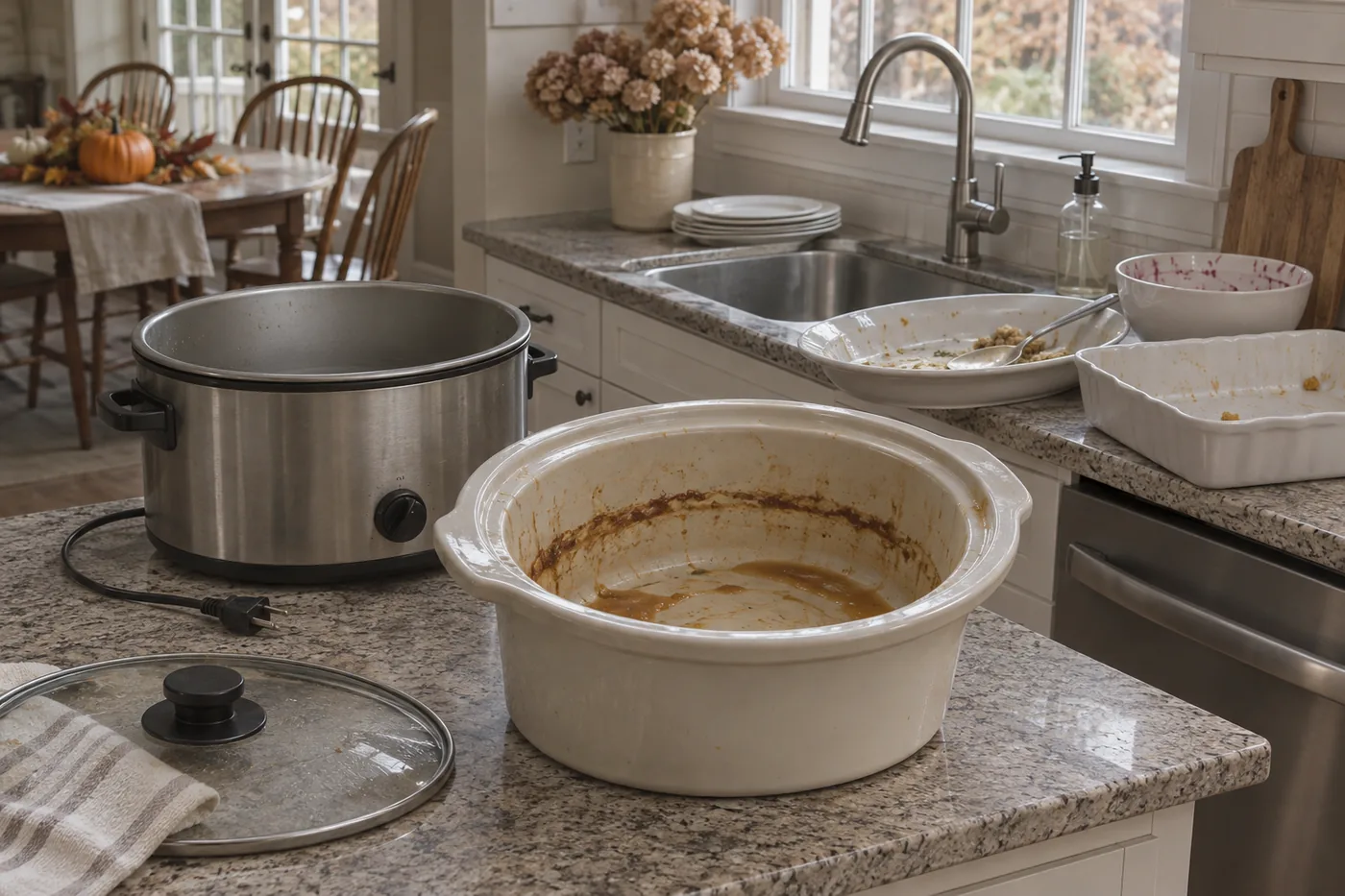 With the leftovers put away, the removable crock and electrical base need different kinds of cleaning.
I'd start with the soft sponge and dish soap already by the sink, following the appliance maker's directions. Crock-Pot says a cloth, sponge, or rubber spatula will usually remove residue, so a bottle sold specifically for slow cookers isn't the first thing I'd add to the cart. The useful distinction is food that needs washing versus spots that need a different treatment.
How we chose
Reviewed Crock-Pot cleaning instructions, Hamilton Beach slow-cooker FAQs, and USDA FSIS food-safety guidance. Recommendations follow three checks: which parts can get wet, whether the remaining mark is food or staining, and whether an extra cleaning product or heated treatment is actually needed.
Part 1How to clean slow cooker residue without damaging the crock?
First, identify the removable vessel rather than treating the entire appliance as a washable pot. Hamilton Beach's slow-cooker guidance says to unplug and let the appliance cool before cleaning, and never immerse the cord, plug, or base. That means the base stays out of the sink, even when gravy has dripped down its side.
Crock-Pot likewise warns against sudden temperature changes, including cold water on hot stoneware or a hot lid. So don't rush a still-hot crock under the faucet to finish the kitchen reset faster. Cooling comes before washing, not halfway through it.
Once the crock has cooled, Crock-Pot permits hot, soapy water for its stoneware and lid. Use the soft sponge or cloth to loosen residue, with a rubber spatula where food needs gentle encouragement; the same guidance rules out abrasive cleaning compounds and scouring pads. If a patch doesn't lift, the next move is a maker-approved treatment, not more force.
Before moving on, look at what remains after rinsing. A raised gravy crust and a flat cloudy patch call for different next steps, so wash away food before assessing the finish. That avoids buying a stain treatment to solve a patch of dinner.
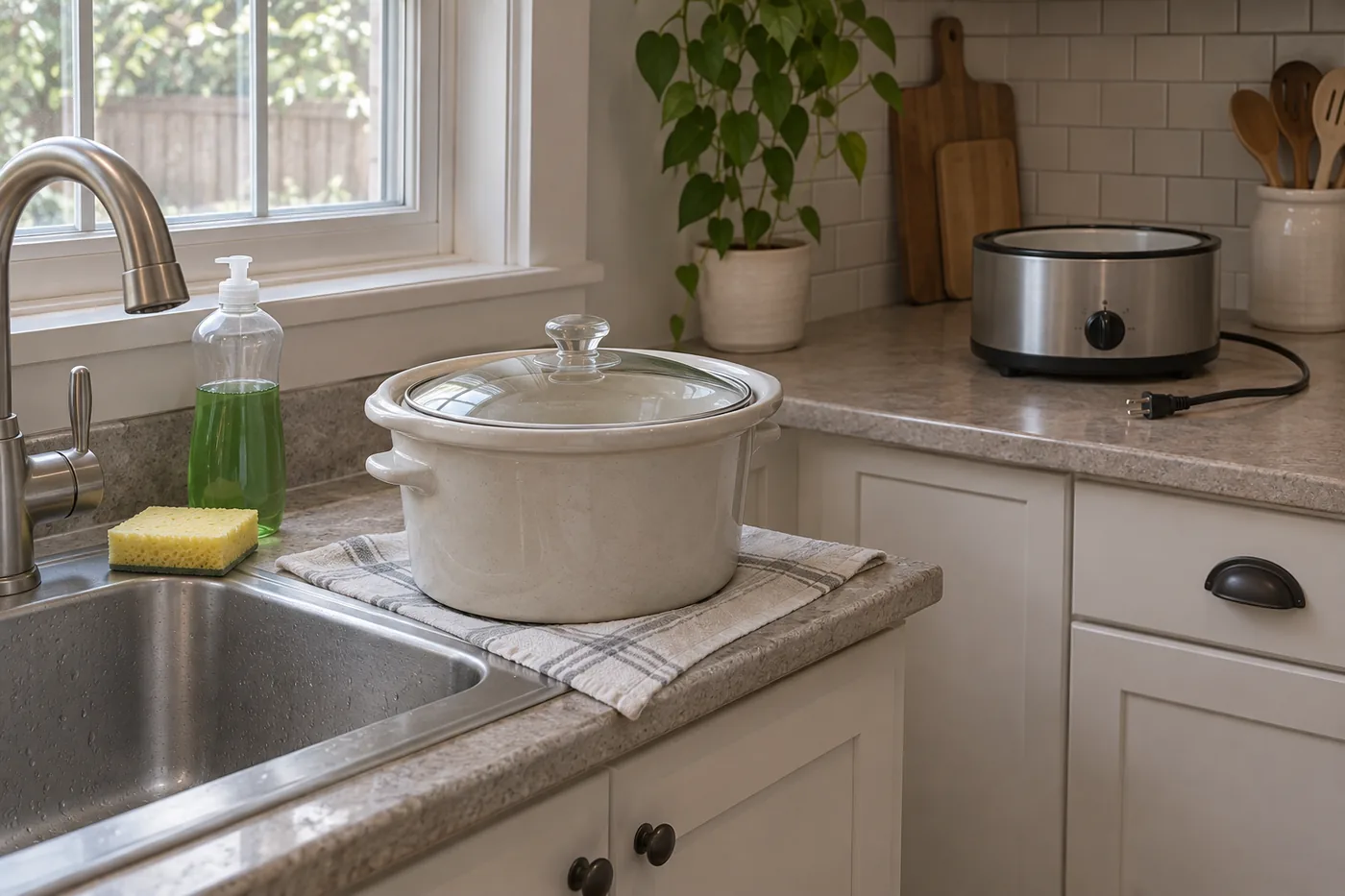 Keep the electrical base separate while washing the cooled removable vessel.
Part 2Is the cloudy film another layer of gravy?
Not necessarily: Crock-Pot's cleaning page specifically addresses water spots and other stains, recommending vinegar or a non-abrasive cleaner. But that doesn't identify every pale mark as a mineral deposit. If the surface is chipped, cracked, or severely scratched, Hamilton Beach says not to use the crock or lid; damage isn't a cleaning challenge.
For an intact Crock-Pot stoneware vessel with water spots, follow that brand's vinegar guidance and your model's care instructions. The general cleaning page doesn't give a dilution or soaking duration, so there's no universal vinegar timer to apply to every cooker. Rinse after treatment and reassess rather than escalating to an abrasive pad.
For a different brand, check its instructions before borrowing that advice. A ceramic crock, a metal insert, and a coated cooking pot aren't interchangeable simply because each fits inside a slow cooker. That's why I wouldn't buy a cleaner based only on a photograph of a shiny replacement bowl.
Match the treatment to the surface and the remaining mark; stronger scrubbing isn't the automatic next step.
Part 3Does a baked-on ring need a heated cleaning cycle?
Only when the maker supports it for your appliance. Crock-Pot publishes a deep-cleaning method for stubborn residue: water goes just above the leftover food line, and its 6-quart recipe uses 1 cup of distilled white vinegar and 1 cup of baking soda. This is a specific brand's procedure, not a general recipe for every electric cooker.
In that procedure, Crock-Pot says to add the baking soda slowly, allowing bubbles to settle before adding more. It then specifies covering the cooker and using LOW for 1 hour. Follow the linked instructions and the model manual together; don't transfer these quantities to a differently sized vessel or a coated insert without approval.
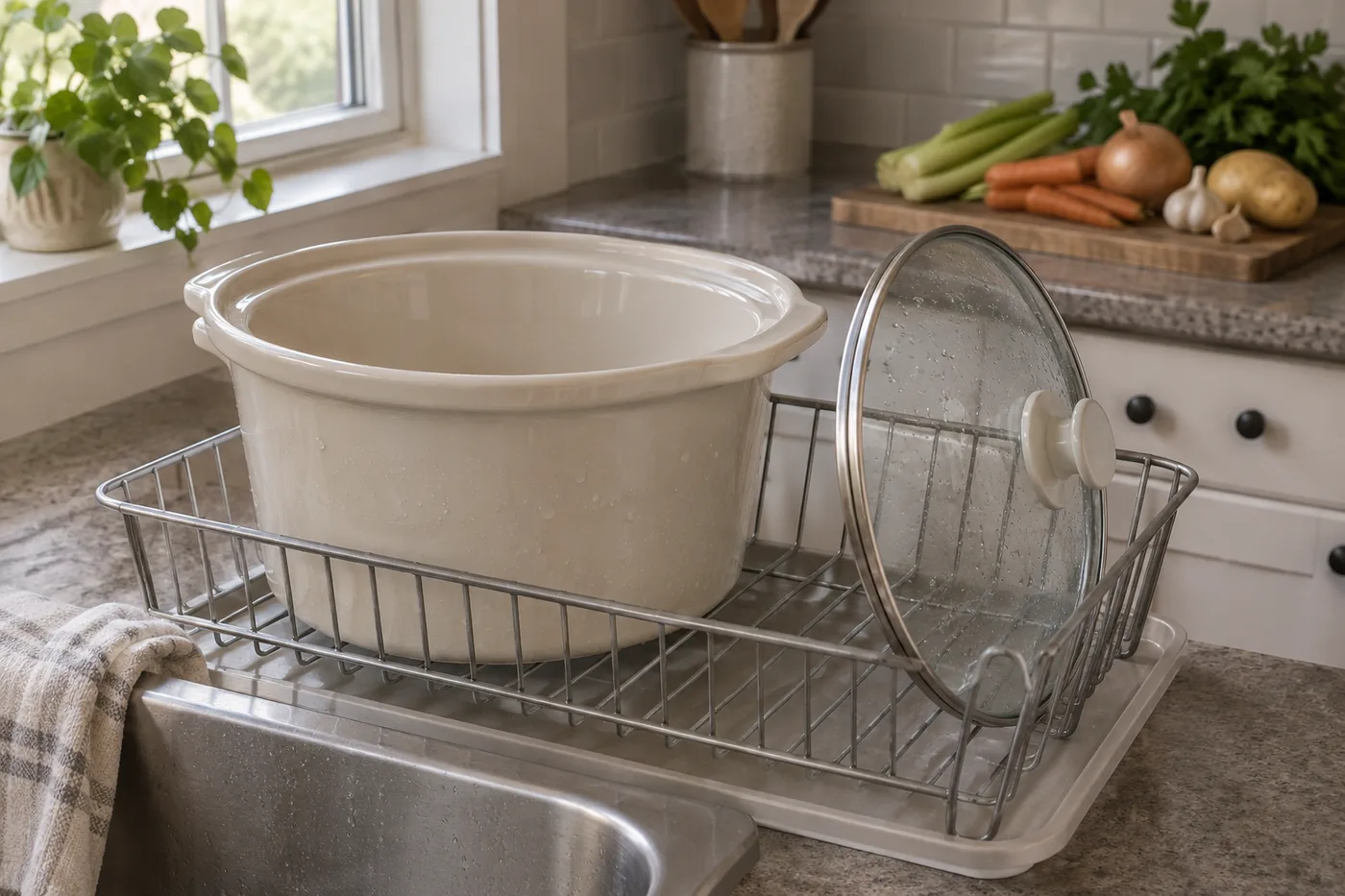 After washing, leave the removable pieces to dry before putting the cooker away.
Crock-Pot's method finishes with a soft sponge as needed, followed by cooling and washing in warm, soapy water. Because the appliance has been heated again, don't treat that final wash as permission to plunge hot stoneware into colder water. The brand's temperature-change warning still applies.
For the holiday crock on your counter, I'd use that escalation only if ordinary washing leaves an actual baked-on ring and the instructions fit the model. A heated cycle adds time and ingredients, so it isn't my default response to a faint water spot. The simplest approved method that removes the residue wins.
Part 4Where does your cleaning money go furthest?
It goes furthest toward preserving the cooker you already own, rather than buying a replacement because its crock looks cloudy. Hamilton Beach permits dishwasher washing for its lid and crock but explicitly says not to use the “SANI” setting because those temperatures could damage the product. So “dishwasher safe” still means checking the cycle and the model manual, not loading the electrical base with the dishes.
For the exterior, Crock-Pot specifies a soft cloth with warm, soapy water followed by wiping dry. Hamilton Beach similarly calls for a soft damp cloth or sponge on the base, then drying. Cleaning the base means wiping, not soaking; persistent problems beyond the described cleaning steps belong with the manufacturer rather than a home repair attempt.
Before the next batch of soup, separate cleaning from leftover handling. USDA FSIS says to refrigerate leftovers in shallow covered containers within two hours after cooking finishes, and advises against reheating leftovers in a slow cooker. Instead, it says to reheat by stove, microwave, or conventional oven to 165°F, then transfer hot food to a preheated slow cooker for holding at least 140°F, checked with a food thermometer.
For anyone returning to “how to clean slow cooker” after the next family dinner, the value calculation stays plain: cleaning cost per use is the portion of supplies actually consumed, and annual cost depends on how often deeper treatment is needed. There's no verified household consumption figure here to turn into a dollar promise. Buy only what the remaining problem requires, not an entire cleaning kit for a pot that ordinary washing can restore.
Method: Reviewed Crock-Pot's routine and deep-cleaning instructions, Hamilton Beach's slow-cooker care guidance, and USDA FSIS leftover advice. The cleaning sequence prioritizes removable-part compatibility, residue type, and avoiding unnecessary purchases. Sources last checked November 28, 2026.
In one sentence
Start with gentle washing, then treat remaining food or water spots according to the maker's instructions.
Frequently asked questions
How to clean crock pot stoneware with a cloudy film?
Crock-Pot recommends vinegar or a non-abrasive cleaner for water spots and other stains. Its routine cleaning page does not specify a dilution or contact time, so follow the model instructions rather than assuming every cloudy mark needs the same treatment.
Can the whole slow cooker go in the dishwasher?
No. Crock-Pot and Hamilton Beach distinguish washable removable parts from the electrical base. Hamilton Beach also warns against its dishwasher SANI setting; check your model's instructions for the permitted parts and cycle.
Can I use a heated cleaning mixture in any crock pot?
No. Crock-Pot publishes a specific deep-cleaning procedure with 1 cup each of distilled white vinegar and baking soda for a 6-quart cooker, followed by LOW for 1 hour. Confirm compatibility with your appliance's instructions rather than transferring the method to another brand, size, or insert material.
Is the best slow cooker one with a dishwasher-safe insert?
That feature can simplify cleanup, but it does not tell you which cycles are permitted or whether a particular damaged insert can still be used. For the cooker already on your counter, removable-part instructions and the condition of the crock matter more than a new appliance purchase.
Sources
- Crock-Pot routine cleaning instructions · 2026-11-28
No numerical dilution or soaking duration specified. Supports hot soapy water, dishwasher washing for lid and stoneware, vinegar for water spots, no abrasives, no sudden temperature changes, and never immersing the heating base.
- Crock-Pot deep-cleaning instructions · 2026-11-28
For 6-quart cookers: 1 cup distilled white vinegar and 1 cup baking soda; add baking soda gradually; cover and use LOW for 1 hour; finish with cooling and warm soapy washing. Also lists half-cup amounts for 3-quart cookers.
- Hamilton Beach slow-cooker care FAQs · 2026-11-28
No numerical cleaning time specified. Cleaning and long-life answers say unplug and cool, never immerse cord/plug/base, avoid the dishwasher SANI setting, and do not use chipped, cracked, or severely scratched crock or lid.
- USDA FSIS slow cookers and food safety · 2026-11-28
Refrigerate leftovers in shallow covered containers within 2 hours; reheat outside the slow cooker to 165°F; transfer hot food to a preheated cooker for holding at least 140°F as measured with a food thermometer.