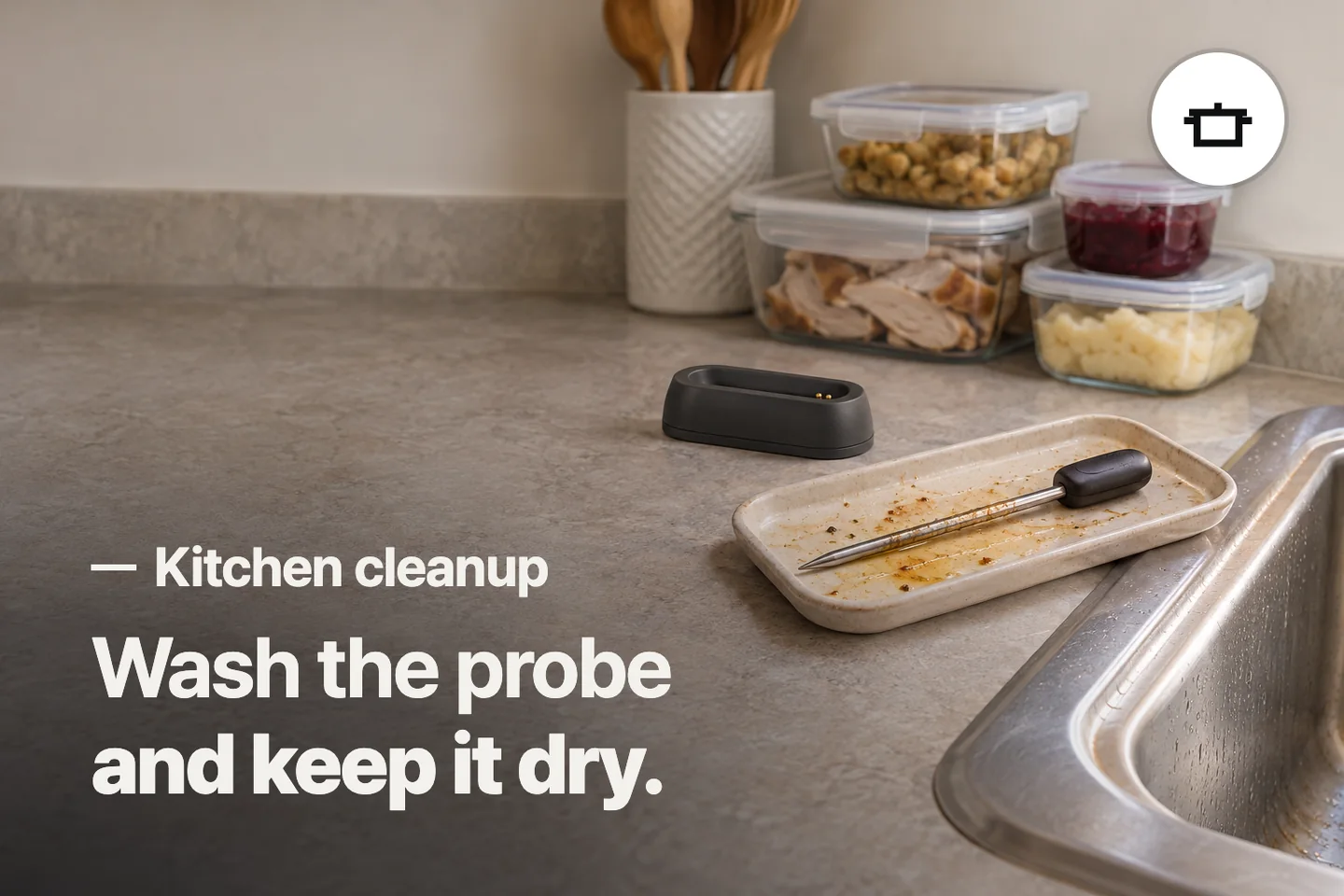
The turkey probe is beside the sink, still greasy, while the leftovers occupy the fridge. For a family of five resetting the kitchen before December dinners, how to clean meat thermometer probes comes down to separating the washable probe from everything that must stay dry.
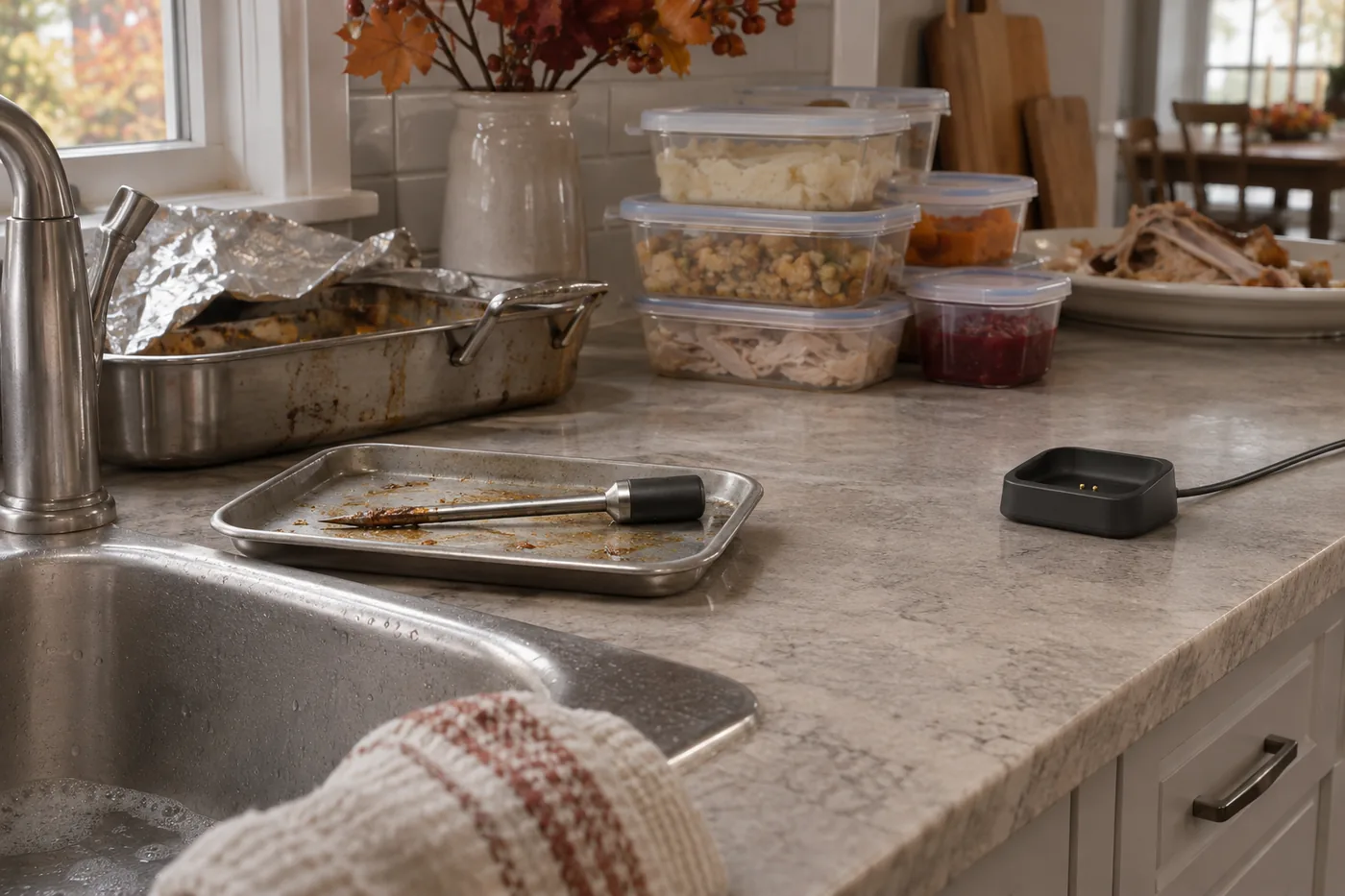 Separate the probe from its charger before starting the cleanup.
I'd start with hand washing, not a sink soak. For a MEATER Plus, the maker recommends hot, soapy water and a sponge, followed by drying before charging; buying a new thermometer or a special cleaning kit isn't the starting point.
That recommendation has a limit: washing away turkey grease is not the same as following a sanitizer's food-contact directions. EPA distinguishes cleaning from sanitizing, so a shiny shaft alone doesn't establish that a chemical sanitizing step has been completed.
How we chose
Reviewed MEATER probe cleaning, Alpha care, and dishwasher instructions, plus USDA thermometer care and EPA chemical-use guidance. The three checks are model-specific water limits, residue at charging contacts, and compatibility with food-contact sanitizing directions; no new tool is necessary to begin.
Part 1How to clean meat thermometer probes without soaking the wrong parts
First, identify the model, not just the brand on the box. MEATER calls its Alpha Collection water-resistant and its Pro Collection waterproof, so advice for a newer Pro probe cannot automatically become instructions for an older MEATER thermometer.
For an Alpha Collection probe such as MEATER Plus, MEATER says to let it cool naturally before washing and avoid prolonged complete immersion. Its cleaning guide allows running water, which means a controlled hand wash is different from leaving the probe under a pile of soaking pans.
The charger is a separate job. MEATER says to keep it away from moisture and extreme heat, so leave it on a dry counter and wipe its contact points with a dry cloth rather than washing it alongside the probe.
Have an instant-read thermometer or a wired probe instead? USDA advises hot, soapy water or the manufacturer's instructions and notes that most thermometers should not be immersed; that makes the exact manual, rather than the wireless label, the deciding reference.
Running-water permission for a probe does not extend to its charger.
Part 2Wash off the film, not just the visible crumbs
Once the probe has cooled, wash the food-contact shaft according to its manual. MEATER permits hot, soapy water and the rough side of a sponge for its probes, so work along the shaft rather than treating a quick wipe of the pointed tip as the whole cleanup.
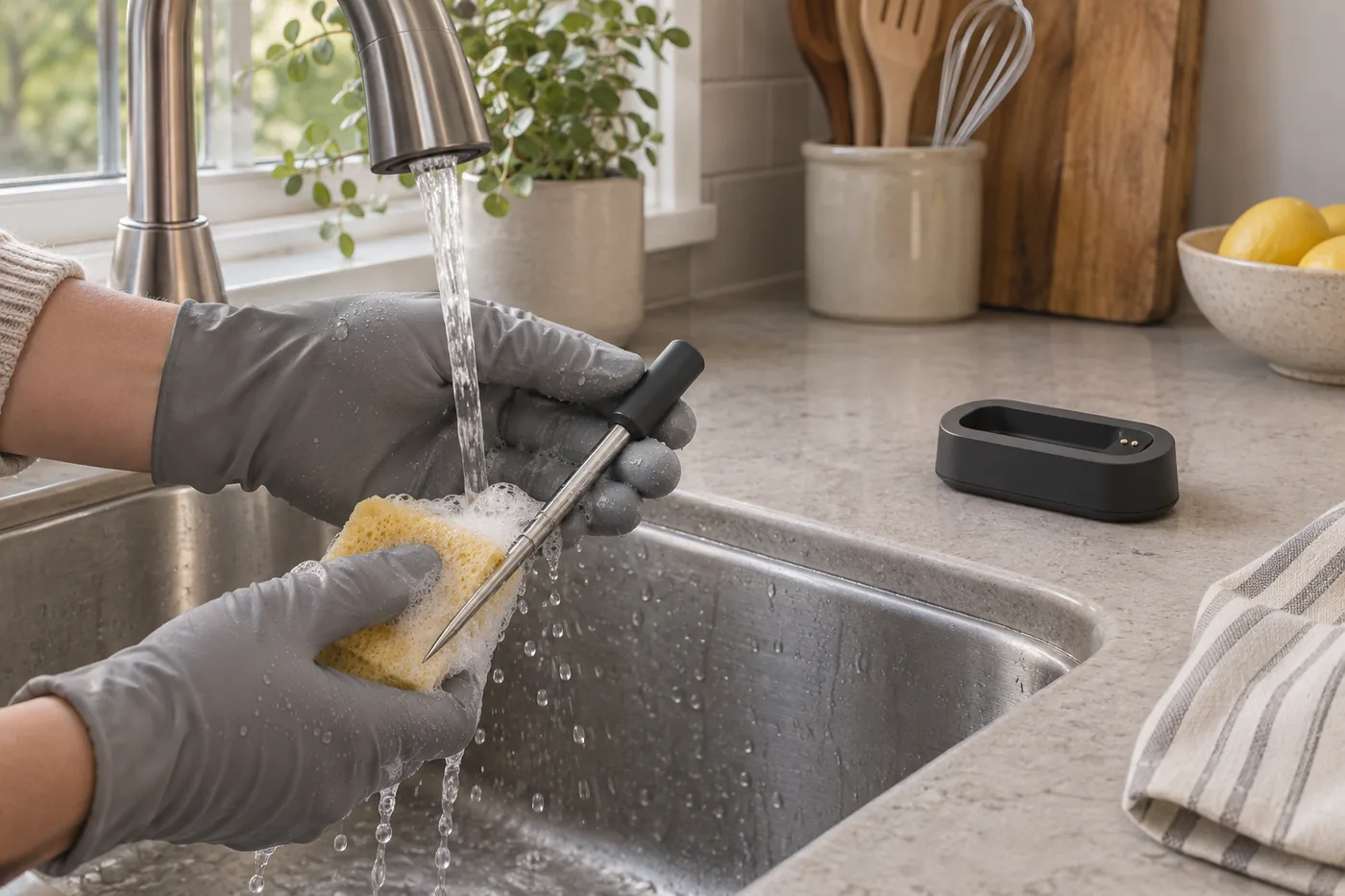 Wash the probe as its manual permits; keep the dock outside the wet area.
For MEATER specifically, the flat end deserves attention. The maker explains that food and smoke deposits can block contact with the charger, which can leave a probe unable to charge and therefore unable to connect.
That film can be hard to see. MEATER even identifies clear grease polymerization as a charging problem, so an apparently silver surface doesn't rule out residue when a previously working probe stops connecting after a smoky cook.
For stubborn buildup, MEATER recommends a scouring pad or a baking-soda mixture. Its published mixture is 3 parts baking soda to 1 part water or white vinegar, followed by washing with soap and water; this is a residue-removal instruction, not a sanitizing recipe.
Keep that advice model-specific. Permission to scrub MEATER's probe does not establish that another manufacturer's coatings, seams, or display housing tolerate the same treatment, so use that other model's cleaning directions rather than borrowing the abrasive step.
Part 3Sanitize only with a food-contact-compatible method
EPA describes cleaning as removing dirt and organic matter with soap or detergent, while sanitizing uses chemicals to kill bacteria on surfaces. So cleaning and sanitizing are different jobs; neither the baking-soda paste nor a sparkling finish should be presented as a validated sanitizer treatment.
Before adding a chemical step, check both the thermometer maker's instructions and the product label. EPA says the label determines the permitted use site and application method, so a bottle intended for household surfaces isn't automatically suitable for the shaft that goes into a roast.
Look specifically for directions covering food-contact surfaces and compatibility with the probe's materials. If the thermometer instructions don't establish a compatible sanitizing method, ask the maker rather than improvising a bleach bath, an alcohol concentration, or an electronics soak.
EPA also requires the surface to stay visibly wet for the full label contact time. That means a wipe immediately followed by drying may not complete the treatment; use the applicable food-contact directions, including any required rinse, before letting the probe dry.
The thermometer's water restrictions still apply during that step. So if the chemical directions require immersion that the probe manual doesn't permit, those instructions are not a workable combination; choose a compatible method with the maker's help instead.
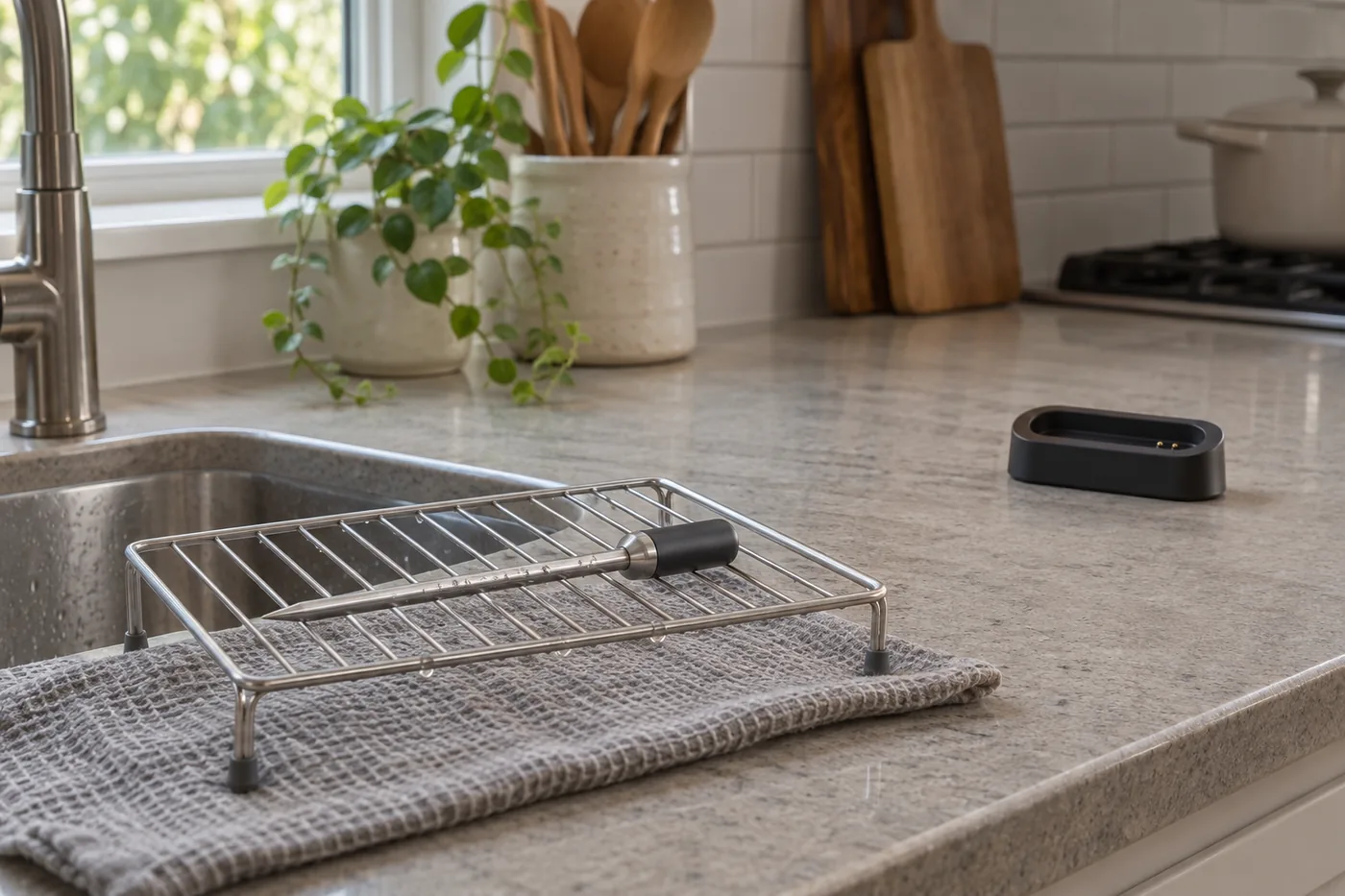 Finish the applicable rinse and drying steps before returning the probe to its dock.
Part 4Check charging before the next roast
After cleaning, MEATER says the probe must be completely dry before docking. Its troubleshooting sequence also calls for wiping charger contacts with a dry cloth, so reconnecting a damp probe is not a shortcut to finding out whether cleanup worked.
Then allow the correct charging interval. MEATER specifies 2 hours for MEATER, MEATER Plus, and MEATER SE, 8 hours for MEATER Block, and 15 minutes for MEATER Pro, Pro Duo, and Pro XL in its cleaning guidance.
If your Bluetooth meat thermometer still won't connect, follow its model-specific support steps rather than assuming Bluetooth itself failed. MEATER identifies inadequate charging caused by residue as a common connection problem, so checking the contact surface belongs before shopping for a replacement.
A dishwasher isn't a universal fix either. MEATER describes Pro Collection probes as dishwasher-safe but still recommends hand washing when charging or connectivity is troublesome, because the grease-and-smoke film may need more direct removal.
For anyone asking how to clean meat thermometer probes after the holiday, my preference is a clean probe and a dry dock, checked before cooking starts. That leaves December's roast dependent on the thermometer's cooking instructions, not on a last-minute attempt to dissolve Thanksgiving grease.
Method: Reviewed MEATER cleaning, Alpha Collection care, and dishwasher guidance alongside USDA thermometer care and EPA chemical-use guidance. The sequence follows model water limits, residue removal, and food-contact label compatibility. No new cleaning product is selected and no purchase links are included. Last checked: November 28, 2026.
In one sentence
Hand wash according to the exact model's water limits, then finish any compatible food-contact sanitizing and drying steps before charging.
Frequently asked questions
Can a wireless meat thermometer go in the sink?
Check the exact model. MEATER permits running-water washing of its Alpha and Pro probes, but Alpha care instructions advise against prolonged complete immersion, and the charger must stay away from moisture. USDA notes that most food thermometers should not be immersed.
Can I put a MEATER thermometer in the dishwasher?
MEATER calls its Pro Collection probes waterproof and dishwasher-safe. It describes Alpha probes as water-resistant rather than waterproof, and recommends hand washing especially when charging or connectivity is affected by residue. These permissions do not cover the charger.
Why won't my Bluetooth meat thermometer connect after cleaning?
For MEATER, food or smoke film can prevent contact with the charger, so the probe may not charge enough to connect. Follow its cleaning instructions, dry the probe completely, wipe charger contacts with a dry cloth, and allow the model's specified charging interval before continuing with support troubleshooting.
Does washing a meat thermometer sanitize it?
EPA distinguishes detergent cleaning from chemical sanitizing. Use a sanitizing method only when both the thermometer instructions and the chemical's food-contact label directions permit it, including contact time and any required rinse. A baking-soda cleaning paste is not a verified sanitizing treatment.
Sources
- MEATER probe cleaning and charging guidance · 2026-11-28
Baking-soda mixture: 3 parts baking soda to 1 part water or white vinegar. Charging after cleaning: MEATER/Plus/SE 2 hours, Block 8 hours, Pro/Pro Duo/Pro XL 15 minutes. Also supports grease-film and dry-contact instructions.
- MEATER Alpha Collection care · 2026-11-28
Supports natural cooling, avoidance of prolonged complete immersion, and keeping charger away from moisture. Page also lists internal and ambient sensor limits of 212°F and 527°F; these are not washing-water targets and are not used as such.
- MEATER dishwasher guidance · 2026-11-28
Pro Collection is waterproof and dishwasher-safe; Alpha Collection is water-resistant. Maker still recommends hand washing, especially for charging issues. No numerical dishwasher cycle temperature or duration is supplied or inferred.
- USDA Food Thermometers: care instructions · 2026-11-28
Thermometer care calls for hot, soapy water or manufacturer instructions; most models should not be immersed. Page last-updated date: March 21, 2025. No numerical washing temperature or duration is specified.
- EPA: cleaning, sanitizing, and disinfecting · 2026-11-28
Defines cleaning versus chemical sanitizing and instructs users to follow label contact time. Page last updated October 8, 2026; no universal probe sanitizer concentration or contact time is given.
- EPA: registered products and directions for use · 2026-11-28
Supports intended-use-site checks and keeping surfaces visibly wet throughout label contact time. Page last updated August 24, 2026. Its 10-minute contact-time illustration is an example, not a thermometer sanitizing prescription, and is not applied to probes here.