Conclusion
The cheaper YISHU suits a nearby desk when its cord reaches and its listed load limits match the connected devices. The higher-priced SUPERDANNY suits a desk needing a longer cord or two USB-C ports, with the same listed current limit.
3 selected products
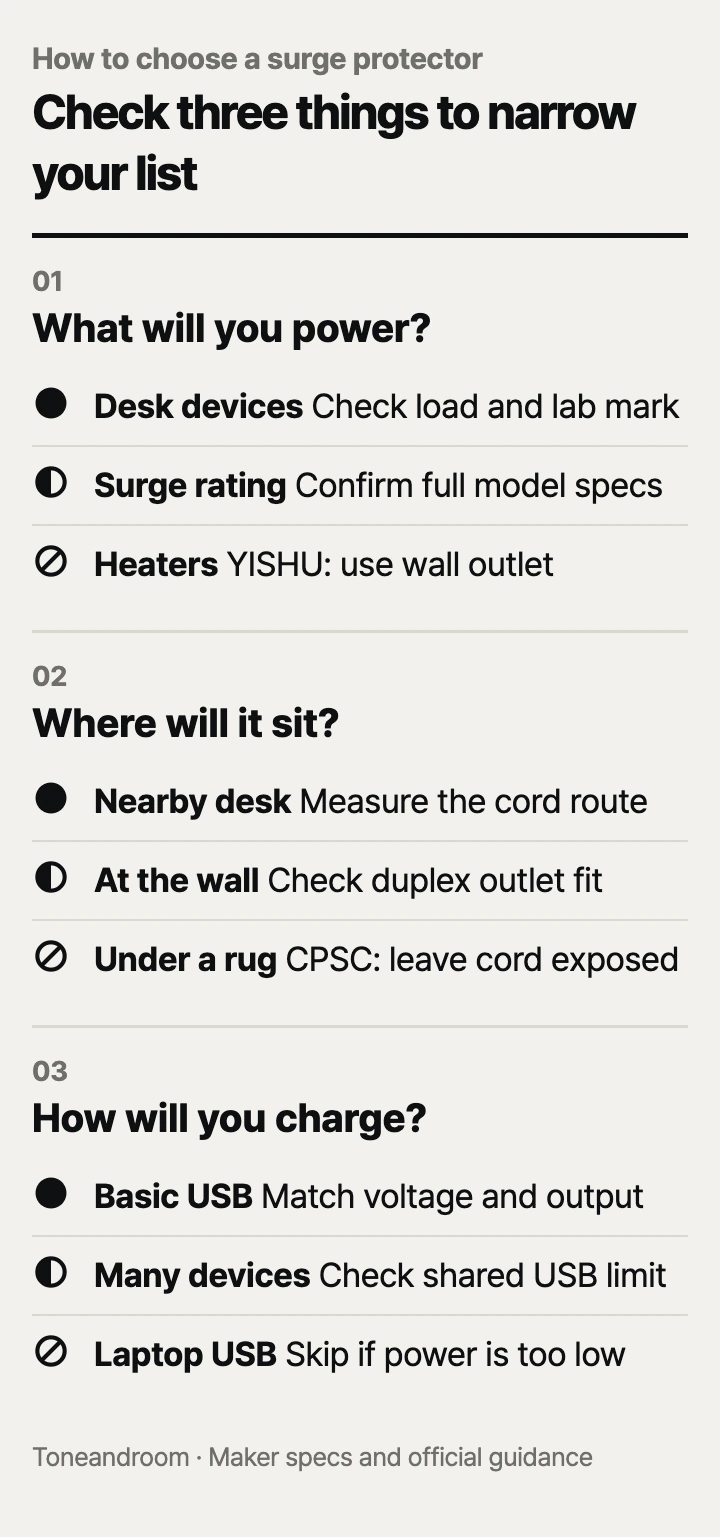
The common mistake is counting outlets before checking what you will plug in and where the strip will sit. Before buying, check these three things, in order
Do the load rating and protection details match your devices?
Start with CPSC's certification-label and load checks before comparing outlet counts or joules. CPSC recommends an independent testing-lab label on both the package and the product, and says the equipment must handle the current required by connected appliances. For strips and surge protectors, CPSC directs shoppers to check the underside for the maker and testing lab. CPSC buying and use guidance.
Write down what will share the strip: monitor, computer charger, desk lamp, speakers, and any other equipment. Read each device's electrical label, then compare the combined demand with the strip's rating. CPSC warns against overloading cords; an empty outlet is not evidence of available capacity.
Swipe sideways to see the full table →
| If your home … | Our take | What to check |
|---|---|---|
| Has a desk with several electronics near an outlet | Worth it | Combined device load, certification mark, and adapter spacing |
| Has a charging shelf beside a standard duplex outlet | It depends | Whether a direct plug-in model fits the wall plate |
| Has a desk beyond a short cord's reach | Only some models | Measure the full route before choosing cord length |
| Needs a strip for a space heater or air conditioner | Skip it | YISHU's manual directs these appliances to a wall outlet |
YISHU rates the AHR-803 at 10 amps, 1,250 watts, and 900 joules. Its manual directs individual devices over 750 watts, including heaters and air conditioners, to a wall outlet. Follow that restriction even when the total is below the strip's rating. YISHU AHR-803 manual.
QINLIANF lists 15 amps and 1,680 joules for the HR-519D. SUPERDANNY lists 10 amps, 1,250 watts, and 1,050 joules for the SDCP04. These are separate specifications: a larger joule number does not increase the listed current limit. QINLIANF specifications, SUPERDANNY specifications.
UL Solutions identifies UL 1363 as the basic standard for relocatable power taps and says their surge-protection component must additionally comply with UL 1449. SUPERDANNY describes a UL-recognized cable; that component description alone does not establish certification of the finished strip. Ask for the complete model's certification details before relying on that wording. UL Solutions certification guidance, SUPERDANNY product details.
Will the cord and outlet layout fit your room?
Choose the placement first: a nearby desk, a wall charging spot, or a longer route across your workspace. YISHU provides a 6-foot cord, QINLIANF plugs directly into the wall, and SUPERDANNY provides a 10-foot cord. That difference is more useful for room planning than the total number of charging connections. YISHU placement details, QINLIANF placement details, SUPERDANNY placement details.
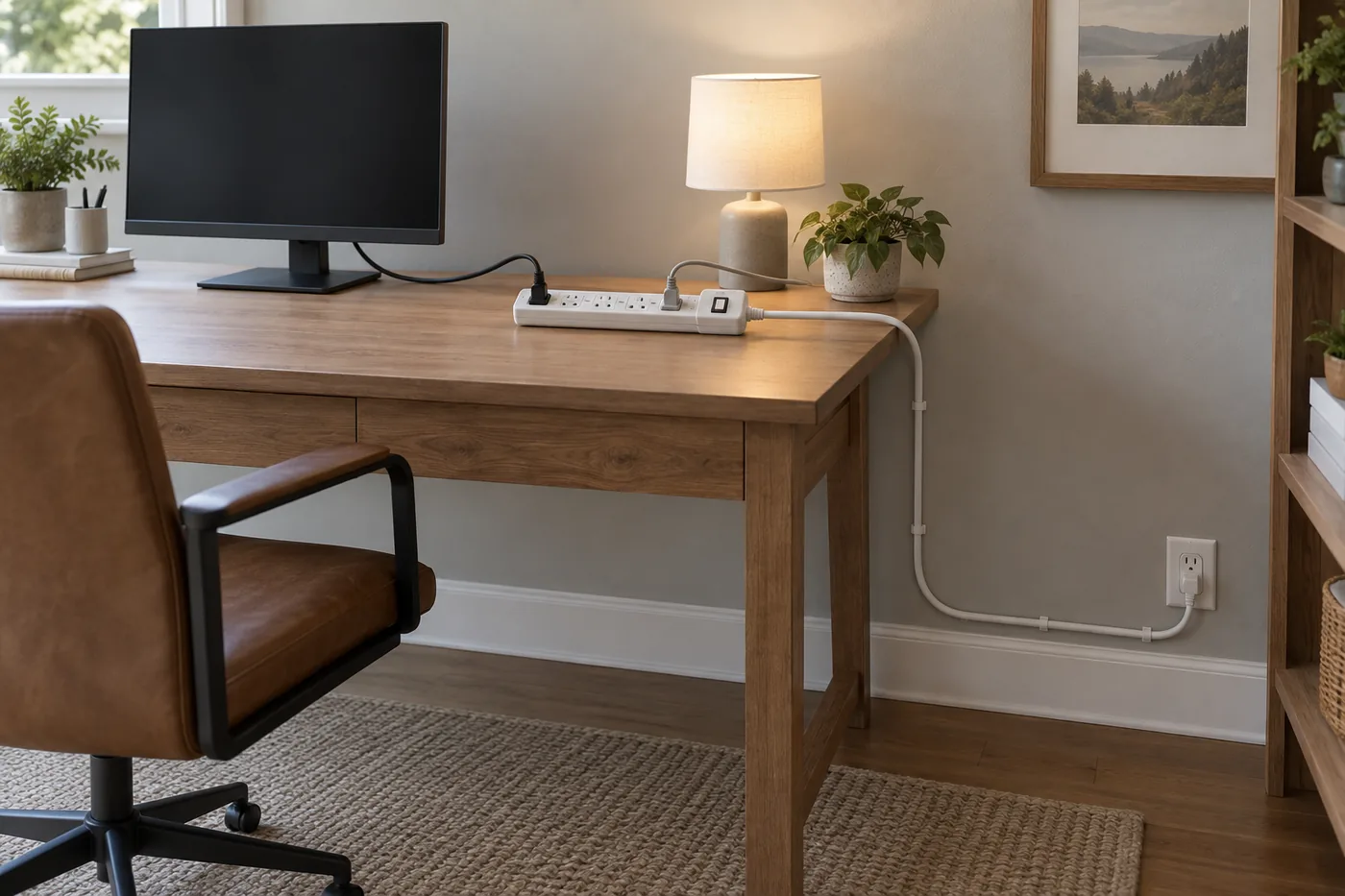
Measure from the wall outlet along the route you actually intend to use, including the climb to a desktop or mounting position. Leave room to move the desk and unplug equipment. CPSC advises against covering cords with rugs or other objects, so a straight-line measurement across an area rug is not a suitable routing plan under that guidance. CPSC cord guidance.
YISHU's AHR-803 has outlets on three sides with listed spacing of 1.8 inches. SUPERDANNY's SDCP04 uses four sides with listed spacing of 1.65 inches. Neither measurement guarantees that every large power brick will fit beside another. Compare the direction and width of your actual adapters, including the cable leaving each brick, with the product layout.
The wall-mounted option needs a different check. QINLIANF says its securing screw is for standard duplex outlets and cannot secure the unit to a GFCI outlet. Inspect your wall plate before ordering, especially if it has test and reset buttons or sits behind furniture. Its five AC outlets can serve a nearby charging shelf, but it cannot move the connections up to a distant desktop.
- Trace the intended cord route before choosing a length.
- Check the wall plug's orientation against nearby furniture.
- Lay out your adapters to see which outlets face the useful direction.
- Keep the switch and charging ports reachable for daily unplugging.
Both corded models list mounting holes. Decide whether you want the strip on the desktop or attached where you can still reach it; mounting convenience is a reason to choose a model, not proof that your adapters will fit.
Will the USB ports charge what you actually own?
Treat these USB ports as basic charging connections, and match their published output to your device's requirements. YISHU's manual lists three USB-A ports, one USB-C port, and 4.2 amps shared at 5 volts. It excludes Quick Charge 3.0 and devices requiring higher charging voltages. YISHU USB specifications.
QINLIANF lists four USB ports, a USB-C maximum of 5 volts at 3 amps, and the same restriction against higher-voltage charging. Combined USB output: Not listed by the maker. That missing shared limit matters if your charging shelf will hold several devices at once. Do not assume each connection can deliver its individual maximum simultaneously. QINLIANF USB details.
SUPERDANNY lists two USB-A and two USB-C ports with 15 watts total across the USB section. Its extra USB-C connection is useful if your everyday cables use that connector, but the shared output makes this a poor match when you specifically need a high-output laptop charger. Keep your laptop's specified charger in the plan rather than counting a USB-C socket as a substitute. SUPERDANNY USB details.
For daily upkeep, YISHU's manual says to leave the strip uncovered and avoid humid environments. CPSC says to replace cracked or worn cords and stop using a cord that feels hot. Include those CPSC checks when rearranging your desk, and leave the maker's protection indicator visible where provided. YISHU care instructions, CPSC maintenance guidance.
How do the popular picks compare side by side?
YISHU fits a nearby budget desk, QINLIANF fits a wall charging spot, and SUPERDANNY fits a desk needing more cord reach. Each carried Amazon's “10K+ bought in past month” label on Oct 14, 2026. That signals popularity; choose among them using the maker-listed specifications below.
Swipe sideways to see the full table →
| Model | Placement | AC / USB connections | Listed surge / current limit | Price (Amazon.com, Oct 14, 2026) | Buy |
|---|---|---|---|---|---|
| YISHU AHR-803 | 6-foot cord; flat plug | 8 AC / 4 USB | 900 J / 10 A | about $9.98 on Amazon.com (Oct 14, 2026) | View on Amazon |
| QINLIANF HR-519D | Direct wall plug; no cord | 5 AC / 4 USB | 1,680 J / 15 A | about $9.99 on Amazon.com (Oct 14, 2026) | View on Amazon |
| SUPERDANNY SDCP04, 10-foot | 10-foot cord; flat plug | 8 AC / 4 USB | 1,050 J / 10 A | about $13.99 on Amazon.com (Oct 14, 2026) |
Prices are what Amazon.com showed on Oct 14, 2026 and change often.
Choose the cheaper YISHU if its cord reaches and its published limits match your desk equipment. Pay more for SUPERDANNY when you need the longer cord or another USB-C connection; its listed current limit remains the same. Choose QINLIANF only when the connections belong at the wall outlet. For all three, a suppressed-voltage rating is Not listed by the maker, so this comparison does not establish which provides the strongest surge protection.
A closer look at each product
If you have a desk near an outlet · YISHU AHR-803 6-foot Surge Protector Power Strip
A 6-foot cord, eight AC outlets, and four USB ports suit a nearby desk. The maker lists 900 joules and a 10-amp limit.
- Eight AC outlets with 1.8-inch spacing
- 6-foot cord with a flat plug
- Three USB-A ports and one USB-C port
- 10-amp limit; YISHU restricts individual devices over 750 watts
- USB charging is limited to 5 volts
If your charging spot is at the wall · QINLIANF HR-519D 5-Outlet Surge Protector Wall Charger
Five AC outlets and four USB ports expand a charging spot without a cord. QINLIANF specifies a standard duplex outlet for screw attachment.
- Direct wall connection
- 1,680-joule listed surge rating
- Five AC outlets with 2.1-inch spacing
- Securing screw does not fit GFCI outlets, per QINLIANF
- Combined USB output: Not listed by the maker
If your desk needs a longer cord · SUPERDANNY SDCP04 10-foot Surge Protector Power Strip
A 10-foot cord reaches farther than the YISHU model, with eight AC outlets and two USB-C ports. SUPERDANNY lists a 15-watt shared USB output.
- 10-foot cord with a 0.3-inch-thick flat plug
- Eight AC outlets across four sides
- Two USB-C ports and two USB-A ports
- 10-amp current limit
- 15 watts total across all USB ports
In one sentence
Choose by load and protection details, placement, and USB output before counting outlets.
YISHU AHR-803 6-foot Surge Protector Power Strip
View on AmazonQINLIANF HR-519D 5-Outlet Surge Protector Wall Charger
View on AmazonSUPERDANNY SDCP04 10-foot Surge Protector Power Strip
View on AmazonWhat to check
- Load and protection · Check current limits and complete-product certification detailsRead each connected device's label and follow CPSC guidance to check the strip's rating and testing-lab mark.
- Placement · Match cord reach, wall fit, and adapter spacingMeasure the intended route from the wall outlet and compare your adapters with the outlet layout.
- Charging output · Check USB voltage and shared outputCompare the devices you charge together with the maker's total USB output and supported charging voltage.
- Load rating and complete-product certification details
- Actual cord route and outlet layout
- Shared USB output and charging requirements
Frequently asked questions
Is a power strip the same as a surge protector?
UL Solutions says only some power strips provide protection against power surges. Its certification guidance identifies additional UL 1449 requirements for the surge-protection component; check the complete product's markings and documentation.
Can I plug a space heater into one of these strips?
YISHU's manual directs heaters, air conditioners, and individual devices exceeding 750 watts to a wall outlet. Follow those restrictions rather than relying on open sockets.
Will a USB-C surge protector charge my laptop?
A USB-C connector alone does not establish the charging output your laptop requires. SUPERDANNY lists only 15 watts shared across its USB ports, while YISHU and QINLIANF describe 5-volt USB charging; compare that with your laptop charger's requirements.
Does the QINLIANF outlet extender fit a GFCI outlet?
QINLIANF says the securing screw works with standard duplex outlets and cannot secure the HR-519D to a GFCI outlet. Choose it for a compatible wall charging spot, or choose a corded model when you need connections on a desktop.
Sources
- YISHU AHR-803 maker manual · Oct 14, 2026
Maker manual hosted by Amazon: load and surge ratings, shared USB output, port types, individual-device restriction, and care instructions.
- SUPERDANNY official SDCP04 product page · Oct 14, 2026
SDCP04 SKU, 10-foot variant, 1.65-inch outlet spacing, 0.3-inch plug, 10 amps, 1,250 watts, 1,050 joules, 15-watt shared USB output, and component-certification wording.
- UL Solutions power strip certification guidance · Oct 14, 2026
UL 1363 for relocatable power taps and additional UL 1449 requirements for surge-protection components; direct plug-in types are included among power strip styles.
- CPSC power strip and cord guidance · Oct 14, 2026
Independent testing-lab labels, current limits, rug-free routing, and replacing hot or damaged cords. Historical incident figures are not used.
Read next
Best home projectors on Amazon.com (2026): 3 things to check first

Best Turntables on Amazon.com (2026): Check Connections, Space, and Stylus Care First

Best Open-Ear Headphones on Amazon.com (2026): Check Space, Fit, and Battery First
Best USB microphone on Amazon.com (2026): check room pickup, desk fit, and daily controls
Other topics
Best potty training seats on Amazon.com (2026): check toilet fit, foot support and cleanup first

Best Bathrobe on Amazon.com (2026): Check Fabric, Fit, and Care First
Best pull-down kitchen faucets on Amazon.com (2026): 3 things to check first