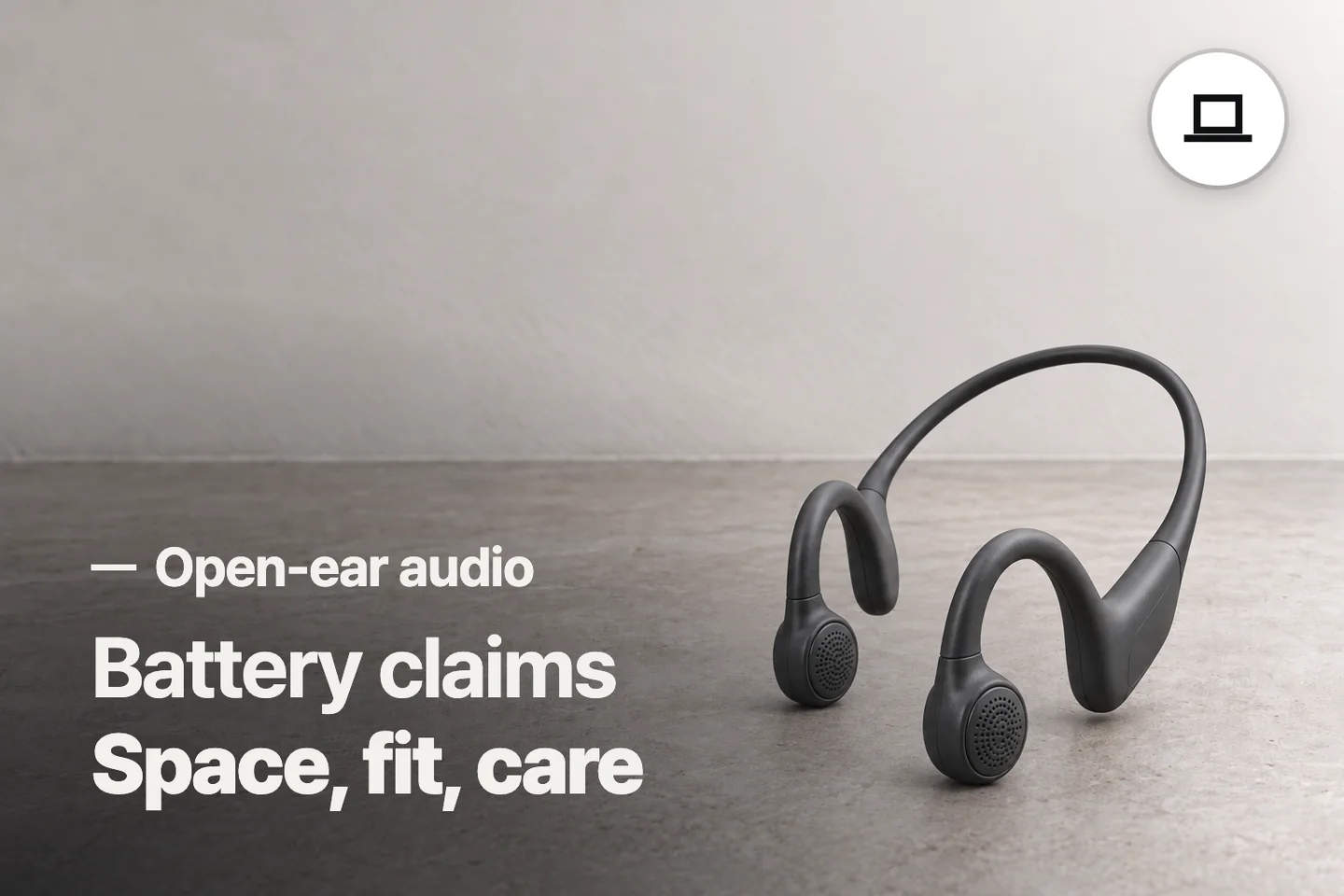
Conclusion
Casual listeners in a quiet home can start with the cheaper TOZO OpenEarRing if the clip-on fit works for them. People who want more published audio and call features can consider the higher-priced Baseus Inspire XC1.
3 selected products
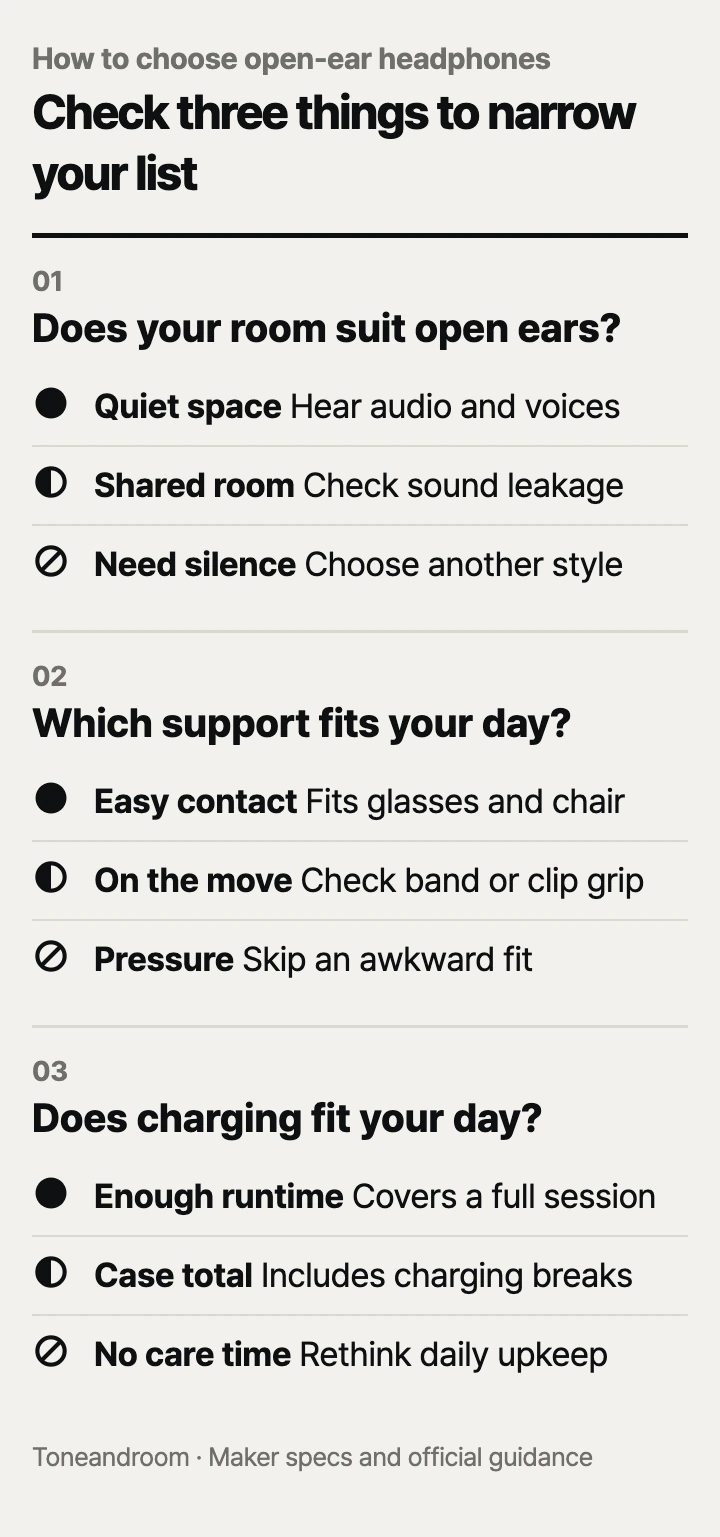
The most common mistake is buying open-ear headphones to quiet a noisy room when their main appeal is leaving your ears open. Before choosing by price or battery claims, check these three things, in order.
Will open-ear headphones suit your listening space?
They make the most sense when you want conversation and room sounds to remain part of your listening experience. Baseus's Amazon.com listing identifies no listening noise control and describes microphone processing for calls instead. TOZO similarly describes the OpenEarRing's noise reduction as a call feature. Those labels do not promise a quieter kitchen or home office. Baseus product listing, TOZO specifications.
Picture your actual listening spot. A podcast while folding laundry is a different job from following dialogue beside a running dishwasher. In an open living room, the TV and other people's conversations remain part of the space. If that is the reason you want open-ear audio, the design fits the task. If it is what you want to escape, start with another headphone style.
Swipe sideways to see the full table →
| If your home … | Our take | What to check |
|---|---|---|
| Is quiet enough for podcasts, but you want to hear someone speak | Worth it | Whether speech stays understandable at your preferred volume |
| Has a home office shared with another person | It depends | Sound leakage and whether room noise interrupts listening |
| Requires switching between a phone and laptop | Only some models | Explicit multipoint support, rather than Bluetooth version alone |
| Has constant TV or appliance noise you want to block | Skip it | A headphone design with listening noise cancellation |
Do not assume an open design keeps your audio private. Before the return window closes, ask someone nearby whether they can hear your usual content at your usual volume. Treat this as a household fit check, especially if you listen beside a sleeping partner or share a desk. A separate room may matter more than paying for extra audio features.
Which fit works with glasses, movement, and your chair?
Choose the support style around what touches your ears and the back of your head during a normal day. TOZO uses separate clip-on earbuds, while PSIER describes the X12 as a flexible titanium-frame model with an included adjustable strap. The X12 listing names the strap among the box contents, so it is a complete headset rather than a replacement accessory. PSIER X12 on Amazon.com, TOZO OpenEarRing on Amazon.com.

The TOZO OpenEarRing is the budget starting point for someone who prefers separate earbuds and wants to avoid a band behind the head. TOZO's technical specifications list 5.1 g per earbud. That is a useful weight reference, but the contact point on your particular ear matters more than a small difference on paper.
The PSIER X12 suits someone who wants a connected headset for walking or exercise, with a strap to adjust its hold. PSIER lists a total headset weight of 23 g. That figure describes the whole headset, so do not compare it directly with the weight of a single clip-on earbud.
A band also gives you something to consider when leaning back. Use your regular desk chair, couch, glasses, and hat during the fit check. Look for pressure where the frame and glasses overlap, and notice whether the rear band meets the headrest. A model that fits while standing can still be awkward in your usual seated position.
- Keep your everyday glasses on while checking ear contact.
- Turn your head and bend down to check whether the audio position shifts.
- Lean against your usual chair and couch before committing to a band.
- Make a call from the place where you normally work.
Baseus offers a clip-on alternative for people who want laptop-and-phone switching. Its official specifications explicitly list multipoint connection. That makes it the clearer choice for this setup, provided its ear grip works for you. PSIER X12 multipoint support: Not listed by the maker.
Can you live with the charging and care routine?
Compare uninterrupted playback first, then decide whether case recharges and daily cleaning fit your routine. TOZO rates the OpenEarRing for up to 10 hours per charge and 40 hours including the case, using AAC at 50% volume. PSIER lists up to 10 hours at 50% volume for the X12 and about 2 hours for a full USB-C charge. Case-assisted totals describe separate listening sessions with charging breaks.
Baseus lists about 8 hours per charge and 40 hours with the case. Its stated playback conditions use 50% volume with Bass Boost and Dolby Audio off. Its support page also lists a USB-C charging port and about 1.5 hours of charging time. Leave room in your schedule for charging rather than assuming a workday will always match the advertised maximum. Baseus support specifications.
The extra cost of the Inspire XC1 buys a different feature set, rather than a longer uninterrupted battery rating. Baseus lists a hybrid driver system, Sound by Bose tuning, and LDAC; Baseus says LDAC works with Android devices only. Its Amazon listing describes a four-microphone call system. For an iPhone owner, multipoint and call features may be more relevant reasons to spend more. Baseus Inspire XC1 on Amazon.com.
Daily upkeep belongs in the buying decision, too. Baseus's maintenance guidance recommends a dry cotton swab or microfiber cloth for earbuds, case, and charging contacts, and advises against cleaning with liquids, harsh chemicals, or sharp objects. Put that cloth near your charging spot so cleaning does not become a separate chore. Baseus care guidance.
For moisture exposure, TOZO lists IPX5 for the OpenEarRing earbuds; PSIER lists IPX5 for the X12 and explicitly excludes underwater use. Baseus lists IP66 for the Inspire XC1 earbuds and says its charging case has standard protection. Follow each maker's guidance for the exact model and keep the charging spot away from the sink.
How do the popular picks compare side by side?
TOZO is the economical clip-on choice, PSIER adds band support, and Baseus adds explicit multipoint and more audio features. TOZO, PSIER, and Baseus publish specifications that support these different uses; the specifications do not establish a universal sound-quality ranking.
Swipe sideways to see the full table →
| Model | Fit and support | Published playback: single charge / with case | Setup features | Price (Amazon.com, Oct 14, 2026) | Buy |
|---|---|---|---|---|---|
| TOZO OpenEarRing | Separate clip-on earbuds | Up to 10 hours / 40 hours | EQ app; USB-C case | about $26.98 on Amazon.com (Oct 14, 2026) | View on Amazon |
| PSIER X12 | Connected band; adjustable strap included | Up to 10 hours / no charging case included | Physical buttons; USB-C headset | about $59.99 on Amazon.com (Oct 14, 2026) | View on Amazon |
| Baseus Inspire XC1 | Separate clip-on earbuds | About 8 hours / 40 hours | Multipoint; Android LDAC; app | about $109.99 on Amazon.com (Oct 14, 2026) | View on Amazon |
Prices are what Amazon.com showed on Oct 14, 2026 and change often.
Start with TOZO for casual listening in a quiet home. Choose PSIER when a connected band and adjustable strap solve your fit needs. Pay more for Baseus when switching devices and its audio features are things you will actually use. A quiet listening spot and comfortable fit remain the deciding factors.
A closer look at each product
If you want budget clip-ons for a quiet home · TOZO OpenEarRing
Separate clip-on earbuds avoid a rear band, and TOZO lists up to 10 hours per charge. The case brings total playback to 40 hours across recharges.
- 5.1 g per earbud in TOZO technical specifications
- USB-C case with a digital battery display
- EQ adjustment through the TOZO app
- Case recharges are needed for the 40-hour total
- Call noise reduction does not provide listening noise cancellation
If you prefer a connected headset for movement · PSIER X12
PSIER lists a flexible titanium frame and an included adjustable strap for fit adjustment. Its claimed playback reaches 10 hours at 50% volume.
- 23 g total headset weight
- Adjustable strap included
- USB-C charging with physical buttons
- Rear band needs clearance against a chair headrest
- Multipoint support: Not listed by the maker
If you switch between a laptop and phone · Baseus Inspire XC1
Baseus explicitly lists multipoint support and a hybrid driver system with Sound by Bose tuning. Its four-microphone call system adds a published call feature for work use.
- Explicit multipoint connection support
- Hybrid drivers and app-controlled audio features
- About 8 hours per charge and 40 hours including case recharges
- Baseus says LDAC requires Android
- Published continuous playback is shorter than TOZO's rating
In one sentence
Choose open-ear headphones by listening space, support style, and uninterrupted battery life before paying for extra features.
TOZO OpenEarRing
View on AmazonPSIER X12
View on AmazonBaseus Inspire XC1
View on AmazonWhat to check
- Listening space · Room noise and sound leakageCheck speech clarity in your normal listening spot and ask someone nearby whether they can hear your audio.
- Fit and support · Clip-on earbuds or a connected bandWear your regular glasses, turn your head, and lean against your usual chair to check contact points.
- Battery and care · Playback per charge, case recharges, and cleaningMatch uninterrupted playback to your routine and set aside a charging spot with a dry cleaning cloth.
- Room noise and sound leakage
- Fit with glasses and chair headrests
- Playback per charge and cleaning routine
Frequently asked questions
Are open-ear headphones the same as bone-conduction headphones?
Open-ear describes the fit, while bone conduction describes how audio is delivered. The PSIER X12 listing specifies bone conduction; the TOZO OpenEarRing and Baseus Inspire XC1 use speaker drivers near the open ear canal.
Do open-ear headphones work well with glasses?
TOZO markets the OpenEarRing clip-on design for glasses wearers, but fit still depends on your ears and frames. Wear your everyday glasses during the return window and check the contact points while turning your head and leaning against your chair.
How do you clean open-ear headphones and their case?
Baseus recommends a dry cotton swab or microfiber cloth for open-ear earbuds, charging contacts, and the case. Its care guidance advises against liquids, harsh chemicals, and sharp objects; follow the included manual for your particular model.
Does 40-hour battery life mean 40 hours without charging?
For the TOZO OpenEarRing and Baseus Inspire XC1, that figure includes case recharges between listening sessions. Their published single-charge ratings are up to 10 hours and about 8 hours, respectively, under the stated playback conditions.
Sources
- TOZO OpenEarRing official specifications · Oct 14, 2026
Technical specifications: 5.1 g per earbud, 10-hour single-charge and 40-hour case total at 50% volume with AAC, USB-C, call noise reduction, and IPX5 earbuds. The FAQ differs on weight; the technical specification is used.
- Baseus Inspire XC1 official specifications · Oct 14, 2026
Multipoint, hybrid drivers, Android-only LDAC, about 8-hour and 40-hour playback ratings at 50% volume with Bass Boost and Dolby Audio off, no listening ANC, and earbud-only IP66 protection.
- Baseus Inspire XC1 support specifications · Oct 14, 2026
USB-C charging port, about 1.5-hour charging time, about 8-hour playback at 50% volume, and 40-hour case-assisted total.
- Baseus open-ear headphone care guidance · Oct 14, 2026
Maker guidance for cleaning earbuds, cases, and charging contacts with a dry cotton swab or microfiber cloth and avoiding liquids, harsh chemicals, and sharp objects.
Read next
Best USB microphone on Amazon.com (2026): check room pickup, desk fit, and daily controls
Best gaming headset on Amazon.com (2026): check connection, comfort, and care first
Best computer speakers on Amazon.com (2026): check connections, desk space, and daily controls first
Best soundbar on Amazon.com (2026): Check TV connection, placement space, and everyday controls first
Other topics
Best Baby Scales on Amazon.com (2026): Check Purpose, Readout, and Setup First
Best towel warmer on Amazon.com (2026): Check towel type, space, and upkeep first

Best Insulated Tumblers on Amazon.com (2026): Check Lid Closure, Fit, and Cleaning First