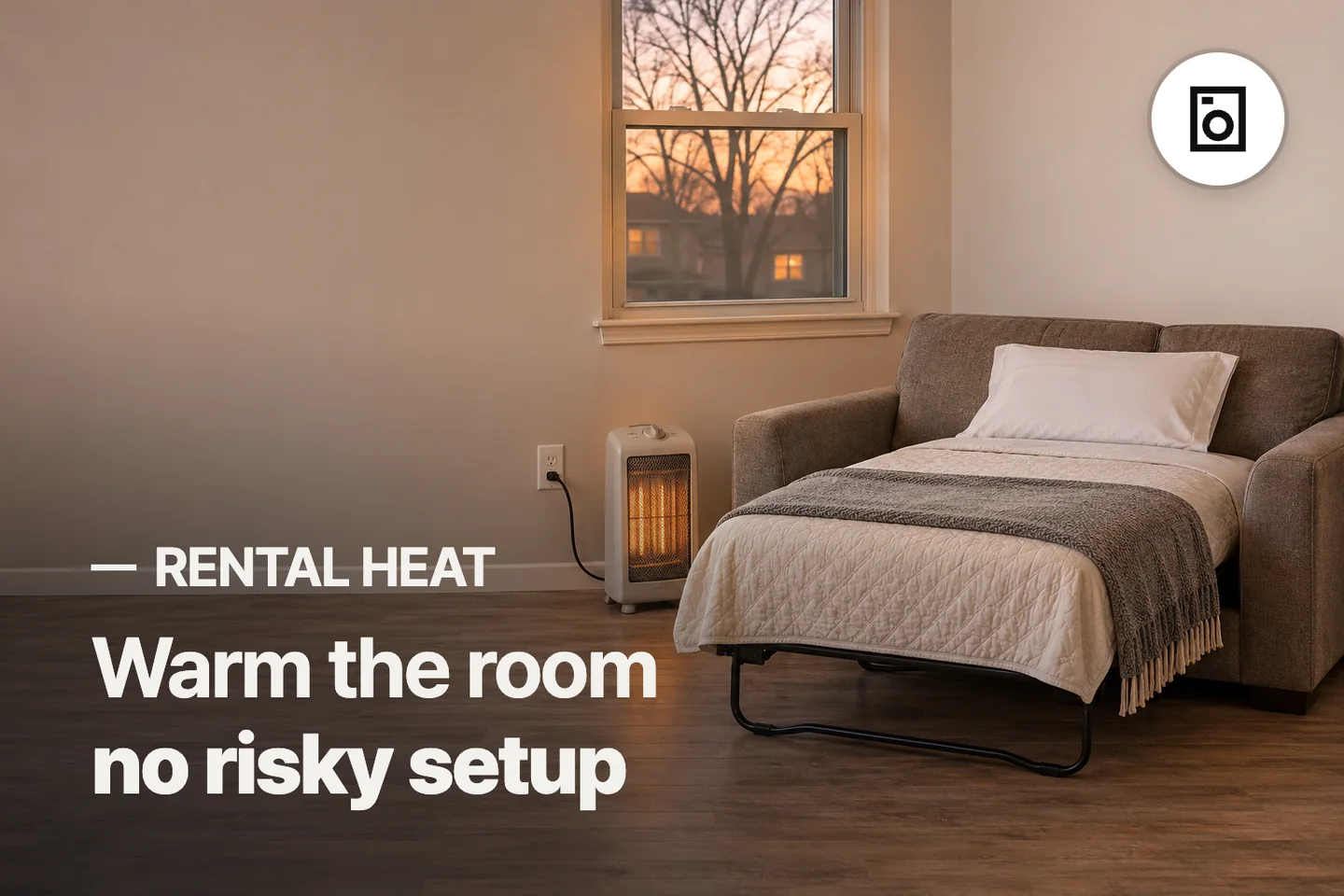
Open the sofa bed before you decide where the portable heater goes. Your guest needs somewhere warm to sleep in this 600 sq ft rental, but the open bed puts blankets and furniture where there was empty floor earlier. That change can turn a convenient heater spot into the wrong one.
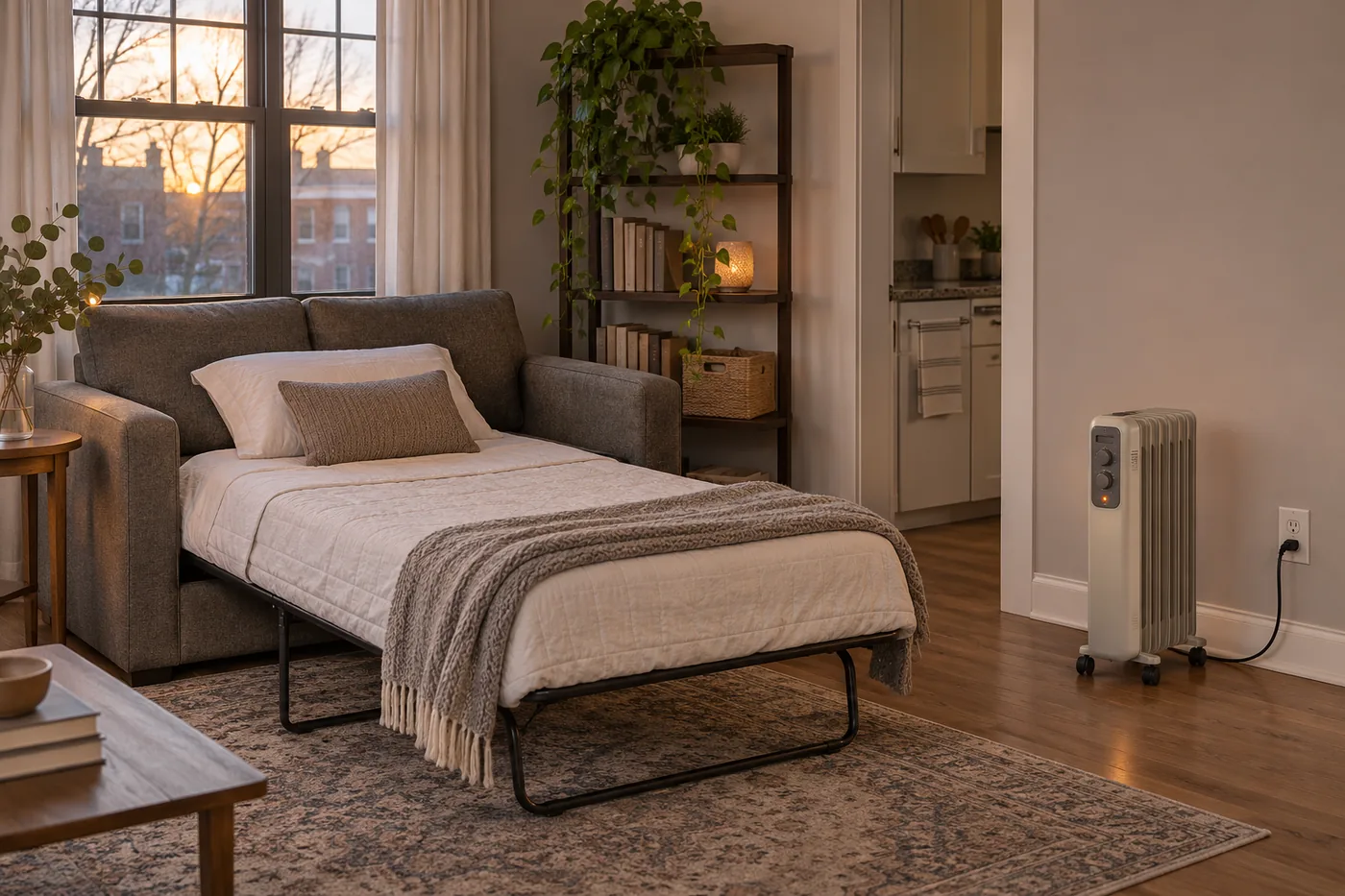 Check the layout with the sofa bed open, not folded away.
Use the portable heater only while someone is awake and attending it, then switch it off and unplug it before sleep. The U.S. Consumer Product Safety Commission, or CPSC, recommends shutting portable heaters off before bed; your building's approved primary heat needs to cover the night. You do not need a new model to start this check.
How we chose
This guide uses CPSC and NFPA safety guidance retained from the earlier source review. The checks prioritize clearance around an open sofa bed, direct-outlet and circuit suitability, and supervised operation with bedtime shutoff; no specific heater model is required.
Part 1Step 1: Leave room for bedding to move
Start with the unfolded bed, curtains, overnight bags, and the blanket that hangs over the edge. CPSC and the National Fire Protection Association, or NFPA, advise keeping combustible materials at least 3 feet from a portable heater. That means measuring from the heater to the nearby fabric, not to the wall behind the sofa.
Set the unit on a solid, level floor and compare the arrangement with its manual. If the maker specifies greater clearance, use that distance; the general rule is not permission to ignore the instructions. A floor spot fails if a curtain or a shifted blanket can enter the required space.
Can your guest get up without brushing the heater or dragging bedding toward it? If not, move the furniture before turning anything on. A narrow passage beside the sleeper is not spare floor just because the heater fits there.
Part 2Step 2: Check the outlet before the thermostat
CPSC advises plugging a portable electric heater directly into a wall outlet, without an extension cord or power strip. So if the cord does not reach from the clear floor space, that location does not work. An adapter does not fix the distance problem.
Read the heater's wattage label and identify what else uses that circuit. Because separate outlets can share a circuit, moving the plug across the room does not establish that you have more capacity. If you cannot identify the circuit or its capacity, ask the landlord before adding the heater load.
Keep the cord visible rather than tucked under a rug or the opened sleeper, following CPSC's cord-safety guidance. If the plug or outlet becomes hot, the connection feels loose, you smell hot plastic, or a breaker trips, stop using the heater. Switch it off, unplug it only if safe, and have the landlord arrange a qualified electrical inspection rather than repeatedly resetting the breaker.
A heater location has to pass both checks: clear floor around the unit and a reachable wall outlet.
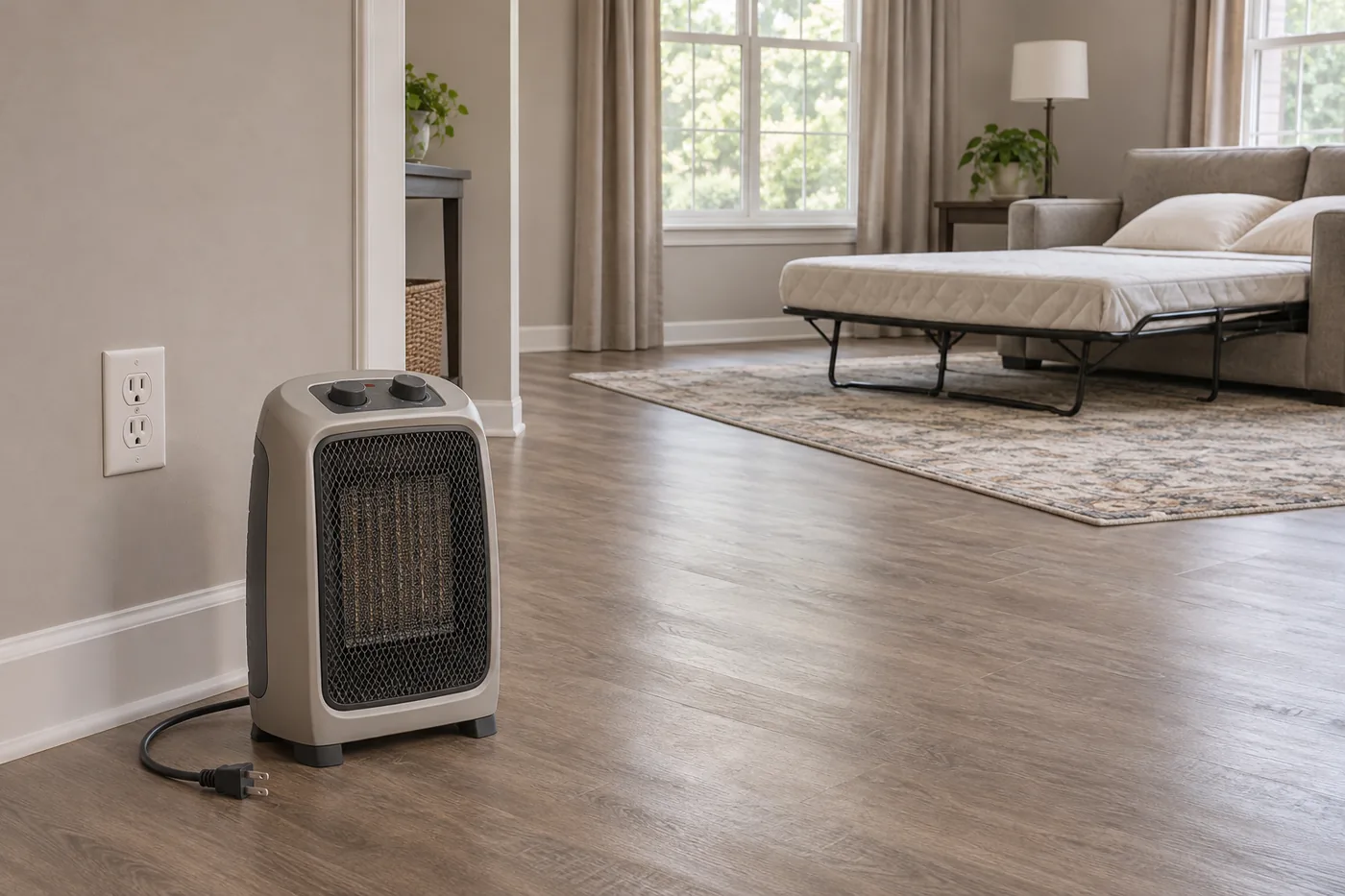 The cord reaches the wall without crossing the route to the bed.
Part 3Step 3: Warm the seating area, not every corner
Once the placement and outlet checks pass, read the exact model's instructions for its intake, outlet, and thermostat. Keep those openings clear according to the maker's directions. If fabric blocks the airflow, a higher setting is not the answer; the setup needs to change.
The apartment's floor area is not a heater sizing promise. An open doorway, drafts, and the distance to the guest area affect where warmth reaches, so the apartment's 600 sq ft figure alone cannot tell you whether this heater will do the job. Check the manufacturer's intended use rather than treating the whole apartment as one heating zone.
Use a separate room thermometer away from the heater's hot-air stream if you need a temperature reading near the seating area. That placement helps you check the space your guest occupies rather than the air coming straight out of the appliance. If comfort depends on pushing the heater closer to the bed, keep the clearance and ask the landlord about the main heat instead.
Part 4Step 4: Make bedtime the stopping point
CPSC and NFPA advise turning portable heaters off when leaving the room or going to bed. So tell your guest the plan before they settle in: off and unplugged before sleep, with the approved primary heat providing overnight warmth. A thermostat or tip-over switch does not replace that bedtime rule.
Leave access to the plug clear while the heater is in use. That means nobody needs to reach behind bedding or pull on the cord to disconnect it. If the opened bed blocks access, rearrange the room before the next warm-up.
What if the living room gets cold again after shutoff? Bring that problem to the landlord and arrange an approved heating solution or another sleeping space. Do not solve inadequate overnight heat by leaving the portable unit running beside a sleeping guest.
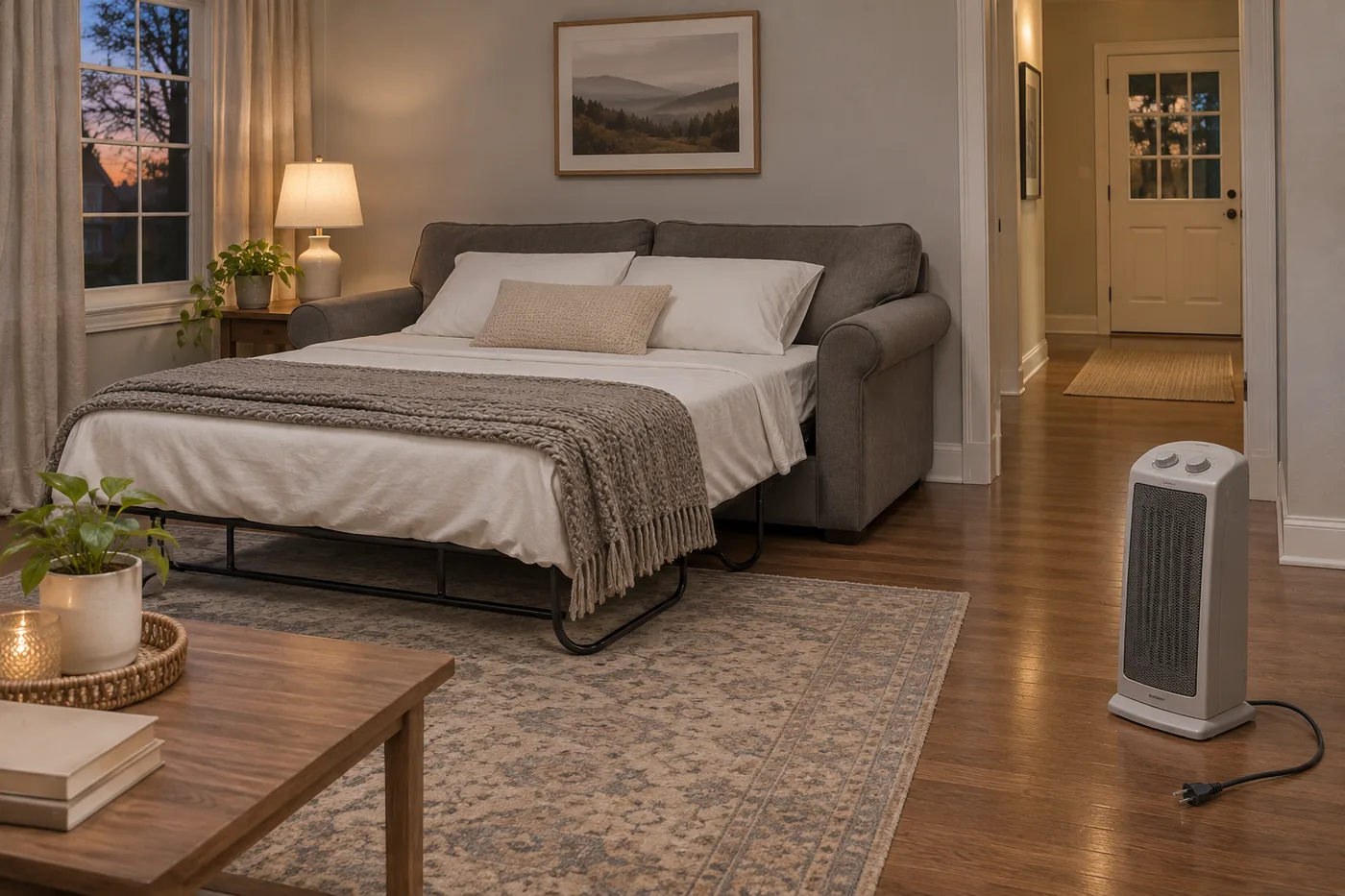 Before sleep, the portable heater is off and disconnected.
Part 5Step 5: Estimate the cost of awake-time heating
Use the wattage printed on your heater and the electricity rate on your own bill. The energy calculation is watts ÷ 1,000 × running hours for kilowatt-hours; multiply that result by your price per kilowatt-hour to estimate the energy charge. Because a thermostat may cycle the element, treating the full rated wattage as continuous gives a different estimate from actual cycling use.
Compare a brief, supervised warm-up with a longer period of operation using the same rate. That comparison is more useful than assuming an “energy efficient” label means a small bill, and it keeps the decision tied to your appliance rather than an invented average rental. Use the appropriate setting's wattage when the maker lists it.
Cost comes after placement and electrical suitability. If the outlet becomes hot or the circuit trips, stop using the heater instead of trying a cheaper operating schedule. And if you are buying anything, resolve the floor-space and outlet problems first; a different heater cannot create missing clearance.
Sources and method: CPSC and NFPA guidance supports the clearance, connection, and bedtime checks. The safety references retain their November 7, 2026 confirmation dates because the November 24, 2026 recheck did not return readable guidance.
In one sentence
Check the open sofa bed, heater clearance, and wall outlet before warming the guest area, then shut the heater off before sleep.
Frequently asked questions
Can an electric heater use a power strip in a rental?
No. CPSC advises connecting a portable electric heater directly to a wall outlet, not an extension cord or power strip. If its cord cannot reach from a position with adequate clearance, change the layout or use another approved heating arrangement.
Can a portable heater stay on while a guest sleeps?
CPSC and NFPA advise switching portable heaters off before going to bed or leaving the room. Turn it off and unplug it before sleep, and arrange approved primary heat for the guest area overnight.
Does an energy efficient heater avoid circuit overloads?
The phrase does not establish the load at a particular setting. Check the heater's wattage and the other loads on the circuit; if the plug or outlet becomes hot or the breaker trips, stop using the heater and request a qualified electrical inspection.
How much clearance does a room heater need beside a sofa bed?
CPSC and NFPA advise at least 3 feet between a portable heater and combustible materials. Check with the sofa bed unfolded and bedding in place, and follow the heater manual when it requires greater clearance.
Sources
- CPSC portable heater safety sheet · 2026-11-07
Retained earlier source findings: at least 3 feet of clearance, direct wall-outlet connection, no extension cords or power strips, and shutoff before sleep. The November 24, 2026 request returned access denied, so the original confirmation date is retained.
- CPSC portable heater safety guidance · 2026-11-07
Retained earlier guidance for 3-foot separation and direct connection to a wall outlet. The November 24, 2026 request returned HTTP 403; no newer confirmation is claimed.
- NFPA heating safety · 2026-11-07
Retained earlier guidance for 3 feet of clearance and turning portable heaters off when leaving or going to bed. The November 24, 2026 request returned the page title but no readable safety guidance, so the original confirmation date is retained.