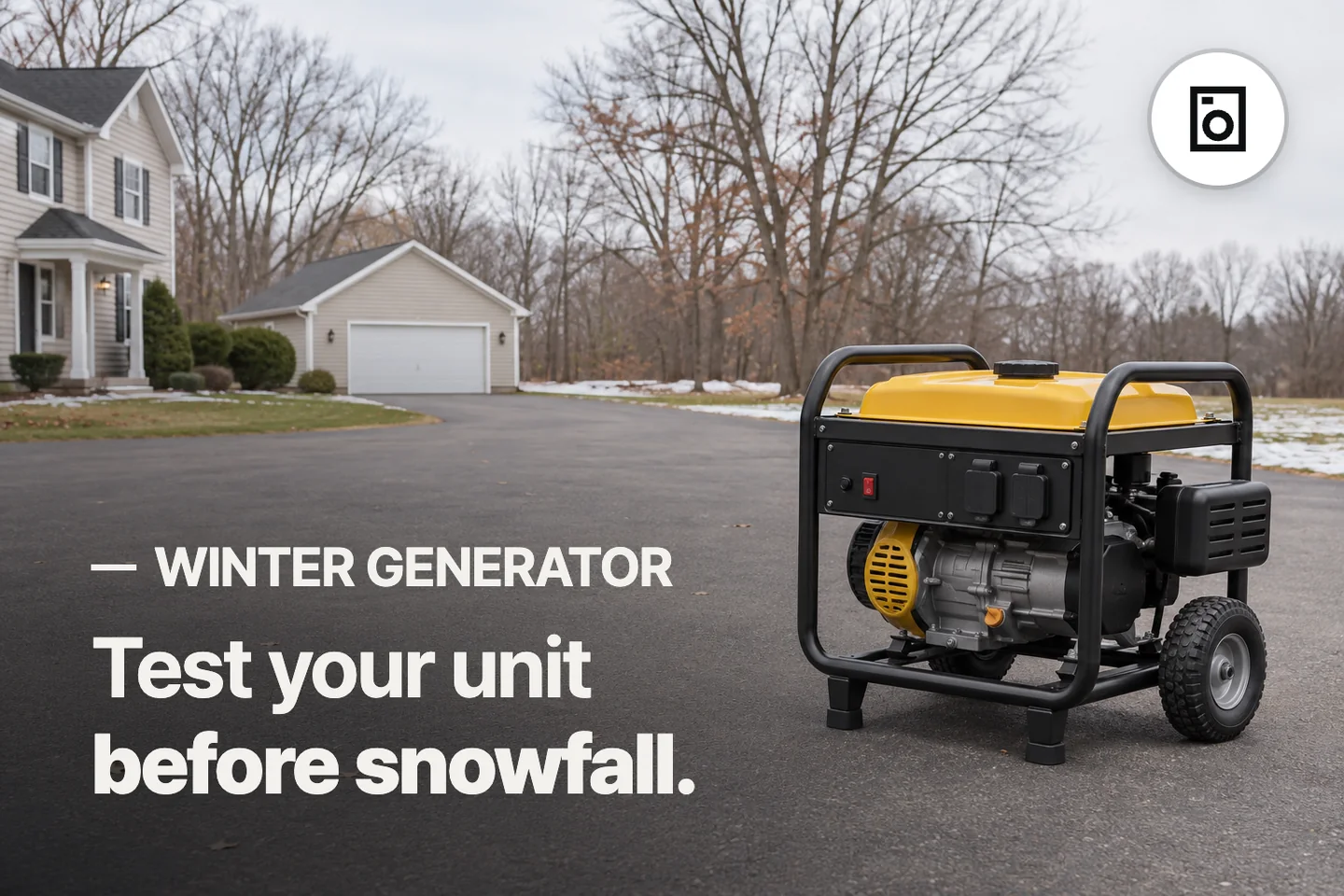
Past midnight, the garage light goes dark just as you reach for the snow-blower battery. If that is your winter-outage worry, a tri fuel generator rehearsal needs to answer something more useful than whether the engine starts: can your actual setup power the essentials safely?
 An outage plan starts with the equipment that needs power, not the biggest wattage on the carton.
I'd keep garage heat optional and rehearse household essentials first. The Westinghouse WGen11500TFc is the model considered here, but its documented 23°F–104°F continuous operating range makes it a conditional choice, not a blanket answer for a deep freeze.
How we chose
Previously verified manufacturer specifications and manuals, plus CPSC guidance, were reviewed for outdoor placement, cold-weather limits, and fuel-specific load capacity. Earlier verification dates are retained where fresh page access or manual text verification was unavailable.
Toneandroom picks
Best tri fuel generator for a winter rehearsal: Top 1
A homeowner rehearsing an electrician-installed backup connection within the documented temperature range.
Westinghouse WGen11500TFc
Manufacturer MSRP $1,699, last verified November 18, 2026; November 24 recheck blocked. Installation, fuel, and maintenance extra. Price varies; check Amazon.
Its documented fuel-specific ratings support a realistic rehearsal, provided outdoor placement, operating temperature, and the electrical installation are suitable.
- Gasoline
- 11,500 W running
- Propane
- 10,500 W running
- Natural gas
- 9,500 W running
- Continuous range
- 23°F–104°F
- You have a suitable outdoor operating spot.
- Your intended fuel supply is properly arranged.
- Confirm prolonged use below 23°F with the maker.
- Arrange compliant building transfer equipment.
What we considered
Outdoor location
Can the property provide a compliant operating spot?
CPSC calls for at least 20 feet from homes with exhaust facing away. The location also needs to meet Westinghouse's clearance and dry-operation requirements; a garage cannot substitute for it.
Cold conditions
Does the expected temperature fit the continuous rating?
Westinghouse documents continuous operation from 23°F to 104°F. A lower-temperature outage calls for manufacturer confirmation or a suitably rated alternative, not confidence based on a mild-weather start.
Usable power
Will the selected fuel and circuits support the essential loads?
Natural-gas running output is 9,500 W rather than the gasoline rating of 11,500 W. Load selection must also leave room for starting demand and respect the installed circuit limits.
Part 1Give the tri fuel generator a safe outdoor address
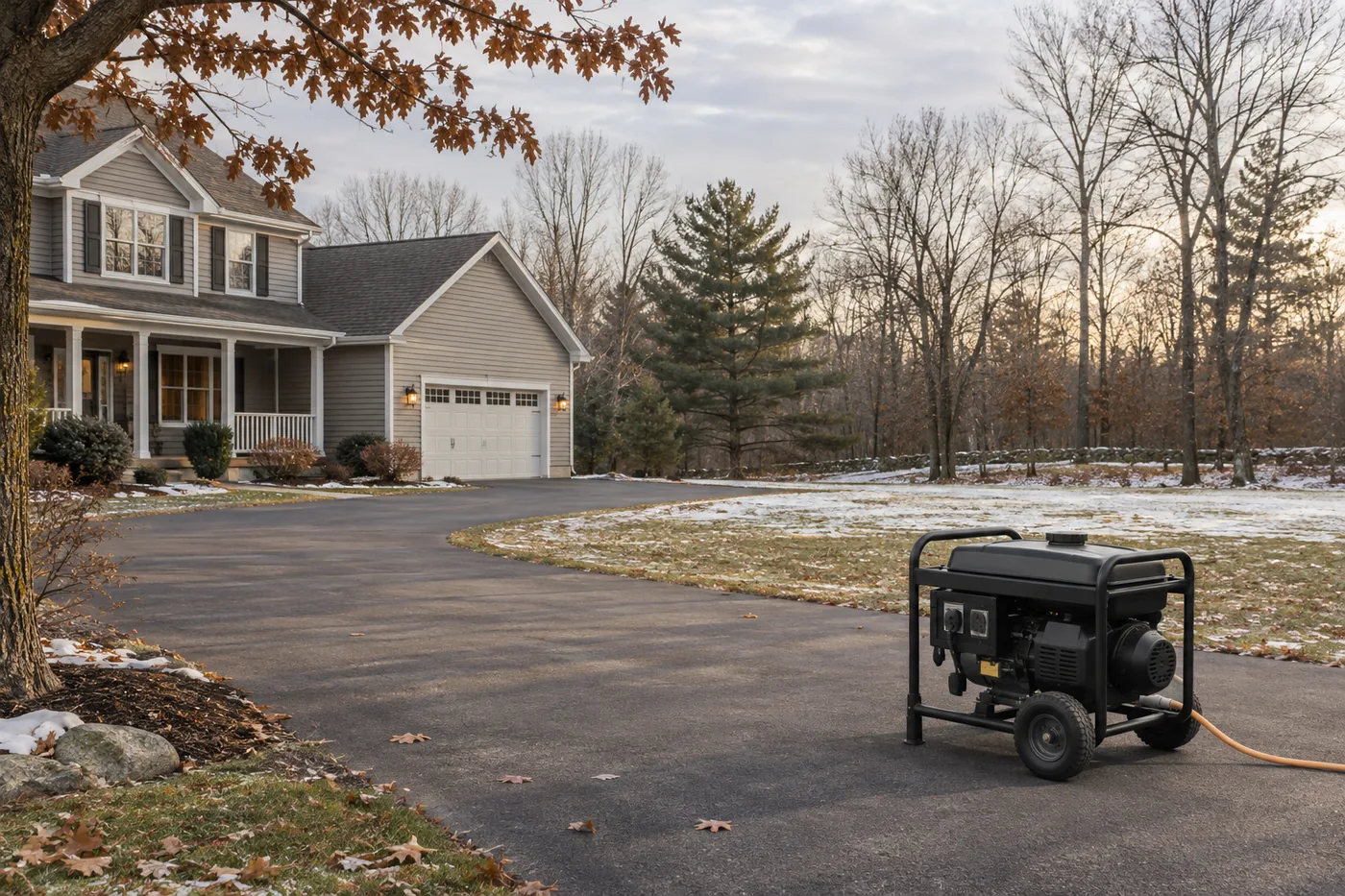
An attached garage is convenient for tools, not a running engine. CPSC says to operate generators outdoors at least 20 feet from homes, with exhaust facing away; an open garage door does not make an attached or detached garage acceptable.
That distance needs to work on your property before the storm arrives. Westinghouse also calls for a solid, level surface and at least 5 feet from combustible materials, while its manual asks owners to consider neighboring homes and airflow.
Snow creates a separate problem. Westinghouse prohibits operation exposed to rain, snow, spray, or standing water, so arrange suitable weather protection that follows its instructions without turning the operating spot into an enclosure.
Inside, CPSC recommends battery-operated CO alarms, or alarms with battery backup, on every level and outside sleeping areas. Those alarms remain necessary even with a generator CO shutdown sensor; if CO poisoning is suspected, CPSC says to get into fresh air immediately and call 911.
An outdoor spot has to satisfy distance, airflow, and weather protection together.
Part 2Rehearse with the fuel you will actually use
The WGen11500TFc has different output ratings for each fuel. That means the gasoline figure cannot stand in for a natural-gas installation when you total the appliances.
Swipe sideways to see the full table →
| Fuel | Running output | Peak output |
|---|---|---|
| Gasoline | 11,500 W | 14,500 W |
| Propane | 10,500 W | 13,500 W |
| Natural gas | 9,500 W | 12,000 W |
Westinghouse's running output, not peak output, is the starting point for sustained loads. But starting surges and the limits of each circuit still need separate attention, even when the overall total looks comfortable.
For natural gas, have a qualified installer verify the supply and connection against Westinghouse's requirements. For propane or gasoline, follow its fuel-handling and storage directions rather than improvising a connection when the forecast changes.
The last verified Westinghouse MSRP was $1,699 on November 18, 2026; the product page could not be rechecked for this rewrite. Spread that equipment cost across a year and it is about $141.58 per month, calculated before installation, maintenance, or fuel—not a payment offer.
Actual monthly running cost needs your own fuel price and consumption record. Multiply fuel consumed during that month's rehearsals and outages by its local unit price, then add any maintenance expense; a wattage rating alone cannot supply that dollar figure.
Part 3Separate a cold start from a loaded start
Start with appliances disconnected, following Westinghouse's location, oil, fuel-selection, and battery-switch checks. That gives you a chance to identify a starting problem before refrigerator or furnace demand complicates it.
Westinghouse lists 10W-30 for typical use, with a temperature chart for other conditions. But a new engine also has break-in instructions, including a restriction on full synthetic oil during break-in, so choosing oil means reading both parts of the manual.
A start on a mild afternoon proves only that day's start. Because Westinghouse allows only short periods at extremes outside its continuous range, a prolonged outage below 23°F needs manufacturer confirmation or a backup solution documented for those conditions.
Once output is stable, Westinghouse directs owners to connect the largest load first, let the generator stabilize, and add the next load. That sequence still has to respect any break-in load restriction and the electrician's selected circuits.
Part 4Leave garage heat out until the essentials fit
What must stay on before the garage gets any power? List the refrigerator and furnace blower's running and starting requirements from their own labels or manuals, so the electrician can account for those loads before adding optional appliances.
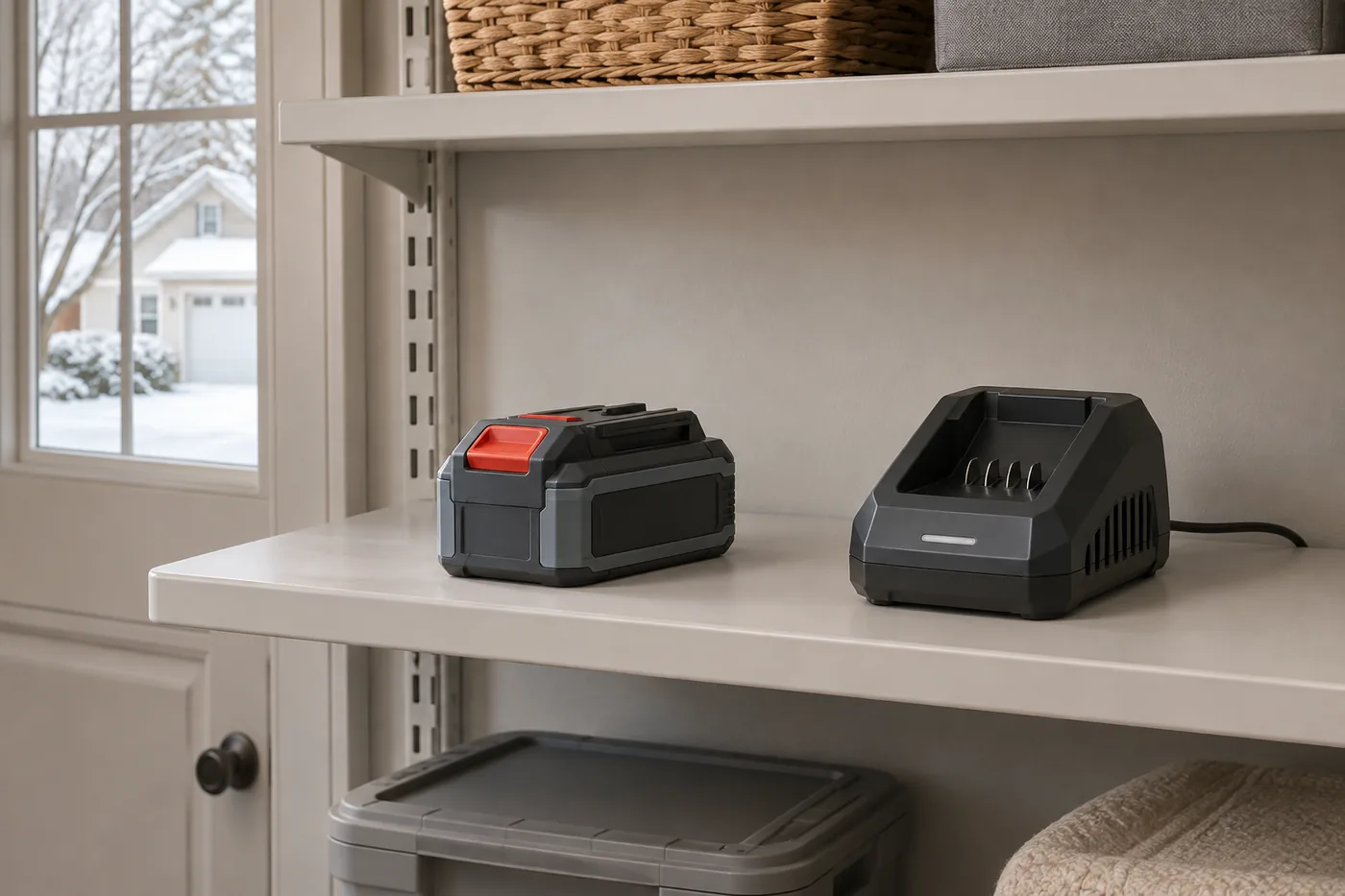 A suitable charging location matters as much as an available outlet.
For a concrete extra-load example, Newair lists its NGH160GA00 heater at 1,500 W, while EGO specifies 550 W input for the CH5500 charger. Together that is a calculated 2,050 W, before household essentials, starting surges, or circuit limits.
Swipe sideways to see the full table →
| Item | Published limit | What it changes |
|---|---|---|
| Newair NGH160GA00 | 1,500 W; up to 160 sq ft | Spot heat, not an entire-garage promise |
| EGO CH5500 | 120 V; 550 W input | Budget charger input rather than snow-blower motor power |
| CH5500 charging environment | 41°F–104°F recommended | An unheated garage may be unsuitable |
That combined wattage is not permission to share an outlet. Newair also lists 15 A for the heater, so an electrician needs to check actual nameplates, branch-circuit loading, and the generator's output distribution.
Newair warns against extension cords and requires at least 3 feet from combustibles. It also prohibits heater use where gasoline, paint, or flammable liquids are used or stored, which can rule out a garage even when spare generator capacity exists.
For building power, Westinghouse requires suitable transfer equipment to isolate the connection from the utility supply. So use an electrician-installed inlet and transfer arrangement, never a wall-outlet backfeed, and do not treat the generator's receptacle rating as extra circuit capacity.
EGO says an out-of-range battery can delay charging. That means moving the battery and charger to a dry location within the recommended range, not aiming the garage heater at them.
Part 5End the rehearsal with a shutdown
Disconnect loads and follow Westinghouse's unloaded cooldown and engine-stop sequence, then turn off the battery switch and selected fuel supply as directed. Its manual requires at least five minutes before gasoline refueling and at least 30 minutes before transport or storage; never refuel a running engine.
 Keep the next correction specific: starting, charging temperature, or the circuit supplying an essential appliance.
Write down what prevented the setup from working, rather than shopping for more watts immediately. A starting fault, an unsuitable charging room, and an overloaded circuit need different fixes; resolving the actual problem is what makes the next tri fuel generator rehearsal useful.
Method and price basis: This rewrite uses previously verified Westinghouse, CPSC, Newair, and EGO material, checked November 18, 2026. Product pages were blocked during the November 24, 2026 recheck, and retrieved manuals could not be text-verified, so earlier figures and their verification date are retained.
In one sentence
Rehearse outdoor placement, the intended fuel, and essential loads before assigning power to garage heat.
Westinghouse WGen11500TFc
Frequently asked questions
Can a generator run in a garage with the door open?
No. CPSC says generators belong outdoors at least 20 feet from homes, with exhaust facing away. An open door does not make either an attached or detached garage safe for operation.
Will the WGen11500TFc supply 11,500 running watts on natural gas?
No. Westinghouse lists 9,500 running watts on natural gas, 10,500 W on propane, and 11,500 W on gasoline. Starting loads and circuit limits still need separate checks.
How much extra load do a garage heater and snow-blower charger add?
The Newair NGH160GA00's listed 1,500 W and EGO CH5500's 550 W input total a calculated 2,050 W. That excludes essential household loads and does not establish that the appliances can share a branch circuit.
Why might an EGO CH5500 delay charging during an outage?
EGO describes delayed charging for an out-of-range battery and recommends a charging environment of 41°F–104°F. Choose a suitable dry location rather than assuming generator power alone resolves the delay.
Sources
- Westinghouse WGen11500TFc · 2026-11-18
Retained original verification: MSRP $1,699; running output 11,500/10,500/9,500 W and peak output 14,500/13,500/12,000 W for gasoline/propane/natural gas. November 24 access returned local_rate_limited. Calculated equipment-only monthly reserve: $1,699 divided by 12, approximately $141.58.
- Westinghouse WGen11500TFc owner manual · 2026-11-18
Retained original verification: continuous operation 23°F–104°F; 5 ft combustible clearance; typical-use 10W-30 oil; at least five minutes before gasoline refueling and 30 minutes before transport/storage. PDF retrieved November 24 but text could not be reverified. Includes break-in, dry-operation, load sequencing, and transfer-equipment instructions.
- CPSC carbon monoxide guidance · 2026-11-18
Retained original verification: generators outdoors at least 20 ft from homes, exhaust facing away; CO alarms on every level and outside sleeping areas; fresh air and 911 for suspected poisoning. November 24 access denied.
- Newair NGH160GA00 specifications · 2026-11-18
Retained original verification: 1,500 W, 120 V, 15 A; up to 160 sq ft spot-heating coverage. November 24 access returned local_rate_limited.
- Newair NGH160GA00 owner manual · 2026-11-18
Retained original verification: 1,500 W, 15 A and 3 ft combustible clearance; no extension cords; no use where gasoline, paint, or flammable liquids are used or stored. PDF retrieved November 24 but text could not be reverified.
- EGO CH5500 charger owner manual · 2026-11-18
Retained original verification: 120 V, 550 W input and recommended ambient charging temperature 41°F–104°F; out-of-range battery charging delay. Calculated combined heater and charger demand: 1,500 + 550 = 2,050 W. PDF retrieved November 24 but text could not be reverified.