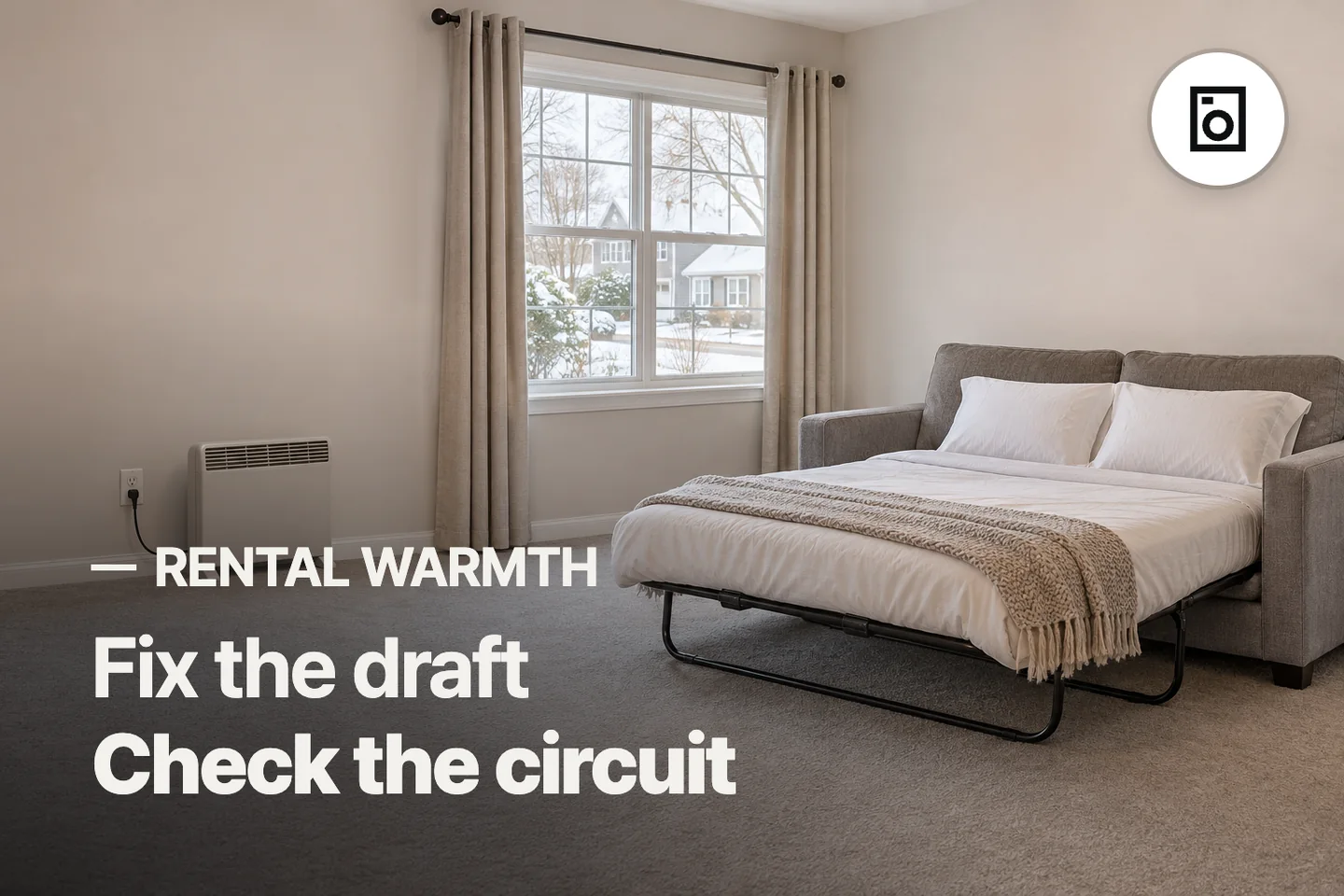
The window seat is chilly, your holiday guests need somewhere to sleep, and opening the sofa bed will swallow the spot where a room heater might go. Before you move the furniture, check the draft, the electrical supply, and the space the open bed leaves behind. More heat is not the first fix.
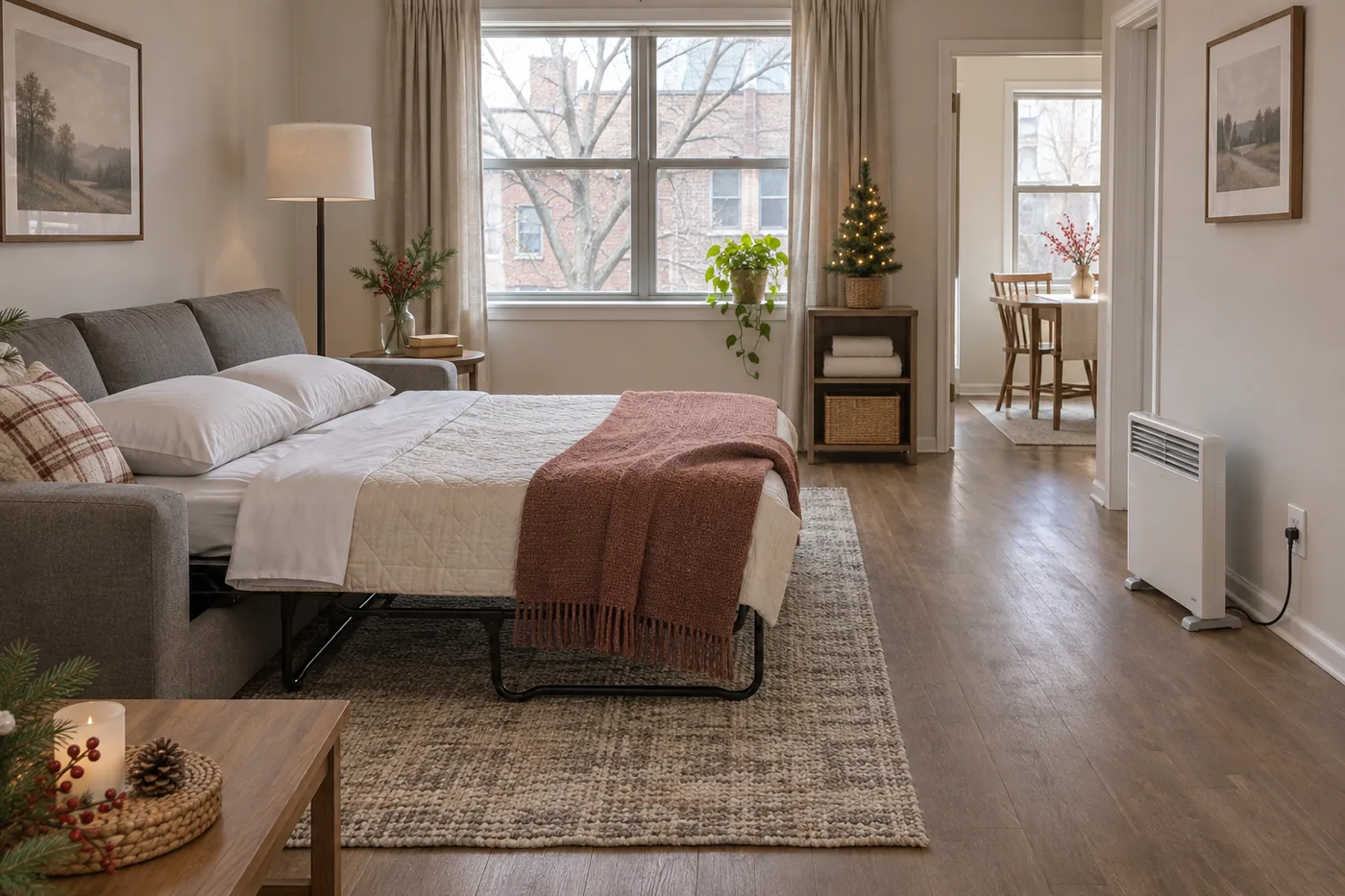 Plan for the sleeping layout before giving the heater a permanent spot.
You may not need another appliance at all. The Vornado AVH10 appears below only to make the electrical load concrete, not as a shopping recommendation; a repair request and a different seating arrangement may solve more than a purchase. Start with what is making the seat cold.
How we chose
EPA ENERGY STAR air-sealing guidance and Vornado's US FAQ were reviewed, with CPSC guidance retained from the original article's dated source check. The sequence prioritizes draft repairs, shared electrical demand, and heater placement with the guest bed open; it does not require a purchase.
Part 1Find the leak before moving the heater
Close the window fully and latch it, then feel around its edges for moving air. If it will not latch or the frame has a visible gap, photograph the problem for management rather than trying to heat around it. That leaves a repairable fault visible instead of making it part of the furniture plan.
EPA's ENERGY STAR guidance identifies door weatherstripping and window caulking as ways to address air leaks. But in a rental, ask management which repair materials they approve before sticking or sealing anything to a painted surface. Their answer determines whether this is a maintenance job or a small change you can make yourself.
Look at the installed heat, too: is a curtain hanging over it, or has the sofa been pushed against its outlet? If the built-in heating is not working, put that in the same maintenance request. A portable appliance should not become the reason a broken heating system stays broken.
Leave unidentified openings alone until management explains their purpose; an air leak and a ventilation opening are not the same repair.
Part 2Check the circuit, not just the socket
A free wall socket tells you where a plug fits, not how much electrical capacity is available. So ask management which outlets share the circuit and what other equipment it supplies. A different outlet may still mean the same circuit.
 Ask which outlets share a circuit before deciding where supplemental heat belongs.
Vornado's US FAQ lists the AVH10's low and high heat settings, alongside current figures in its heater energy guidance. These figures describe the appliance demand; they do not establish a safe allowance for your apartment. That distinction matters when guests arrive with more things to plug in.
Swipe sideways to see the full table →
| AVH10 setting | Published power | Published current | Question for management |
|---|---|---|---|
| Low | 750 W | 6.25 A | Can the shared circuit accommodate this load? |
| High | 1,500 W | 12.5 A | Can it accommodate this larger load with everything else connected? |
Give management or a qualified electrician the heater's nameplate details and a list of the other appliances on that circuit. If they cannot confirm the arrangement is suitable, pause the plan rather than assuming low heat makes unknown wiring acceptable. Low is a smaller demand, not an electrical inspection.
CPSC guidance calls for connecting an electric space heater directly to a wall outlet, not an extension cord or power strip. Vornado additionally rules out multi-outlet adapters, timers, and smart plugs for its heaters. If the heater cannot reach a suitable outlet from a suitable location, an extra cable does not rescue that location.
Part 3Open the guest bed before measuring clearance
Does the proposed spot still exist when the sofa becomes a bed? CPSC calls for at least three feet from combustible materials, including furniture, drapes, and bedding. So assess the blanket hanging over the open mattress, not just the sofa's daytime outline, and follow any greater clearance in the exact heater's instructions.
That makes the nighttime layout a separate check. A chair that fits beside the folded sofa may carry a guest's coat later, while a curtain can move toward the heater. Vornado's FAQ emphasizes clear airflow and active monitoring, so a convenient corner is not enough if those conditions disappear once people settle in.
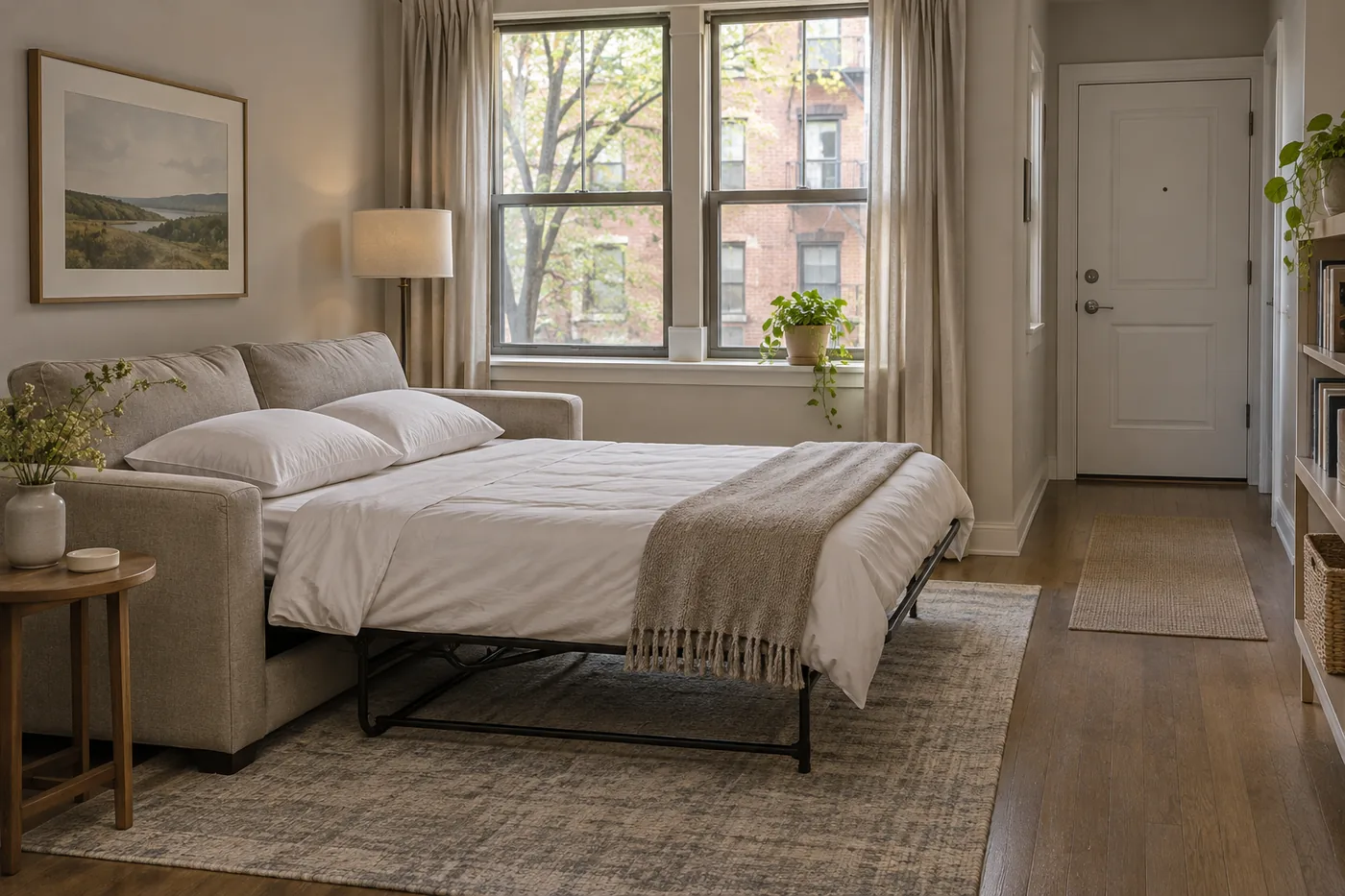 The open bed reveals how much floor space is actually available.
Use the model's placement instructions rather than improvising with a stool or shelf to reclaim floor space. For cord routing, CPSC advises against placing heater cords under rugs or carpeting. Keep the route out of the guest's path as well; a rug should not be the solution to a cable crossing the room.
If the bed, walking route, direct wall connection, and required clearance cannot coexist, leave the portable heater out of that layout. You can move seating away from the draft while management addresses the underlying problem. What you cannot do is count the same patch of floor as both bedding space and heater clearance.
Part 4Use the controls without promising whole-apartment heat
Once the circuit and placement are suitable, use the heater for the occupied living area according to its instructions. Vornado says the AVH10 adjusts heat output and fan speed as the room approaches the selected temperature. That is a control feature, not proof that it can make every room comfortable.
Vornado's FAQ does not commit to a particular room size for its heaters. So do not turn a whole-room label into a coverage promise or a deadline for warming your rental. Check comfort at the occupied seat, without moving the appliance closer to furniture than its instructions allow.
An energy-saving label also cannot tell you the bill by itself. Vornado's energy explanation compares heaters drawing the same wattage; your electricity rate and actual operating time still matter. So use your own utility rate for cost planning, not the FAQ's illustrative electricity price.
Part 5Make switching off part of the guest routine
CPSC says not to leave portable heaters operating while people sleep. Vornado likewise says its heaters are for attended use and should be switched off when you leave the room or go to sleep. That means bedtime changes the heating plan, even if the living room still feels cool.
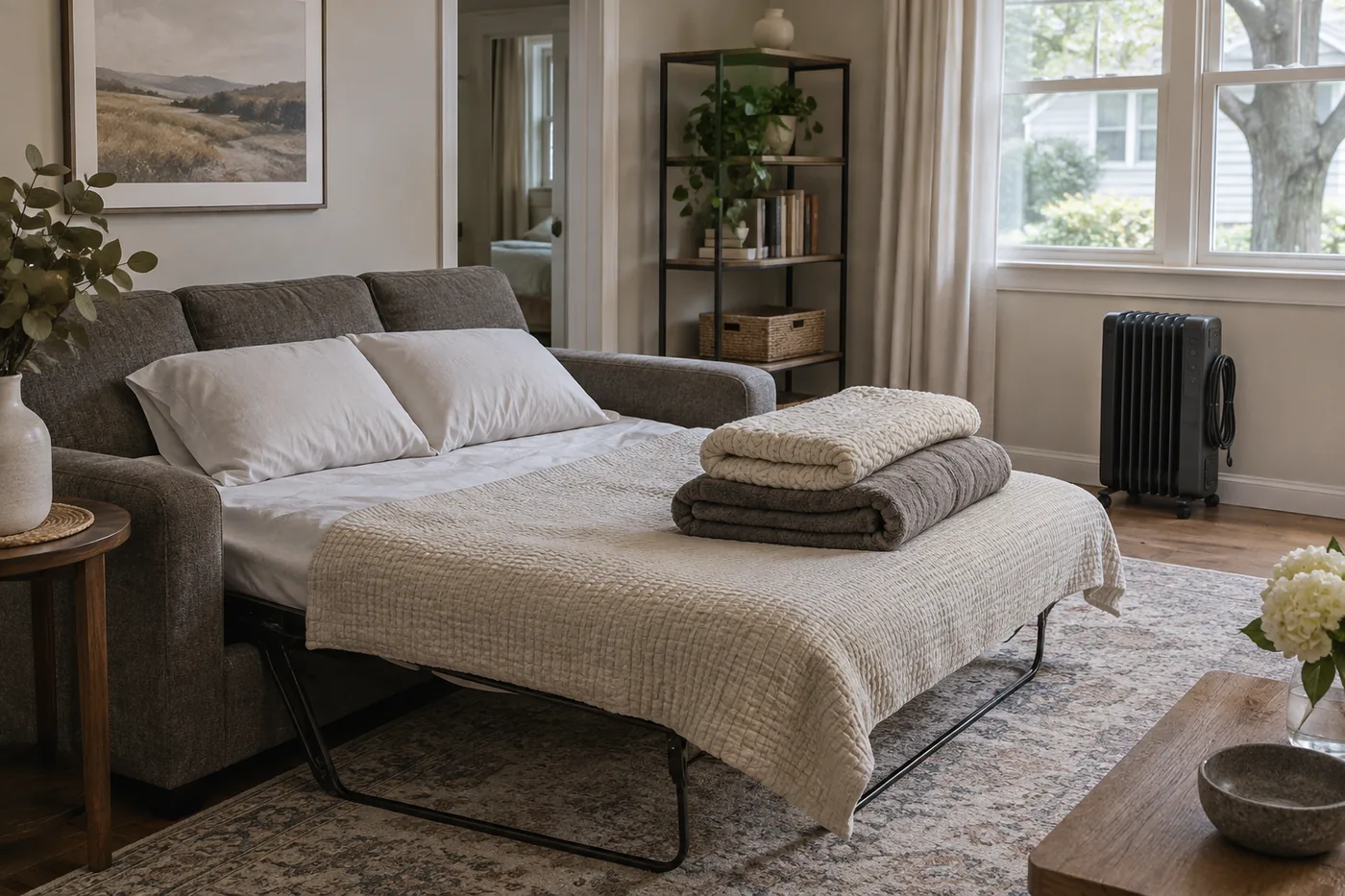 An overnight guest setup should not depend on a running portable heater.
Vornado also says the plug must fit securely in a properly functioning outlet. If the connection is loose, the heater behaves abnormally, or the breaker trips, stop using that arrangement and contact management or the manufacturer as appropriate. Repeated resets do not establish that the shared load is suitable.
Before leaving to collect guests, switch the heater off; before anyone sleeps, do the same. If installed heat cannot keep the apartment comfortable overnight, ask management to address that problem rather than extending portable-heater operation into sleeping hours. The useful endpoint is a comfortable guest setup that does not need someone to stay awake supervising it.
Sources and method: This sequence uses EPA ENERGY STAR air-sealing guidance and Vornado's US FAQ, checked November 24, 2026. CPSC clearance, cord, connection, and sleeping guidance is retained from the original article's November 9, 2026 check because its page could not be reopened. The checks are drafts, shared electrical load, and placement with the bed open.
In one sentence
Trace the draft and confirm the circuit before reserving floor space for supplemental heat.
Frequently asked questions
Can a room heater share a circuit with other appliances?
Only after management or a qualified electrician assesses that circuit and its other loads. Vornado lists the AVH10 at 750 W on low and 1,500 W on high, with corresponding current figures of 6.25 A and 12.5 A in its heater FAQ. Those are demands, not your circuit's available capacity.
How far should a space heater be from a sofa bed?
CPSC guidance calls for at least three feet from combustible materials, including bedding and furniture. Assess the fully opened bed and hanging blankets, and follow any greater clearance required by the exact heater's instructions. CPSC also says not to operate a portable heater while sleeping.
Will an energy efficient heater warm the whole apartment?
Do not infer whole-apartment coverage or a lower bill from that description. Vornado's FAQ does not specify a particular room size, and running cost depends on power use, operating time, and your own electricity rate. Treat portable heating as attended supplemental warmth, not a substitute for repairing installed heat.
Can a smart plug switch the heater on before guests arrive?
Vornado explicitly prohibits smart plugs, timers, multi-outlet adapters, surge protectors, and extension cords with its heaters. CPSC calls for a direct wall connection and says not to leave portable heaters operating while sleeping. Follow the exact model's instructions and keep operation attended.
Sources
- CPSC winter heating safety guidance · 2026-11-09
Retained from the original article's November 9 check; reopening was blocked on November 24. At least three feet from combustible materials; direct wall connection, no extension cords or power strips, no heater cords under rugs or carpeting, and no portable heater operation while sleeping.
- Vornado US heater FAQ · 2026-11-24
AVH10 heat settings: 750 W low and 1,500 W high. General heater current guidance: 6.25 A low and 12.5 A high, with separately named exceptions. Confirms AVH10 automatic heat and fan adjustment; no particular room-size promise. Also covers secure wall connection, attended use, unobstructed airflow, and prohibited adapters, timers, and smart plugs.
- EPA ENERGY STAR air sealing guidance · 2026-11-24
Identifies door weatherstripping and window caulking as simple air-leak fixes. Its up-to-10% annual energy-bill figure concerns sealing plus insulation together; it is not used as a savings claim for this rental or any individual repair.