The stair-landing lamp clicks on before dinner, and a family counting bulbs for a winter upgrade reaches forty sockets before the shopping list is finished. In this hypothetical American home, the awkward part isn't finding a big box; it's deciding how many of those bulbs will actually leave the box. Eight left over.
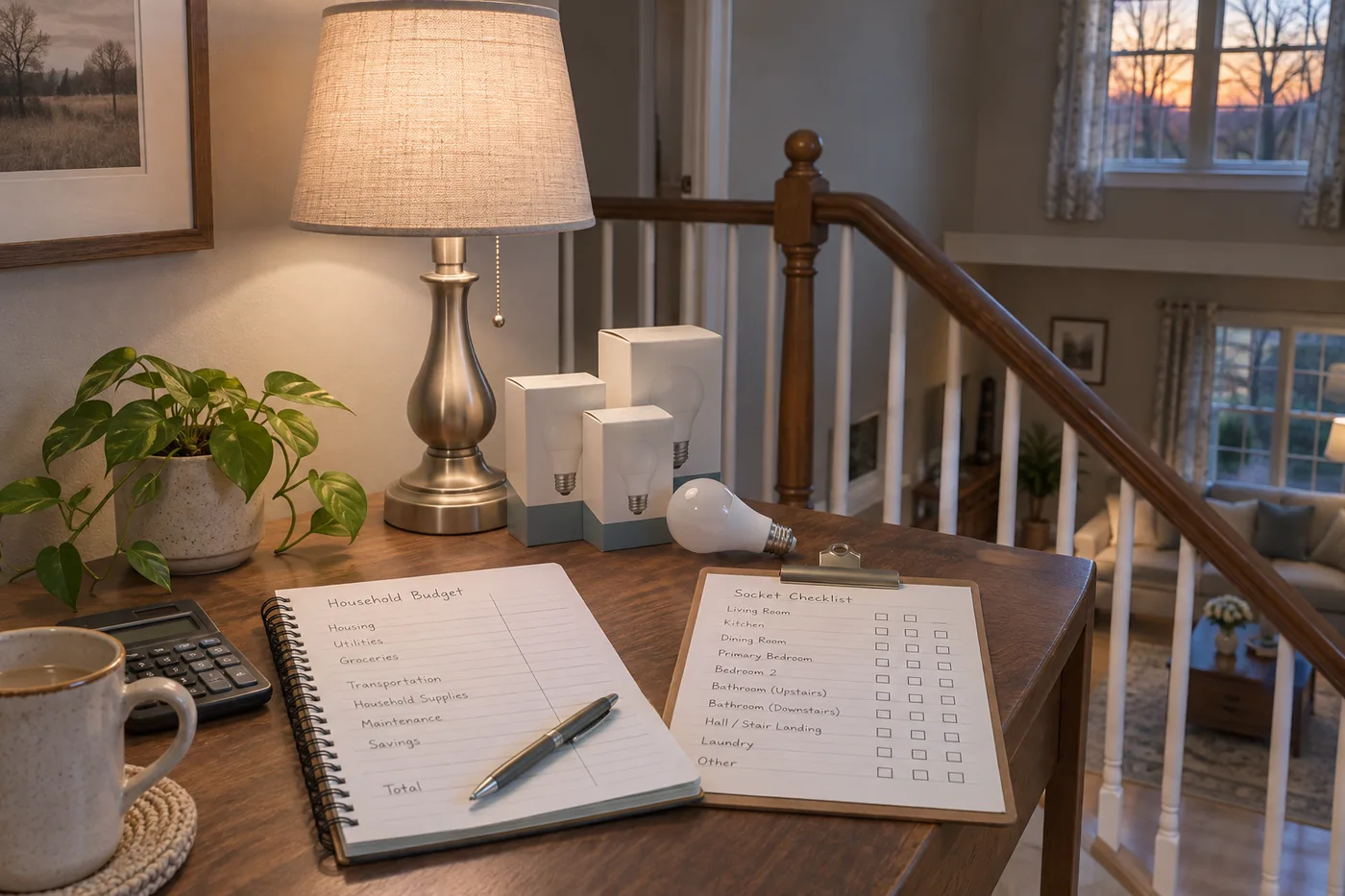 The shopping list starts with occupied sockets, not the number printed on a carton.
I'd start the price comparison with Sunco A19_ND-2700K-1PK singles, rather than assume its A19-9W-3K-12PK multipack is cheaper: the saved maker prices put forty singles at $39.60 versus $51.96 for four packs. But those are November 10, 2026 item-price benchmarks, not current offers; Sunco's pages could not be refreshed on November 24.
How we chose
Compared saved Sunco maker specifications and November 10 prices with EIA electricity-rate data rechecked November 24. The three checks were socket compatibility, cost for the required quantity and savings from existing wattage; current Sunco prices and retailer discounts could not be established.
Part 1Count the sockets that match
A forty-socket house is not automatically a forty-bulb order, because a bedside lamp, a dimmed dining fixture and a specialty fitting may need different things. So the count worth pricing is compatible sockets, with the exceptions written beside them rather than discovered after delivery.
Sunco's saved specifications identify both compared products as E26, 120V and non-dimmable, with 850 lumens of listed output. That makes them a useful comparison for matching, ordinary switched fixtures, not a blanket replacement plan for every light in a house.
The color difference matters, too: Sunco lists 2700K for the 8W single and 3000K for the 9W multipack. Because those are different color temperatures as well as different models, the cheaper line in the table is not a promise of identical light.
Sunco's earlier page also excluded the 9W model from California sales. But the saved material did not establish enclosed-fixture permission, so a shopper with enclosed fixtures needs the maker's confirmation before treating those sockets as part of this order.
Part 2Pay for bulbs, not box size
The old Sunco display priced the 9W twelve-pack at $12.99 and a matching single at $1.50, while the separate 8W model was $0.99 per single. So the useful comparison is the total for the job, not just the rounded $1.08-per-bulb figure on the multipack.
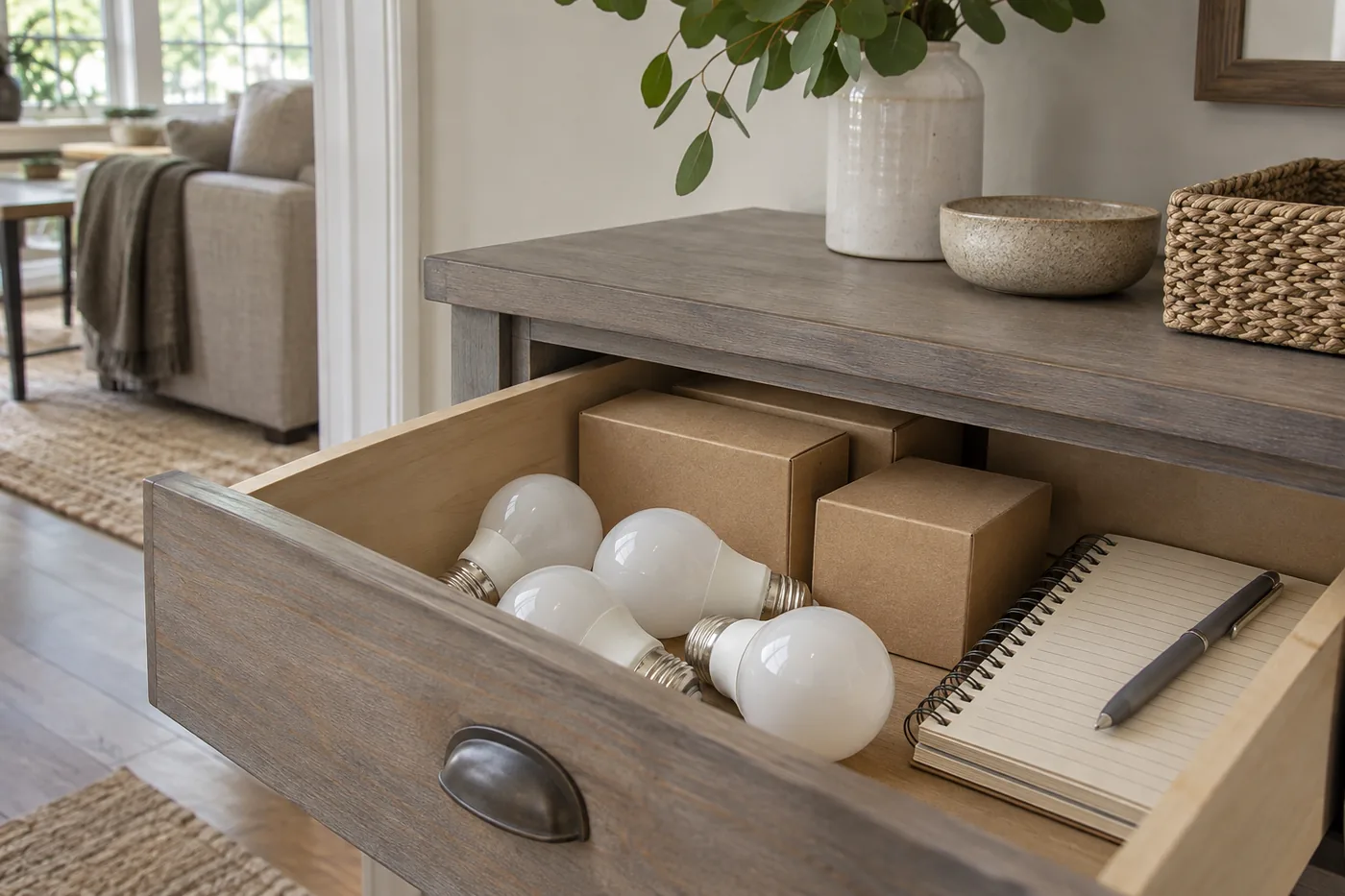 Spare bulbs count toward the bill even when they stay in the drawer.
Swipe sideways to see the full table →
| Ordering route | Maker item prices, checked November 10, 2026 | Forty-socket calculation |
|---|---|---|
| Sunco A19-9W-3K-12PK only | $12.99 per twelve-pack | Four packs: $51.96; 48 bulbs, eight spare |
| Same 9W model, packs plus singles | $12.99 per pack; $1.50 per matching single | Three packs plus four singles: $44.97; 40 bulbs |
| Sunco A19_ND-2700K-1PK | $0.99 per single | Forty singles: $39.60; 40 bulbs |
These are calculated subtotals before shipping and tax, using the earlier saved prices. Because neither Sunco price page was readable during the November 24 refresh, the table keeps its original checking date rather than presenting the numbers as a fresh quotation.
Within the same 9W model, buying exactly forty costs $6.99 less than buying forty-eight. That means the extra eight bulbs have a real price, even if the larger order looks tidier in a shopping cart.
Would you actually need those spares? If not, the four-pack route ties up $12.36 more than the different 8W single-bulb route, before delivery charges, and unused spares save no electricity.
The earlier Sunco page advertised free continental-US shipping on orders over $100, which none of these bulb-only subtotals reaches. So a fresh shipping quote could change the order of the totals; adding unwanted goods merely to cross that threshold would enlarge the purchase instead of proving a saving.
At the saved prices, matching the quantity to the sockets beats buying another full pack of the same 9W bulb.
Part 3Measure savings from the old bulb
The phrase “60W equivalent” describes the intended brightness comparison, not the electricity already being used in your lamps. So the old bulb's actual input watts belong in the calculation before any payback claim does.
For an explicit example, suppose forty compatible sockets contain actual 60W incandescent bulbs, each operating three hours daily. Using a 365-day year, replacing them with 8W LEDs saves 40 × (60 − 8) × 3 × 365 ÷ 1,000 = 2,277.6 kWh annually.
The EIA lists the 2025 US residential average at 17.30 cents per kWh, confirmed on its page on November 24, 2026. At that historical rate, the example saves about $394.02 annually, making the earlier $39.60 item subtotal equivalent to roughly 37 days of lighting savings before shipping and tax.
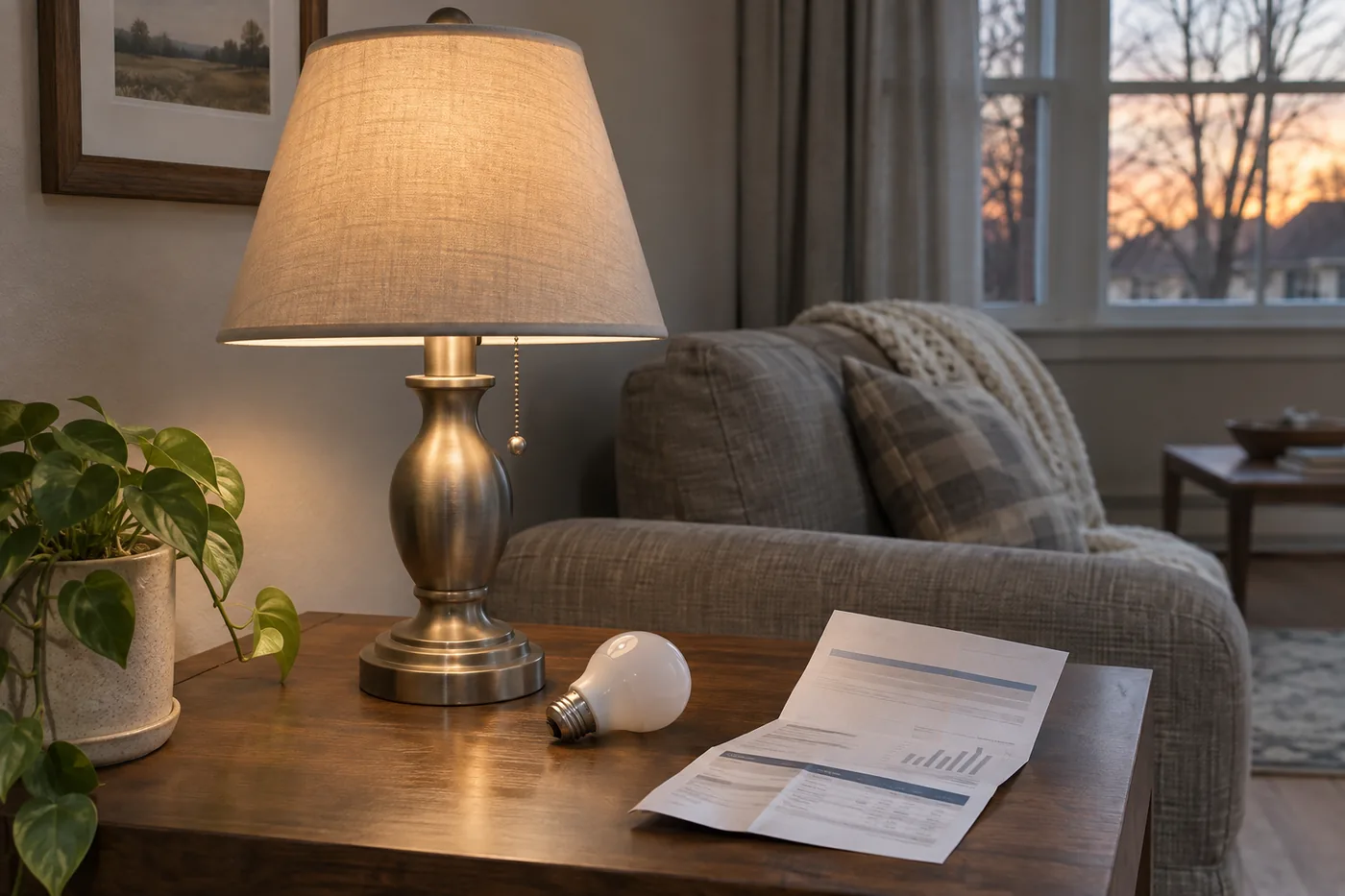 The existing bulb's wattage and the household's electricity rate determine the savings calculation.
That short recovery depends on replacing incandescents, not simply buying something labeled LED. If the forty installed bulbs are already 9W LEDs, changing them to 8W saves just 43.8 kWh, or about $7.58 a year, at the same hours and historical rate.
Because a national average is not your tariff, use the per-kWh charge that actually changes with consumption on your own bill. These examples also hold operating hours constant and leave out heating and cooling effects, so they do not predict the combined winter utility bill.
Part 4Buy when the delivered total works
A Black Friday or Cyber Monday heading does not establish a discount on the model that fits your fixtures. So compare the same model and quantity against an earlier actual selling price, then include shipping and tax before choosing a checkout total.
This comparison establishes no current retailer sale or historical low, and the saved Sunco figures are useful only as dated reference points until a seller supplies a new quote. That is enough to spot an oversized order, but not enough to declare today's cheapest store.
I'd leave working LEDs in place when the only benefit is the small wattage change calculated above, and price compatible replacements where older, higher-wattage bulbs are still doing long daily shifts. Because the savings come from installed bulbs, the useful purchase may be smaller than a whole-house box order.
Sources and method: Sunco product specifications and maker-store prices saved from November 10, 2026 were compared by socket compatibility, required quantity and delivered cost. The Sunco pages could not be refreshed on November 24; the EIA rate was rechecked that day. Forty sockets, 60W existing incandescents and three daily operating hours are illustrative assumptions, not household measurements. No retailer discount or price history was established.
In one sentence
A multipack is cheaper only when its delivered cost works for the bulbs you can actually install.
Frequently asked questions
Is a twelve-pack of LED bulbs always cheaper than singles?
No. At Sunco's saved November 10, 2026 prices, four 9W twelve-packs cost $51.96 for 48 bulbs, while three packs plus four matching singles cost $44.97 for exactly 40. These are item subtotals, not refreshed November 24 offers.
Do the Sunco 8W single and 9W multipack provide identical light?
The saved maker pages list 850 lumens for both, but 2700K for the compared 8W single and 3000K for the 9W multipack. They are separate models with different listed color temperatures, not interchangeable package sizes of one bulb.
Can replacing working LEDs pay back in about 37 days?
That example replaces forty actual 60W incandescents with 8W LEDs for three daily hours, using a $39.60 item subtotal and EIA's 2025 residential average of $0.173 per kWh. Replacing forty existing 9W LEDs with 8W LEDs saves only about $7.58 annually under the same assumptions; shipping and tax are excluded.
Does waiting for a holiday sale guarantee a lower price?
No verified current retailer discount or price history is established here. Compare a fresh delivered quote with an earlier actual price for the same model and quantity rather than relying on the sale label.
Sources
- Sunco A19-9W-3K-12PK · 2026-11-10
Original article's saved maker data: $12.99 per 12-pack, $1.50 matching single, 9W, 850 lumens, 3000K, E26, 120V, non-dimmable; California sales excluded; free continental-US shipping advertised on orders over $100. Derived totals: $51.96 for 48 and $44.97 for 40. Reopened November 24, 2026 but received local_rate_limited; original figures and check date retained.
- Sunco A19_ND-2700K-1PK · 2026-11-10
Original article's saved maker data: $0.99 per single, 8W, 850 lumens, 2700K, E26, 120V, non-dimmable; calculated item subtotal $39.60 for 40. Reopened November 24, 2026 but received local_rate_limited; original figures and check date retained.
- EIA electricity prices and factors affecting prices · 2026-11-24
Read the 2025 US residential average of 17.30 cents per kWh. Illustrative calculations assume 40 installed bulbs, three daily hours and 365 days: 60W to 8W saves 2,277.6 kWh and about $394.02 annually, with about 37 days to recover a $39.60 item subtotal; 9W to 8W saves 43.8 kWh and about $7.58 annually. Assumptions are not measured household data.