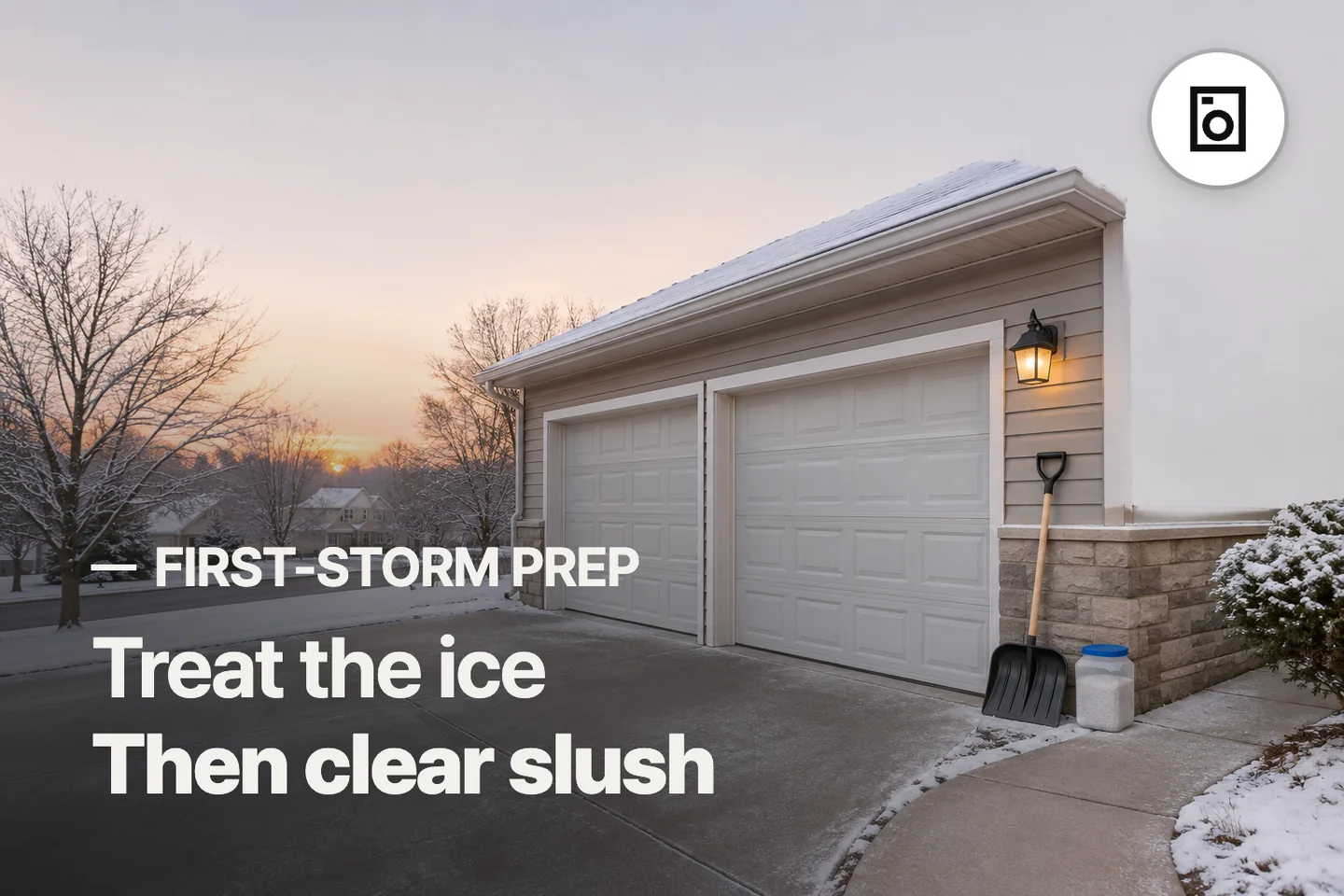
Before dawn, your garage door opens, but the short walk to the car is glazed over. Now the first storm has become a departure problem, and a bag of ice melt only helps if the concrete underneath—and the water left afterward—get attention too.
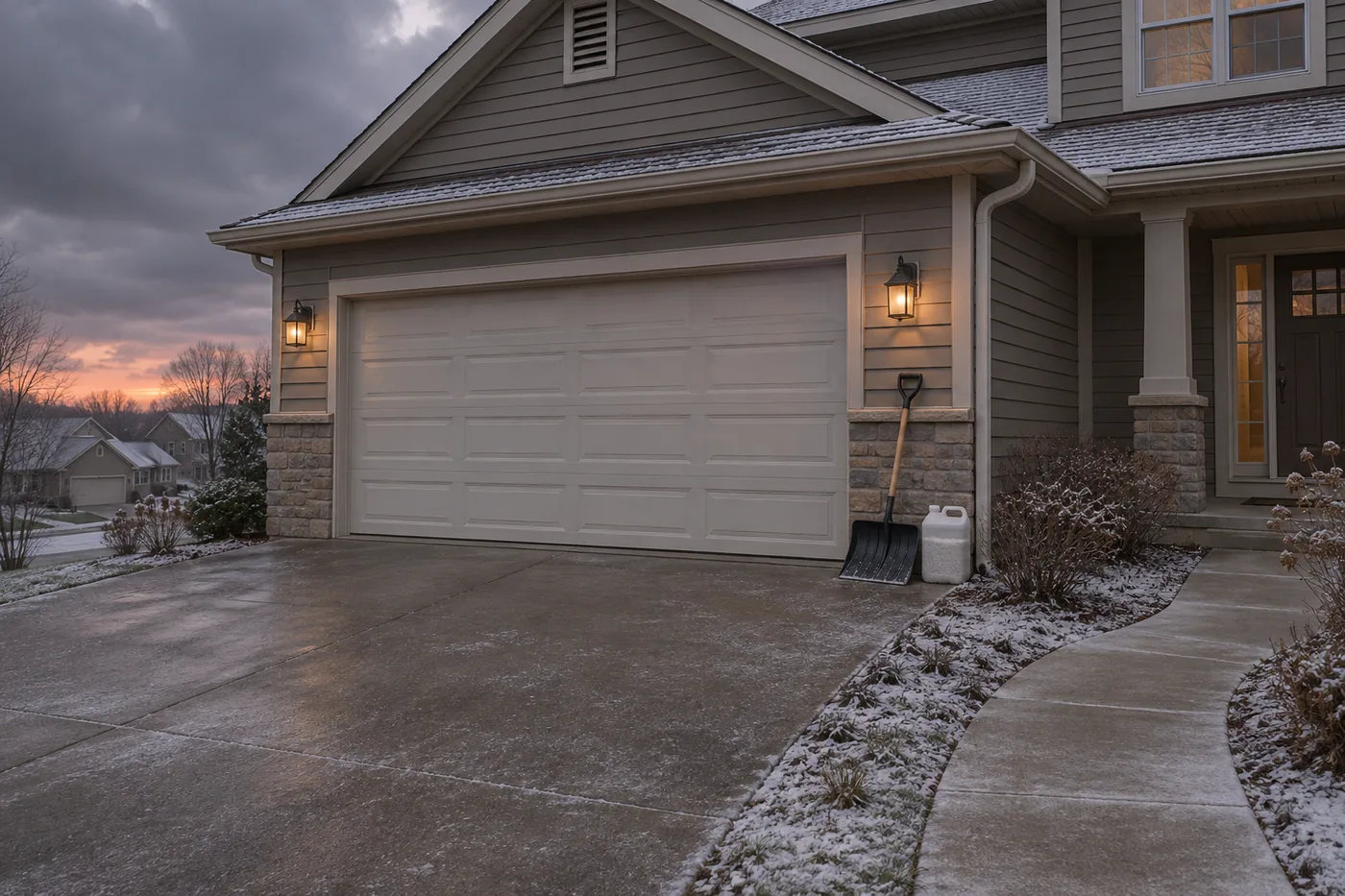 The route to the garage needs attention before the car leaves it.
For compatible mature concrete, I'd choose OxyChem PELADOW Premier Snow and Ice Melter for the remaining bonded ice after shoveling, because its maker publishes both application guidance and surface limits. But clear snow first, measure the treatment, then remove the slush; a visible scattering of pellets does not establish that a slope is ready for walking or driving.
How we chose
Reviewed OxyChem's product and application guidance alongside Scotwood Industries and Kissner instructions. The three checks were concrete compatibility, a documented product-specific starting rate, and the work needed to remove released ice and slush; no retail price was verified.
Toneandroom picks
Best ice melt for compatible concrete: Top 1
Residual bonded ice after shoveling, on compatible mature concrete with a plan for slush removal
OxyChem PELADOW Premier Snow and Ice Melter
US manufacturer retail price: Not listed by the maker (checked November 24, 2026). Amazon: Price varies; check Amazon. No seller price or stock verified.
I would choose this documented option for residual ice on suitable concrete because the manufacturer explains its starting rate, surface limits, and clearing sequence. Current package directions still govern the application.
- Form
- CaCl2 pellets
- Low temp
- −25°F
- Base rate
- 28 lb/1,000 sq ft
- Slab age
- At least 1 year
- You can measure the icy area
- You can remove released slush
- Not for new or weak concrete
- No universal preventive dose
What we considered
Concrete condition
Is this surface suitable for the chemical?
OxyChem limits its concrete guidance to properly built and cured surfaces at least one year old. That makes pavement condition the first filter, with masonry paths assessed separately.
Measurable dose
Can the amount be tied to the area needing treatment?
The maker publishes a starting rate of 28 lb per 1,000 sq ft, subject to conditions. This supports an explicit area calculation rather than borrowing another blend's rate or inventing a preventive dose.
Removal plan
Can released slush be cleared and drainage checked?
OxyChem's instructions include clearing slush after treatment. A product alone cannot finish that job or establish that a sloped route has reliable footing.
Part 1Check the slab, then the downhill end
Start with the concrete, not the weather app. OxyChem's guidance applies to concrete at least one year old, properly designed, constructed, and cured for winter conditions; simply reaching that birthday does not make every slab suitable.
Scotwood Industries also says not to apply ice melter to concrete less than one year old. So if the driveway is newer, already flaking, or of uncertain construction, ask the installer about an appropriate clearing method rather than assuming a stronger chemical will help.
Look where the walk meets the driveway and where water collects downhill. That low spot needs to stay in your clearing plan, because loosening ice without removing the resulting water leaves another job unfinished.
OxyChem excludes stone, brick, and mortar joints from its calcium chloride deicer recommendations. So a decorative path alongside suitable concrete is not automatically part of the same treatment area.
Surface condition comes before chemical choice; the driveway and the front path may need different approaches.
Part 2Prepare before the storm, without guessing a dose
Bring the shovel, spreader, and labeled container within reach before precipitation begins. That way the supplies are not waiting beyond the very slope you need to clear, and you can read the package without standing on ice.
Kissner distinguishes anti-icing before precipitation from deicing afterward. The preventive job is limiting the bond to pavement, not making a deep snowpack disappear.
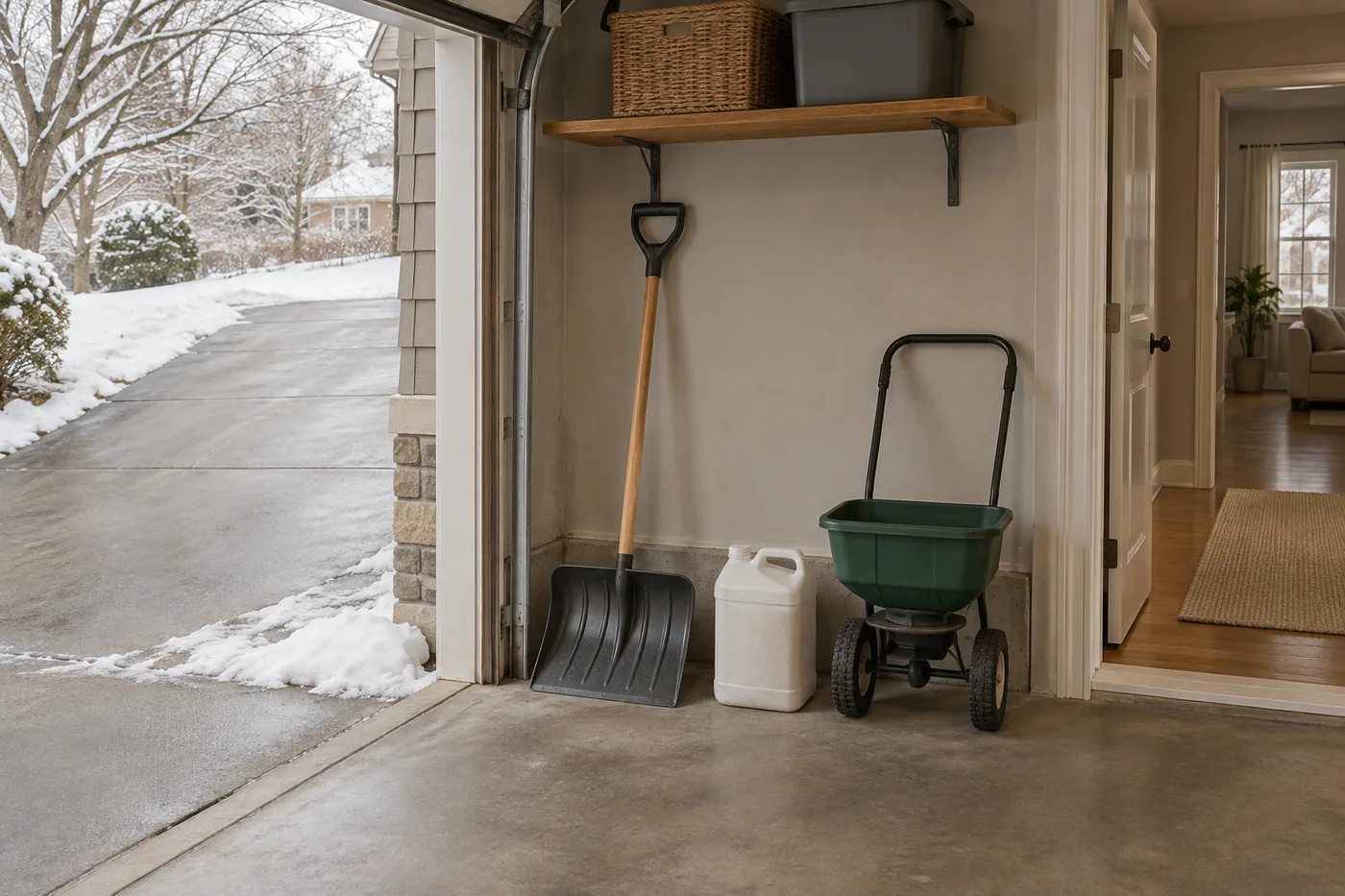 Keep supplies reachable without crossing the untreated slope.
Does that mean spreading PELADOW before every storm? Not from the sources checked here: OxyChem's opened guidance does not establish a universal household pretreatment dose, so use preventive treatment only when the current package permits it for your surface and gives the relevant rate.
A homemade liquid mix is not a shortcut around that missing instruction. OxyChem warns that liquid deicer applied in humid conditions before a storm can absorb moisture, become diluted, and freeze as temperatures fall; overapplication can also cause slickness.
Before the storm is also the time to measure the driveway and front walk separately. Those measurements become useful after shoveling, when you can distinguish the actual remaining icy area from pavement that no longer needs chemical treatment.
Part 3Calculate for the ice that remains
OxyChem PELADOW Premier Snow and Ice Melter is a calcium chloride pellet product whose page describes sidewalk ice melting down to −25°F. That encompasses an illustrative 15–25°F forecast, but the temperature limit is not a clearing-time or traction guarantee for a sloped driveway.
OxyChem's published starting rate for its calcium chloride products is 28 lb per 1,000 sq ft, also expressed as 4 oz per square yard. But the maker says to adjust for temperature and ice thickness, so this is a starting reference—not a command to coat every exposed inch.
For a worked example, assume a 600 sq ft driveway and use the published pounds-per-area rate. That makes the arithmetic below a household planning calculation, not a manufacturer coverage promise or a preventive dose.
Swipe sideways to see the full table →
| Area being considered | Calculation | How to use it |
|---|---|---|
| Entire assumed 600 sq ft driveway | 600 × 28 ÷ 1,000 = 16.8 lb | Reference only if the entire area needs deicing |
| Separate concrete front walk | Measured sq ft × 28 ÷ 1,000 | Keep this outside the driveway total |
| Remaining isolated ice | Actual patch area × applicable package rate | Exclude pavement already cleared of ice |
That whole-driveway figure is substantial. So weigh the material, follow the current package, and check spreader calibration rather than judging the amount by how full the hopper looks; another blend's rate does not transfer to this product.
Spread evenly, without piles, then allow the chemical to loosen the bond before removing the released material. OxyChem's sequence is explicit: snow removal, calibration, treatment, slush removal.
For the monthly household cost, divide your receipt's bag price by its net weight in pounds, then multiply by the pounds actually used that month. That gives a cost tied to your purchases rather than an invented dollar saving; the manufacturer's page does not provide a retail price, and no Amazon seller price was verified on November 24, 2026.
A deicing calculation tells you what an area-based starting rate means; it does not replace the package or supply a pretreatment rate.
Part 4Clear the slush, and know when to stop
Once the ice releases, shovel away the slush instead of leaving it at the bottom of the slope. Scotwood Industries explains that lingering slush can refreeze and contribute to freeze–thaw flaking, which is why removal is part of treatment, not optional cleanup.
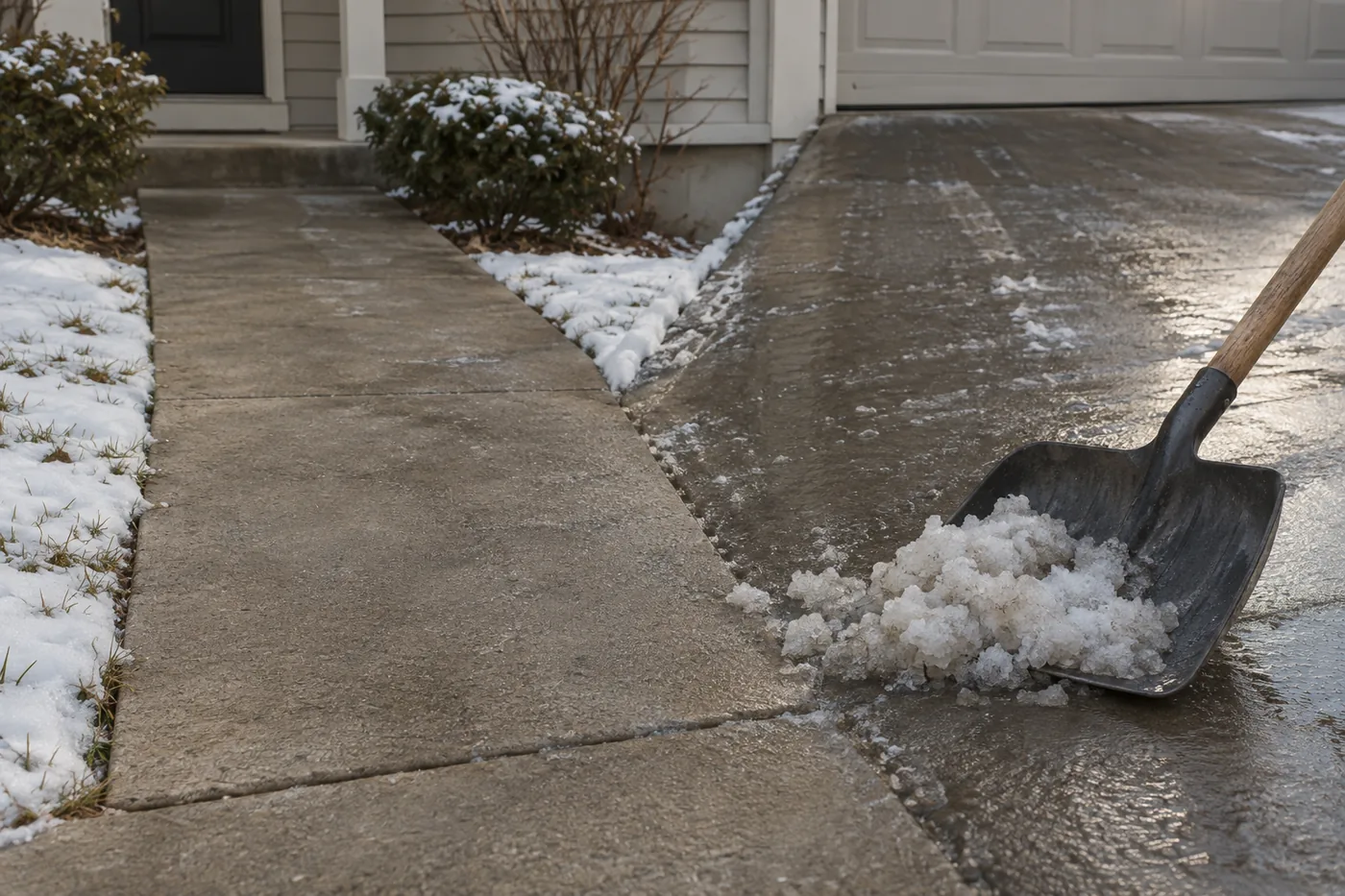 The downhill junction needs a final check after the ice releases.
Return to the low spot you identified before the storm. If water keeps collecting there, more pellets do not correct the drainage; avoid treating the route as ready and arrange appropriate clearing or drainage help when footing remains unreliable.
Stop repeated applications if the concrete is shedding flakes or its suitability remains uncertain. OxyChem says excess deicer does not accelerate melting, so another blanket pass adds expense and runoff without resolving the underlying surface problem.
The same pause applies when bulk snow is still the obstacle. Kissner advises shoveling wet, heavy snow once accumulation exceeds 1 inch, with reapplication only if necessary; a snow blower would be a separate equipment decision, not a replacement for clearing slush and checking drainage.
Finish at the entrance, too. OxyChem recommends absorbent mats and prompt cleaning with fresh water followed by thorough drying when residual deicer reaches hard indoor flooring, so the clearing job does not end with a slippery patch inside the door.
Sources and selection: OxyChem product and application pages, Scotwood Industries' FAQ, and Kissner's application guidance were reviewed for surface compatibility, product-specific dosing, and removal steps. The driveway area and forecast are illustrative assumptions; the treatment weight is calculated, not a measured result. Last checked November 24, 2026; confirm the current package and local selling price before purchase.
In one sentence
Treat compatible concrete only after clearing snow, then remove the slush and inspect the downhill end.
OxyChem PELADOW Premier Snow and Ice Melter
Frequently asked questions
How much ice melt would a 600 sq ft driveway need?
Using OxyChem's published starting rate, 600 × 28 ÷ 1,000 equals 16.8 lb if all 600 sq ft actually needs deicing. This is an illustrative calculation, not a pretreatment dose; measure the remaining ice, follow the current package, and calculate the walk separately.
Can I spread PELADOW before the first snow?
The reviewed guidance does not establish a universal household preventive rate. Use before-storm treatment only when the current package permits that application on your surface and supplies the applicable instructions.
Is there a fixed dose for a 15–25°F forecast?
OxyChem says to adjust its starting application rate for temperature and ice thickness. The reviewed pages do not give separate fixed doses for those forecast endpoints, so do not invent a multiplier.
Can ice melt go on a new concrete driveway?
OxyChem's guidance is for properly designed, built, and cured concrete at least one year old; Scotwood Industries also advises against ice melter on younger concrete. Ask the installer about appropriate clearing for newer or deteriorating pavement.
Why does the downhill end keep icing after treatment?
Check for water that collects after the ice releases. Scotwood Industries warns that slush left behind can refreeze, so clear it promptly; recurring collection calls for a drainage assessment rather than assuming more deicer will solve it.
Sources
- OxyChem PELADOW Premier Snow and Ice Melter · 2026-11-24
Read −25°F sidewalk guidance; 28 lb per 1,000 sq ft or 4 oz per square yard starting rate; minimum one-year concrete guidance with construction and curing conditions. No retail price listed. The article's 600 sq ft and 15–25°F are illustrative household assumptions, not maker specifications; 16.8 lb is calculated from 600 × 28 ÷ 1,000.
- OxyChem responsible sidewalk deicing · 2026-11-24
Read 28 lb per 1,000 sq ft or 4 oz per square yard starting rate, adjustment for ice thickness and temperature, and concrete at least one year old. Also read snow removal, spreader calibration, slush removal, and warning that diluted liquid pretreatment can freeze; no universal household preventive dose given.
- Scotwood Industries concrete-care FAQ · 2026-11-24
Read that ice melter should not be used on concrete less than one year old. Read prompt slush removal guidance and explanation of refreezing and concrete flaking; no PELADOW dose taken from this source.
- Kissner application guidance · 2026-11-24
Read anti-icing/deicing distinction and advice to shovel wet or heavy snow when more than 1 inch accumulates, reapplying only if needed. Its generic 1–4.5 lb per 540 sq ft rate is not used for the PELADOW calculation.