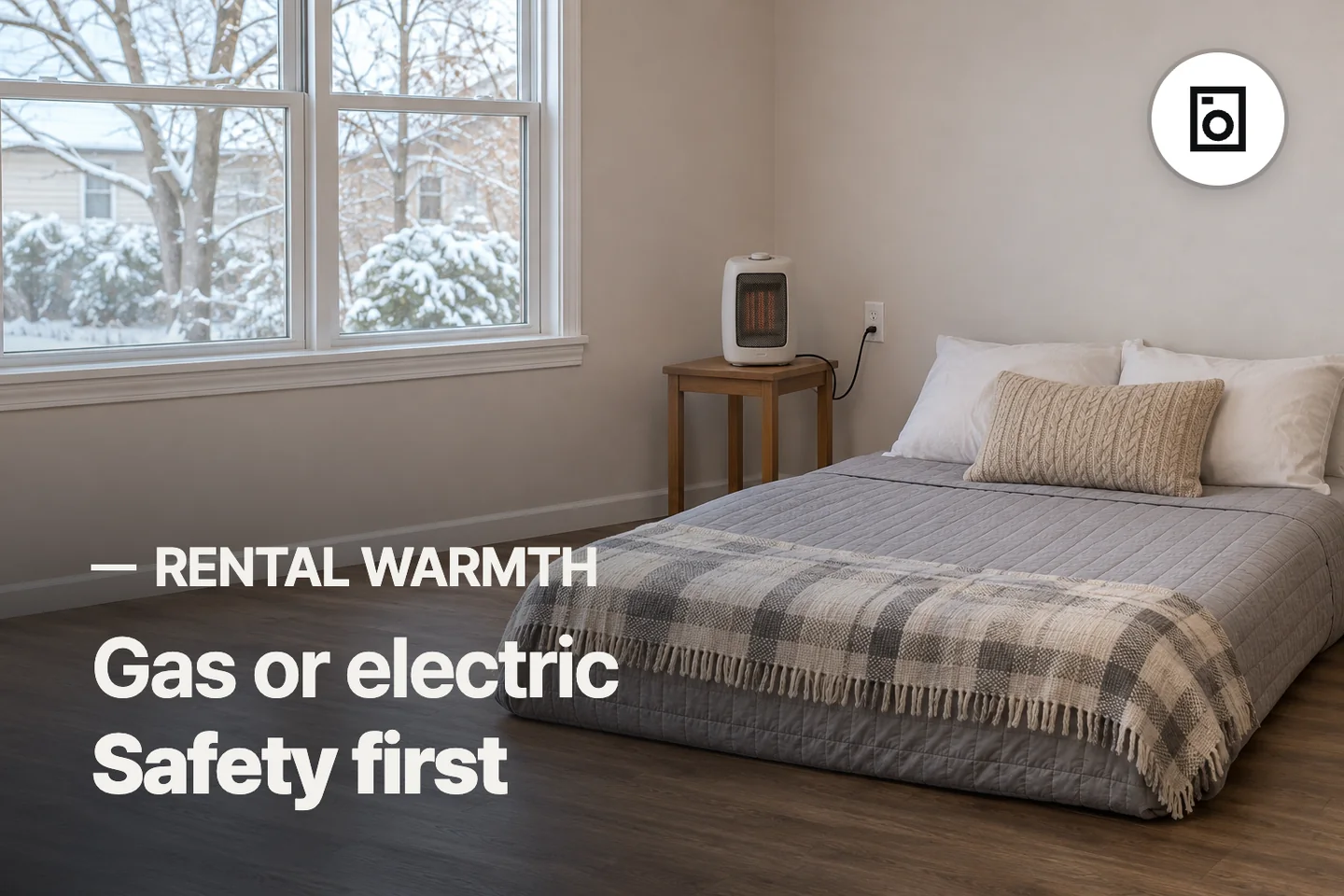
The folding guest bed opens across the living room, and suddenly the heater's spot belongs to somebody's suitcase. Now the rental has somewhere for a visitor to sleep, but its heating plan involves a duvet, a wall outlet, and some very optimistic furniture arranging.
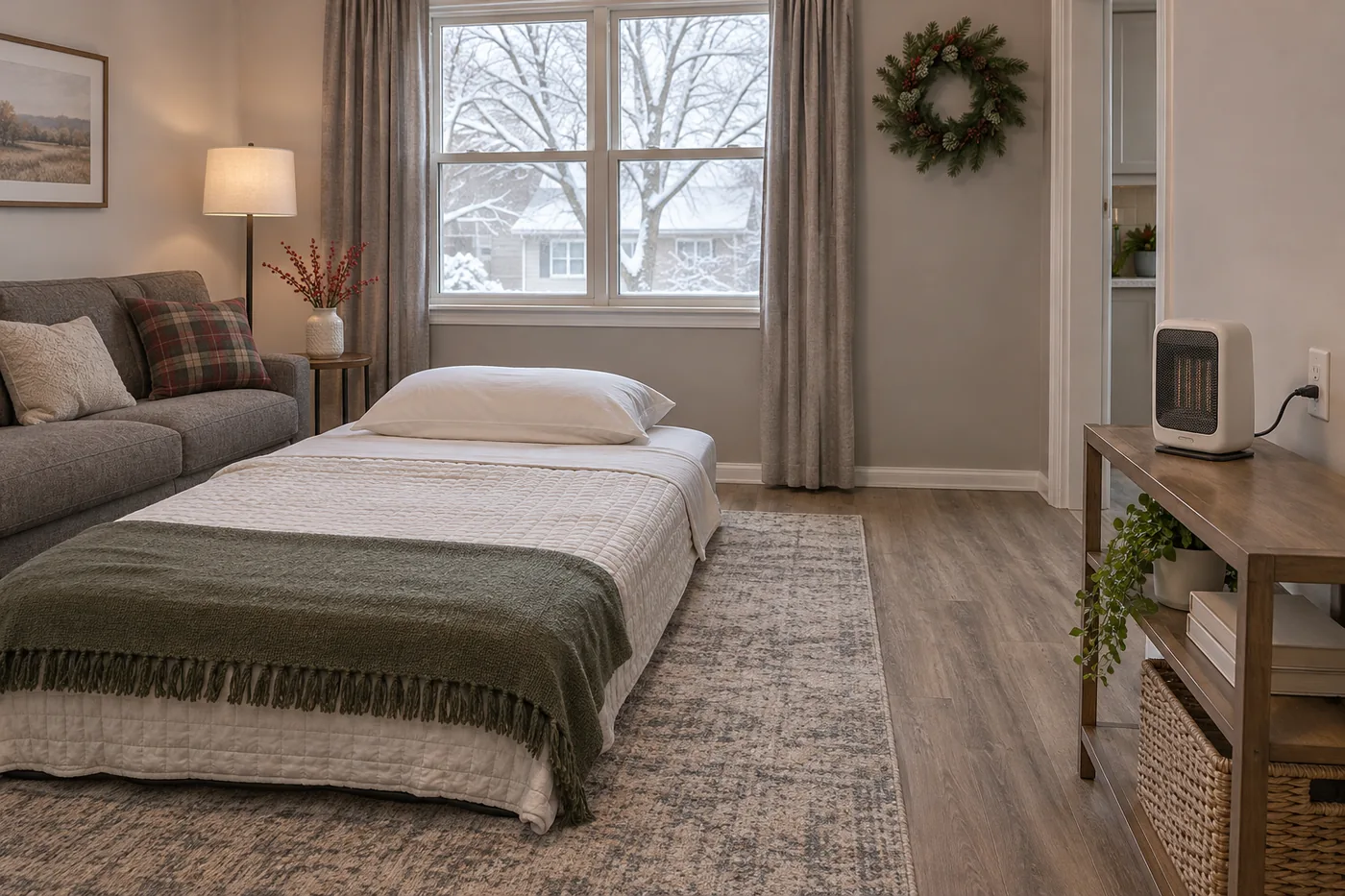 Unfold the bed before deciding whether the room has space for supplemental heat.
I'd keep the existing, approved gas system if it already serves this room; I would not install one for a holiday visit. The Rinnai EX08DTN Direct Vent Wall Heater represents that fixed setup, while the Honeywell UberHeat 5 HCE210B Ceramic Small Space Heater is my removable option only for permitted, awake-time warmth with all required clearances.
How we chose
I compared Rinnai's product details, the Honeywell manual and seller listing, CPSC guidance, and EIA energy tables. The three filters were rental permission, usable space with the guest bed open, and cost calculations that separate verified specifications from assumptions.
Toneandroom picks
Best gas or electric heater for rental guests: Top 2
The rental already has approved direct-vent natural-gas heat serving this room, maintained by a qualified professional.
Rinnai EX08DTN Direct Vent Wall Heater
Equipment price: Not listed by the maker; Rinnai product page checked November 24, 2026. Request a complete installed quote for an authorized replacement.
This is the existing-system option, not a new no-drill purchase. It avoids adding a portable heater to the guest corner only when the approved installation already suits the room and is working properly.
- Btu range
- 3,000–8,000 Btu
- Fuel
- Natural gas
- Venting
- Direct vent
- Mount
- Surface mounted
- Approved installed heat already serves the guest area
- No extra portable appliance beside the open bed
- Any new installation needs permission and professional work
- Venting, condition, and clearances need checking
Portable heat is permitted, a suitable wall outlet is accessible, and the open guest bed leaves the manual's required clearance for awake-time use.
Honeywell UberHeat 5 HCE210B Ceramic Small Space Heater
$49.95 at Honeywell Store, before tax and any shipping, checked November 24, 2026. Amazon: Price varies; check Amazon.
It supplies removable small-space warmth without a new vent or wall attachment. The manual's placement requirements and CPSC's switch-off-for-sleep guidance still apply, regardless of its small size.
- High
- 1,500 W
- Low
- 900 W
- Supply
- 120 V
- Weight
- 2.8 lb
- Lease allows supervised supplemental warmth
- Open bed leaves clearance and direct outlet access
- Switch off before anyone goes to sleep
- No extension cord, power strip, or bedding base
What we considered
Rental permission
Does this option belong in the apartment without unauthorized work?
A fixed direct-vent heater and a removable electric appliance involve different permissions. I included the gas model only for an already-approved installation, and the electric model only where management permits portable heat.
Real floor space
Will the unfolded bed leave the required clearance and outlet access?
The Honeywell manual requires an open, stable surface with clearance from walls and combustible material. I prioritized a layout that still works with luggage and bedding in place, rather than the appliance's compact dimensions alone.
Energy arithmetic
Can the operating cost be calculated without guessing fuel input?
The Honeywell's published wattage supports a clear electricity example. I left the Rinnai's model-specific hourly cost unpriced because the opened maker page did not clearly identify its displayed Btu range as fuel input.
Part 1Permission comes before the shopping cart
Start with what the landlord already provides. If that heating isn't working properly, ask for maintenance rather than making a portable appliance the guest room's unofficial furnace; also get the lease's portable-heater answer in writing.
The Rinnai is a natural-gas, surface-mounted direct-vent heater, not something that moves out of the way when breakfast starts. Its published range is 3,000–8,000 Btu, which means adjustable zone heat, not a guarantee that the far side of an open apartment will feel equally warm.
Rinnai directs buyers toward professional installation. So this model fits our cramped-room comparison only when an approved installation already exists and its condition, venting, and suitability are confirmed by a qualified professional.
The maker's page gives no equipment price, so an authorized replacement needs an installed quote. But a new gas line, vent opening, or wall attachment is not a renter's quick fix for an approaching visit.
Part 2A little heater still needs a big empty patch
The Honeywell's seller lists 1,500 W high and 900 W low: faster spot warming or less output while someone sits nearby. That gives you a way to adjust warmth without attaching equipment to the building, but it doesn't turn a small ceramic heater into whole-apartment heat.
Honeywell Store lists it at $49.95 before tax and any shipping, checked November 24, 2026. That's the appliance purchase alone; the outlet keeps its own running tab, and an Amazon price wasn't verified.
Its small body is the misleading part. The Honeywell manual requires a firm, level, open surface at least 3 feet from any wall or combustible material—a yardstick of empty space, even after the duvet slips and the suitcase opens.
Does that patch still exist with the bed unfolded? If not, the portable option doesn't fit this room, however easily the appliance itself fits in a cupboard.
The manual also specifies a direct wall connection, not an extension cord or power strip, and warns against bedding or deep carpeting as a base. So an outlet hidden behind the guest mattress isn't a problem to solve with a longer cord.
Part 3Compare the room, not just the fuel
Swipe sideways to see the full table →
| Room question | Rinnai EX08DTN Direct Vent Wall Heater | Honeywell UberHeat 5 HCE210B Ceramic Small Space Heater |
|---|---|---|
| Permission | Existing approved installation, with maintenance arranged | Lease permission for portable electric heat |
| Setup | Fixed direct vent; professional work for changes | Suitable wall outlet and manual-compliant open space |
| Guest bedtime | Operate the installed system according to its instructions | Switch off before sleeping |
| Purchase price | Not listed by the maker; request an installed quote | $49.95, Honeywell Store, November 24, 2026; tax and shipping extra |
Gas needs a different safety conversation. CPSC warns that incorrectly installed, poorly maintained, or badly vented fuel-burning heating systems can cause carbon monoxide poisoning; an open window isn't a substitute for getting a faulty system inspected.
CPSC recommends CO alarms on every level and outside sleeping areas. That means the visitor's actual sleeping spot matters, even when the lease calls this a living room rather than a bedroom.
For electric heat, no combustion at the appliance does not mean no fire risk. CPSC says never to leave portable heaters running while sleeping, so the Honeywell's tip-over and overheat protections don't make it an overnight bedside solution.
A clear outlet is only half the space check; the unfolded bedding has to stay clear too.
 The bedtime arrangement needs working installed heat, not a portable heater left running beside bedding.
Part 4Hourly cost without the wishful arithmetic
Electricity is the easier calculation: selected kilowatts multiplied by your bill's applicable dollars per kWh. EIA lists a 2025 residential average of 17.30 cents per kWh, a historical national measuring stick rather than this apartment's current tariff.
At that rate, continuous high heat costs 1.5 × $0.173 = about $0.26 an hour. Low costs 0.9 × $0.173 = about $0.16, so the lower setting saves roughly a dime per continuously heating hour by supplying less heat.
Gas needs another step. EIA lists August 2026 residential gas at $27.05 per thousand cubic feet, and its estimated conversion is 1,036 Btu per cubic foot; together those yield about $0.0261 per thousand Btu purchased, a fuel-cost building block rather than a room-heating bill.
Multiply that building block by the unit's confirmed hourly fuel input in thousands of Btu. But the opened Rinnai page doesn't clearly label its displayed range as fuel input, so plugging that range into an hourly bill would turn an uncertain specification into a confident-looking answer.
These gas and electricity figures cover different periods, not equal delivered warmth. So thermostat cycling, vent losses, local charges, and any electricity the gas system uses still matter; cheaper fuel cannot make a new installation free.
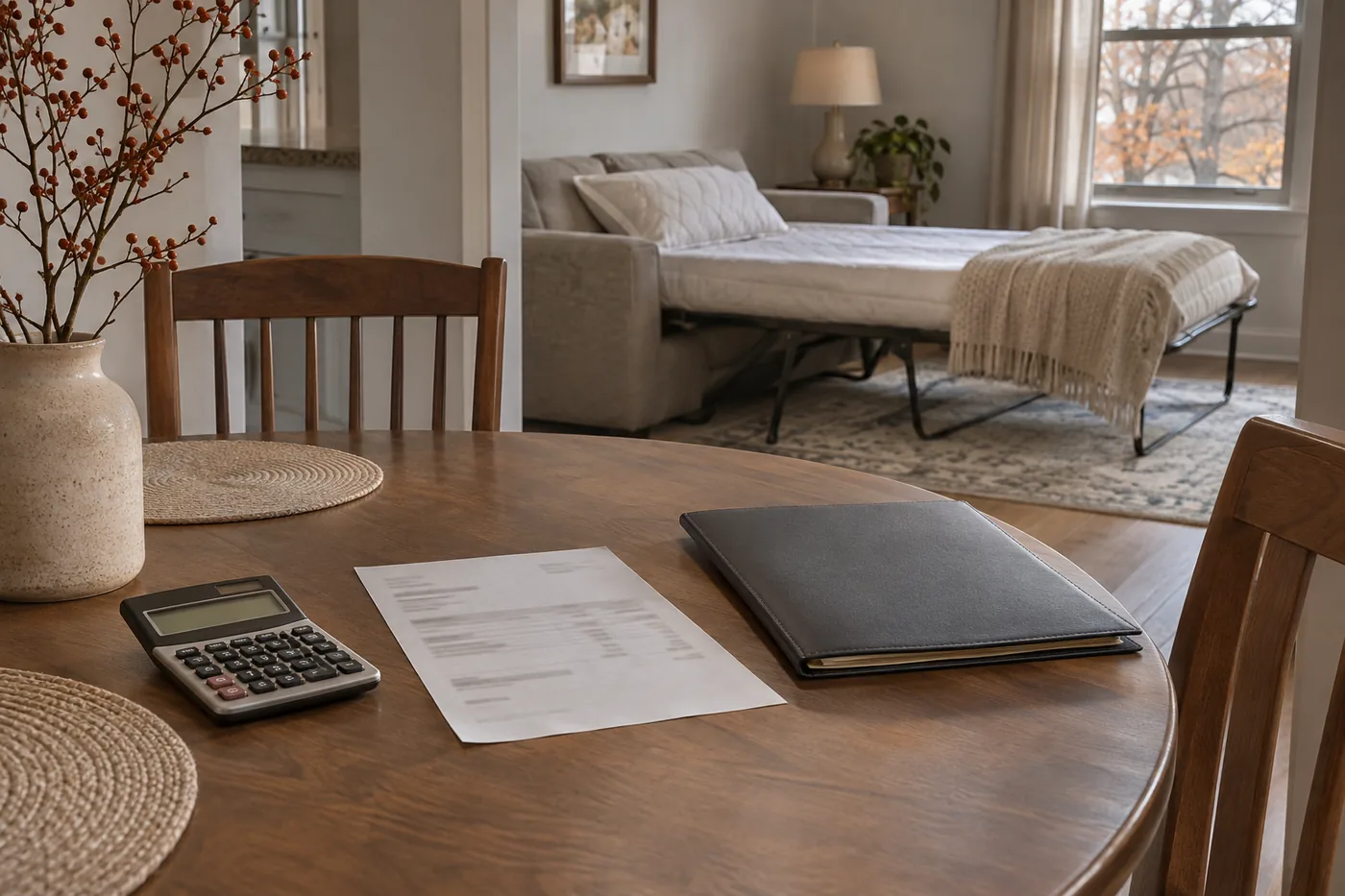 Use the rate on the apartment's own bill before budgeting for extra warmth.
Part 5Leave the guest somewhere to sleep
My preference is boring: use the maintained installed heat when it already suits the room. But if portable heating is allowed and the open bed leaves the manual's full clearance, the Honeywell can add supervised warmth before bedtime.
If neither arrangement works, I'd change the sleeping layout and contact management, not squeeze the heater into the last available gap. The visitor came for a bed, not a night shift watching a heating appliance.
Sources and method: Rinnai's product page, the Honeywell manual, Honeywell Store, CPSC guidance, and EIA tables informed this comparison. Product and energy pages were checked November 24, 2026. CPSC guidance retains its original November 14, 2026 check because today's request was blocked; utility benchmarks are historical, not local quotes.
In one sentence
Keep suitable existing gas heat; use permitted electric spot heat only where the unfolded guest bed leaves the required space.
Rinnai EX08DTN Direct Vent Wall Heater
View on Official storeHoneywell UberHeat 5 HCE210B Ceramic Small Space Heater
View on Official storeFrequently asked questions
Can a gas heater be a no-drill guest-room option?
Only in the sense of using an existing approved installation that already serves the room. A new Rinnai EX08DTN requires professional installation and landlord authorization; it is not a temporary portable purchase.
Can a ceramic heater run while a guest sleeps?
CPSC says never to leave portable heaters running while sleeping. Turn the Honeywell off before bedtime and use the properly functioning installed system according to its instructions; ask management to address inadequate heating.
How much does the Honeywell cost per hour?
Using EIA's historical 2025 residential average of 17.30 cents per kWh, continuous heating is about $0.26 an hour on high or $0.16 on low. The lower figure also means lower heat output; actual cost depends on the apartment's tariff and thermostat cycling.
How far does the heater need to be from the guest bed?
The Honeywell manual calls for a firm, level, open surface at least 3 feet from any wall or combustible material. CPSC also specifies at least 3 feet from bedding, furniture, and curtains, so check the arrangement with the bed fully unfolded and the duvet in place.
Sources
- Rinnai EX08DTN Direct Vent Wall Heater · 2026-11-24
Published minimum 3,000 Btu and maximum 8,000 Btu; natural gas, surface mounted, direct vent, supplemental or zone heating. The displayed range is not assumed to be confirmed fuel input. Equipment price is not displayed.
- Honeywell UberHeat 5 HCE210B Ceramic Small Space Heater · 2026-11-24
Honeywell HCE210/HCE220 manufacturer manual: HCE210 low 900 W, high 1,500 W; 120 V, 60 Hz. Placement on a firm, level, open surface at least 3 feet from any wall or combustible material; direct wall outlet, no extension cord or power strip; no bedding or deep carpeting base.
- CPSC winter heating safety guidance · 2026-11-14
Retains original article's verified guidance and check date: at least 3 feet from bedding, furniture, and curtains; direct wall outlet, no extension cord or power strip; never leave portable heaters running while sleeping. CO alarms on every level outside sleeping areas and professional inspection of fuel-burning systems. Reopening on November 24, 2026 returned HTTP 403; no new verification claimed.
- EIA residential electricity benchmark · 2026-11-24
2025 residential average 17.30 cents/kWh. Derived continuous heating: 1.5 kW × $0.173/kWh = $0.2595/hour, about $0.26; 0.9 kW × $0.173/kWh = $0.1557/hour, about $0.16. Historical national benchmark, not a current local tariff.
- EIA residential natural-gas price table · 2026-11-24
August 2026 residential natural gas: $27.05 per thousand cubic feet. The opened 2026 row ends with this populated month; no November price is assumed.
- EIA natural-gas energy conversion · 2026-11-24
Estimated 2026 delivered natural gas: 1 cubic foot = 1,036 Btu. Derived fuel-cost factor: $27.05 divided by 1,036 = about $0.0261 per thousand Btu purchased. Multiply by confirmed hourly fuel input in thousands of Btu, then account separately for the heater's electricity.