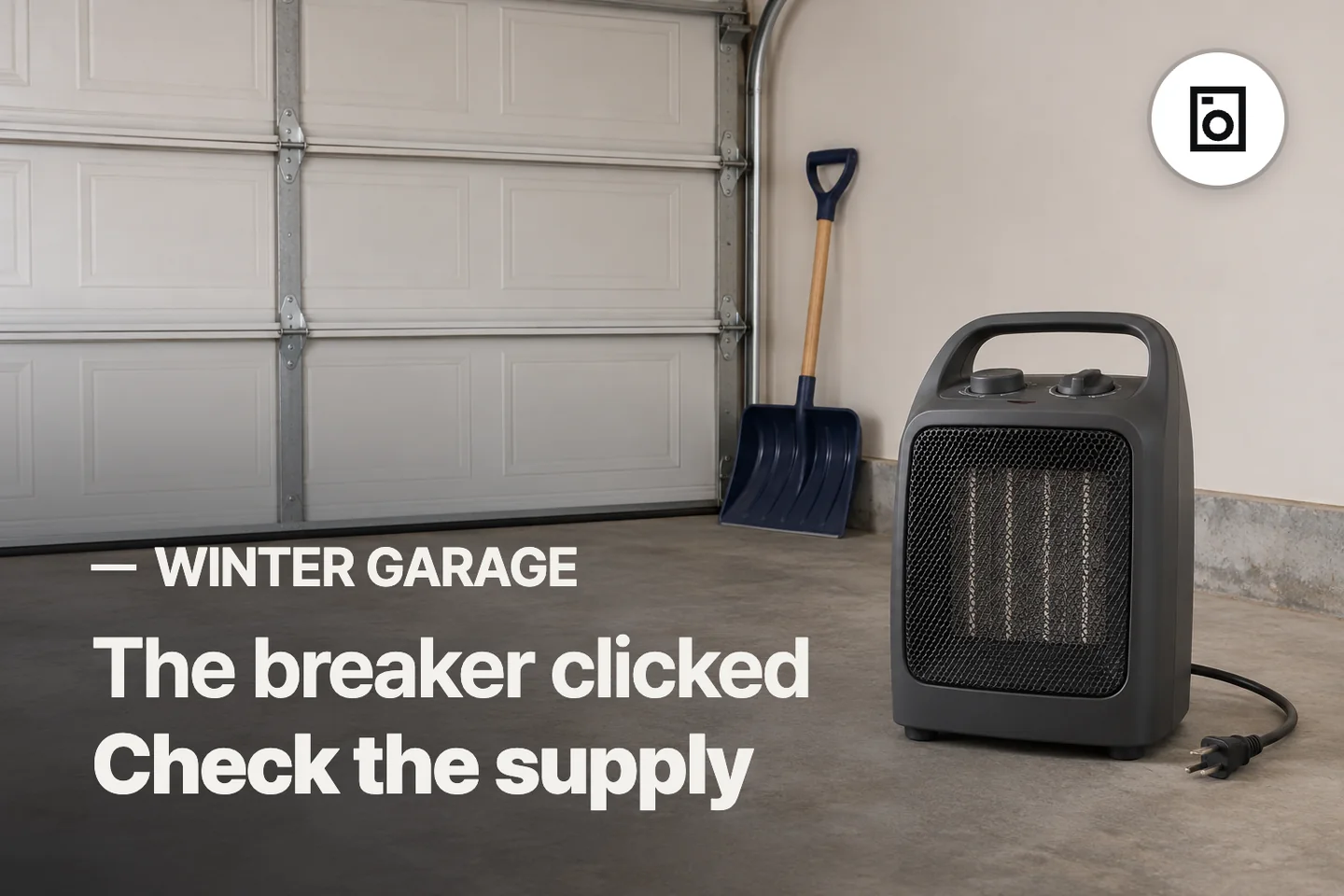
The garage heater falls silent before dawn, just as you reach for the snow shovel beside the back door. Now the attached garage is cold, the forecast is getting worse, and resetting the breaker feels like the quickest way to get moving.
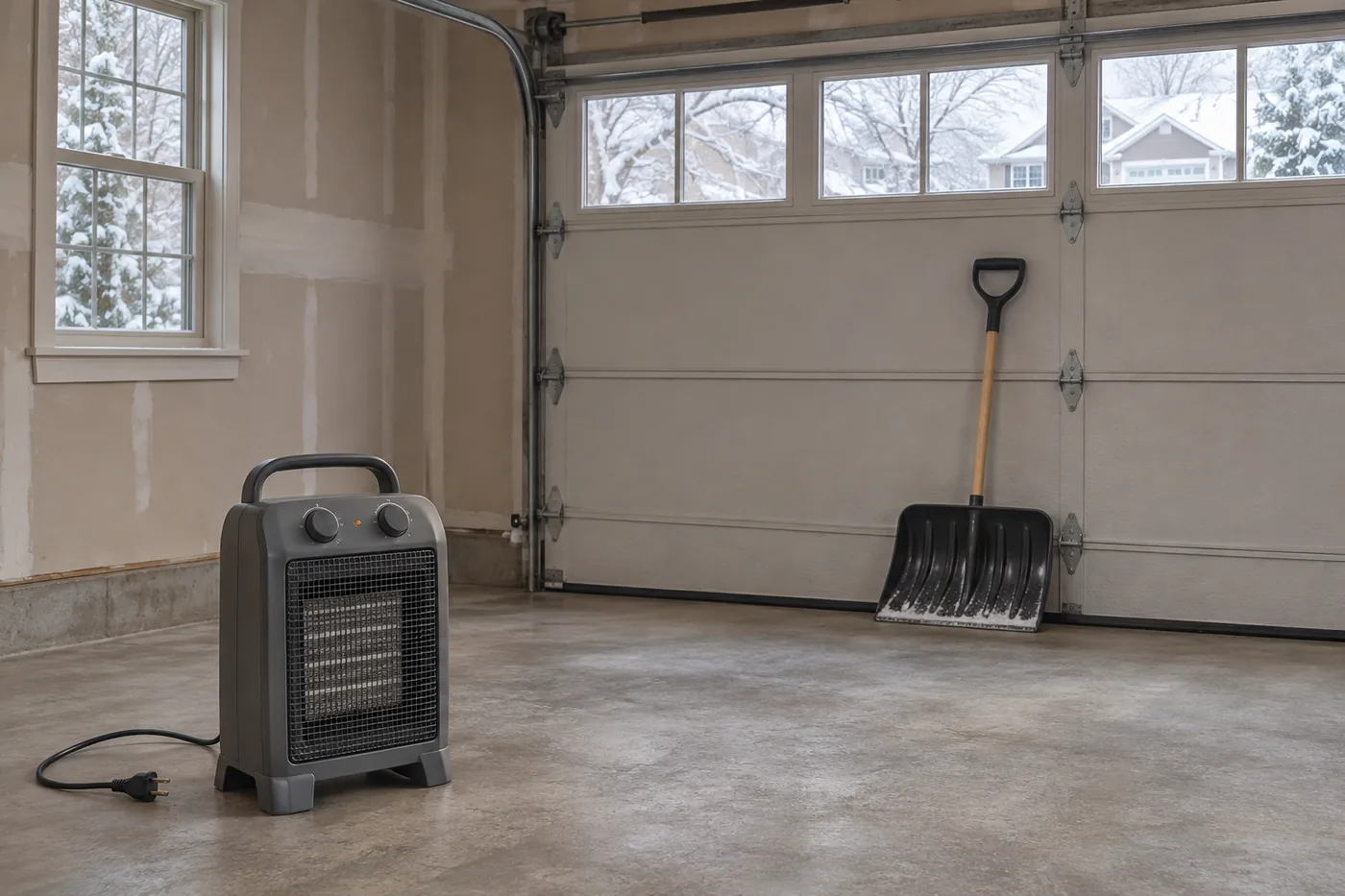 An interrupted heater needs a supply check, not a hurried replacement.
Leave the heater off while you establish what stopped. No replacement heater or accessory is needed for these checks; the useful tools are its manual, the visible labels and a written account of what happened. Buying more heat would leave the electrical question unanswered.
How we chose
CPSC heater guidance, ESFI safety advice and OSHA electrical-protection guidance inform this sequence. The checks prioritize identifying the interruption, examining the visible connection and matching the nameplate to the supply question; no replacement equipment is selected. Source verification dates are retained where pages could not be rechecked.
Part 1Find out what actually switched off
A dark heater does not identify the failed part. Was a breaker handle visibly out of its usual position, had a ground-fault circuit interrupter released, or were the lights still on while only the heater stopped?
That distinction matters because a breaker trip and a heater shutdown are different events. Note which device operated without opening the electrical panel's protective cover, removing an outlet cover or deliberately recreating the interruption.
ESFI, the Electrical Safety Foundation International, advises inspecting heaters for damaged plugs, frayed parts and loose connections. So if the connection looks damaged, leave the equipment unused rather than trying another socket to see whether it behaves better.
A burning smell, discoloration, buzzing or a loose receptacle belongs on the electrician's call list. If the interruption has already happened again, that history belongs there too; repeated resets are not a repair.
Write down whether heat had just started, had been running for a while, or stopped as another appliance started. That sequence gives the electrician something concrete to investigate, whereas “it was cold outside” does not establish the cause.
Record the device that opened and the sequence before it did; neither observation alone proves an overload.
Part 2Inspect the connection without making a workaround
Start with the path from heater to wall. If it includes an extension cord, a cord reel or a power strip, that connection needs to come out of the plan, not be replaced by a heavier-looking version.
The U.S. Consumer Product Safety Commission, or CPSC, directs portable electric heaters to wall outlets rather than extension cords or power strips. So if the cord cannot reach a suitable outlet, keep the heater off at that location and ask an electrician about a properly placed supply.
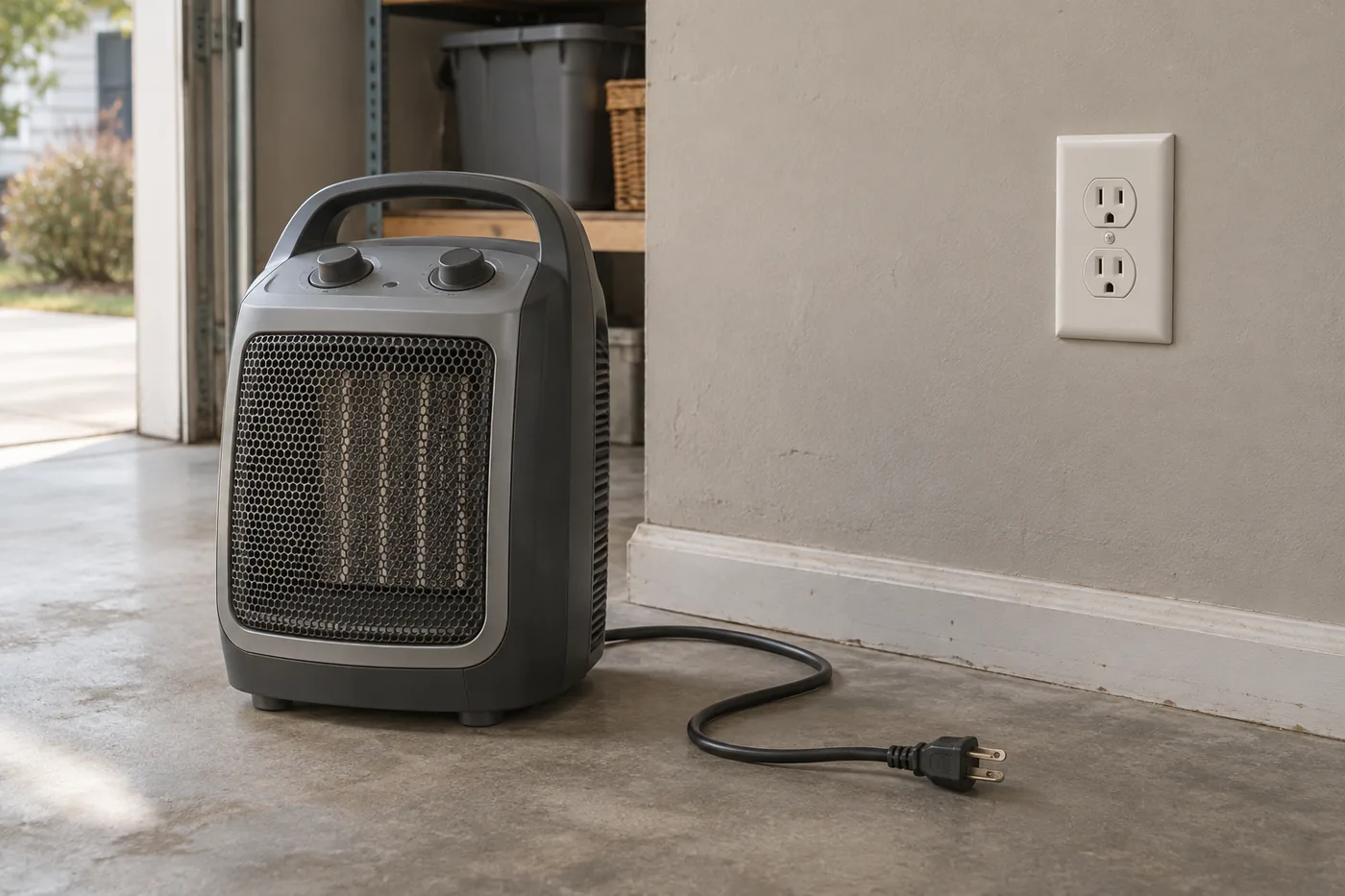 A reachable outlet is part of the installation, not a reason to add a longer cord.
ESFI also advises against connecting other electrical devices to the same outlet as a heater. But an empty neighboring receptacle does not establish that the rest of the circuit is unloaded; the circuit still needs to be identified.
Check the floor space as well as the cord. CPSC calls for at least three feet from combustible materials, so stored cardboard, coats and other clutter cannot occupy that clearance; follow a larger distance if the heater's own instructions require it.
ESFI calls for a level, flat location away from traffic and describes space heaters as supplemental heat, not equipment for drying clothing or thawing pipes. That rules out turning the heater toward wet gloves while the original power problem remains unresolved.
Part 3Match the heater label to the circuit question
Copy the model, voltage, wattage and any listed amperage from the heater nameplate. Then record only the affected breaker's externally visible rating; if reaching either label requires unsafe access or dismantling, leave that part to the electrician.
A circuit rating is not an allowance for every outlet. OSHA's electrical standard discusses branch circuits rated at 15 and 20 amperes, but its wider point is that conductors and equipment need overcurrent protection appropriate to their current-carrying ability.
That is workplace guidance, not your home's installation approval. So a larger breaker is not the next troubleshooting step: an electrician must assess the wiring, equipment and applicable residential requirements before any circuit change.
List the freezer, chargers, work lights and other equipment that lost power alongside the heater. But do not unplug essential equipment casually or assume an outlet across the garage provides an independent circuit; uncertain connections need tracing.
Swipe sideways to see the full table →
| What you can observe | What to hand over or check next |
|---|---|
| Other equipment stopped with the heater | Give the electrician the shared-load list and heater label details. |
| A ground-fault device released | Identify that device; do not bypass it or label the event an overload. |
| The supply appears unchanged but heat stopped | Consult the model's thermostat and protective-shutdown instructions. |
| The plug, cord or outlet looks damaged | Keep the heater unused and arrange assessment of the affected equipment. |
The point is a useful record, not a home wiring experiment. An electrician can work from those observations without you running the heater again merely to complete the table.
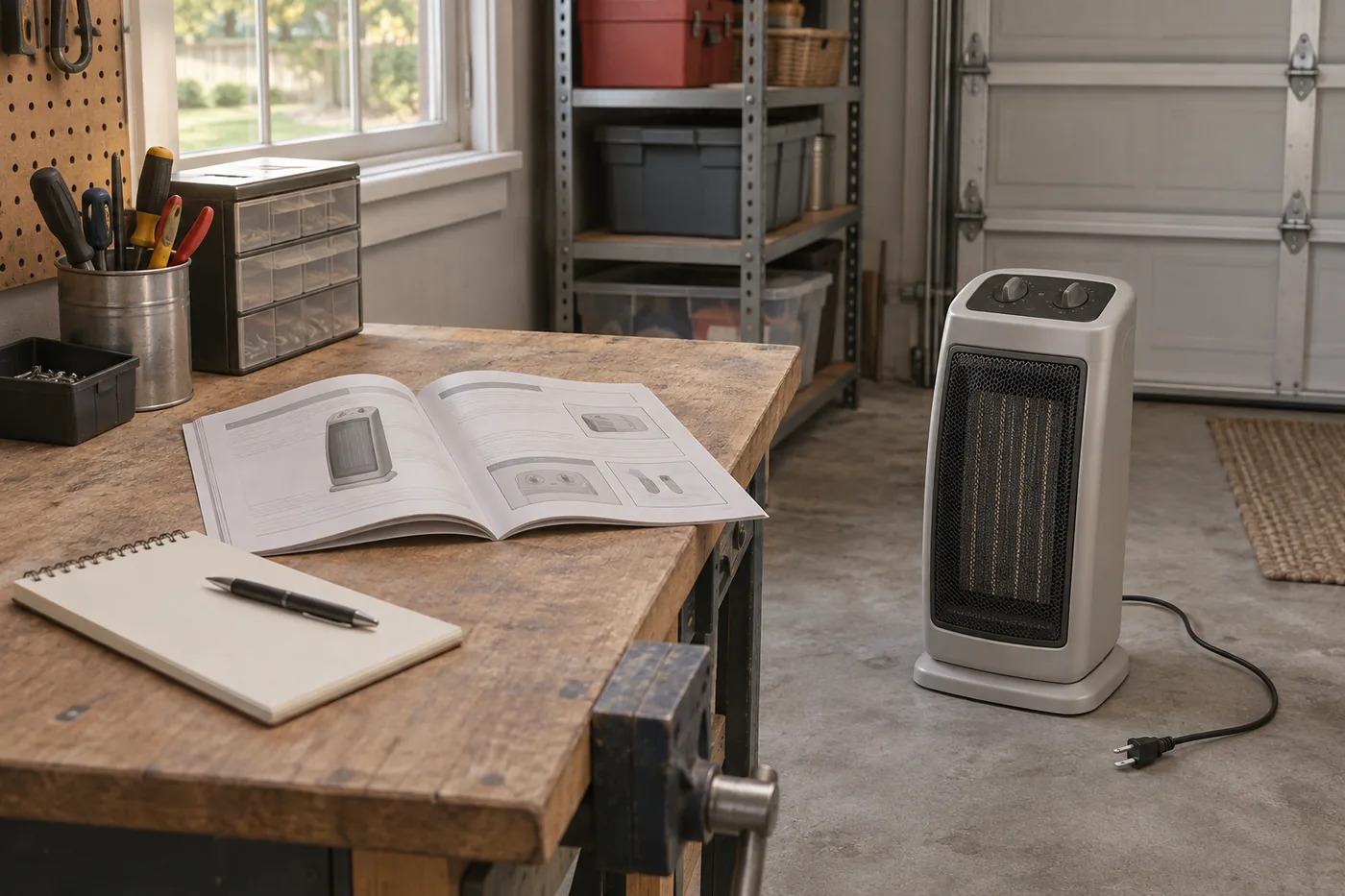 The model label and manual help separate temperature control from power protection.
Part 4Leave the thermostat question until last
A thermostat asks for heat when the temperature calls for it. That means lowering the temperature setting is not the same as selecting lower wattage; any separate low-output mode needs to be identified in that particular model's manual.
If such a mode exists, include its stated wattage in the information for the electrician. But do not use it to hide another interruption, and do not bridge a thermostat or bypass a protective switch to keep the garage warm.
Where only the heater stops, follow its manufacturer's shutdown and service directions before assuming a failed thermostat. A protective shutdown and ordinary temperature cycling need different responses, and the manual supplies the model-specific distinction.
For the household budget, monthly heating cost follows actual heating-on time. Multiply the selected input in kilowatts by heating-on hours during the billing month, then by your bill's price per kilowatt-hour; fixed utility charges remain separate.
That calculation needs your tariff and the heater's operating time, neither of which is established here. So there is no honest monthly dollar estimate, and a lower thermostat setting cannot promise a particular saving in a garage that keeps losing heat.
If replacement eventually becomes necessary, give the installer the garage dimensions, insulation and intended working temperature. Until the interruption is explained, the immediate job is restoring a suitable supply and confirming the heater is fit to use—not choosing a bigger model.
Sources and method: This sequence draws on CPSC portable-heater guidance, ESFI connection and placement precautions, and OSHA's explanation of overcurrent protection. The linked source material was last verified on November 16, 2026; access attempts on November 24, 2026 did not return readable guidance, so the earlier verification dates are retained. OSHA is background, not residential installation authority.
In one sentence
Keep the heater off, identify what interrupted operation, and collect the label and circuit observations for a safe assessment.
Frequently asked questions
Why does my garage heater trip a 20-amp breaker?
The rating applies to the circuit, not separately to each outlet. Shared loads or a fault may be involved, but the trip alone does not identify the cause. Leave the heater off and give an electrician its nameplate details, the affected equipment list and the interruption sequence.
Will a heavy extension cord stop the breaker tripping?
CPSC directs portable electric heaters to wall outlets, not extension cords or power strips. A heavier cord is not a fix for an unexplained trip. If a suitable outlet is out of reach, leave the heater unused there and arrange an appropriate supply.
Does turning down the garage heater thermostat reduce wattage?
A thermostat setting determines when heat is requested, not the input of a separate heat mode. Check the model's manual for any specifically labeled lower-wattage setting, and do not use that setting to conceal a recurring interruption.
Can I replace the breaker with a larger one?
Do not treat a larger breaker as a heater repair. OSHA explains that overcurrent protection must suit the current-carrying ability of conductors and equipment; residential changes require an electrician's assessment under applicable local requirements.
Sources
- CPSC winter heating precautions · 2026-11-16
Original verified source specifies at least three feet from combustible materials and direct wall-outlet connection instead of extension cords or power strips. Reopening on 2026-11-24 returned Access Denied; original facts and verification date retained.
- ESFI space heater safety tips · 2026-11-16
Original verified source specifies at least three feet from combustibles; also covers damaged plugs, loose connections, no other devices in the same outlet and level placement. Reopening on 2026-11-24 did not return readable guidance; original verification date retained.
- OSHA wiring design and protection · 2026-11-16
Original verified source discusses 15- and 20-ampere branch circuits and overcurrent protection appropriate to safe current-carrying ability. Workplace background only, not residential installation authority. Reopening on 2026-11-24 did not return readable guidance; original verification date retained.