Long before the morning alarm, the garage side door catches on a crust of white grit and stays slightly open. For a homeowner getting a two-car garage ready for snow, that little failure explains why a garage heater belongs later on the shopping list.
 The first repair is at the threshold, not on the heater shelf.
I'd clear the threshold and repair the door gaps before choosing any heater. That means leaving the purchase undecided until the floor is clean, the heat requirement is calculated, and an electrician has confirmed the supply.
For scale, keep the original planning example: a 20-by-20-foot garage near 25°F, with old deicer residue underfoot. Those are assumed household conditions, not measurements from a heater trial, so they cannot establish a warm-up time.
How we chose
Reviewed Frost King weatherseal specifications, Scotwood's deicer guidance, King Electric's sizing and electrical pages, and EIA's electricity table. The three checks are door and floor condition, building-specific heat demand, and compatible electrical supply; running costs are calculations rather than measured results.
Part 1Start where the door fails to close
With the overhead door shut, look for daylight at the sides and bottom. Then check the side-door threshold, because a sweep riding over grit cannot meet a clean surface.
Clear the contact surfaces before buying replacement strips. Frost King's Dual Vinyl Garage Door Side and Top Weatherseal has a rigid base and flexible sweep, with listed lengths of 7 ft and 9 ft; those lengths help with ordering, but they say nothing about monthly savings.
The important distinction is sides and top versus bottom. This weatherseal is for the jamb area, so a floor gap needs a bottom seal matched to the door rather than another strip of the same material.
With the heater off, collect loose deicer gently with a broom and dustpan, following its label for disposal. Scotwood Industries explains that ice melters make brine by lowering the freezing point below 32°F; the resulting slush still needs removing, rather than being left under the car.
Scotwood also advises against applying ice melt to concrete less than one year old. That warning makes the actual deicer label and floor finish more useful than a generic cleaning recipe: follow the coating maker's residue-removal instructions instead of flooding a freezing slab.
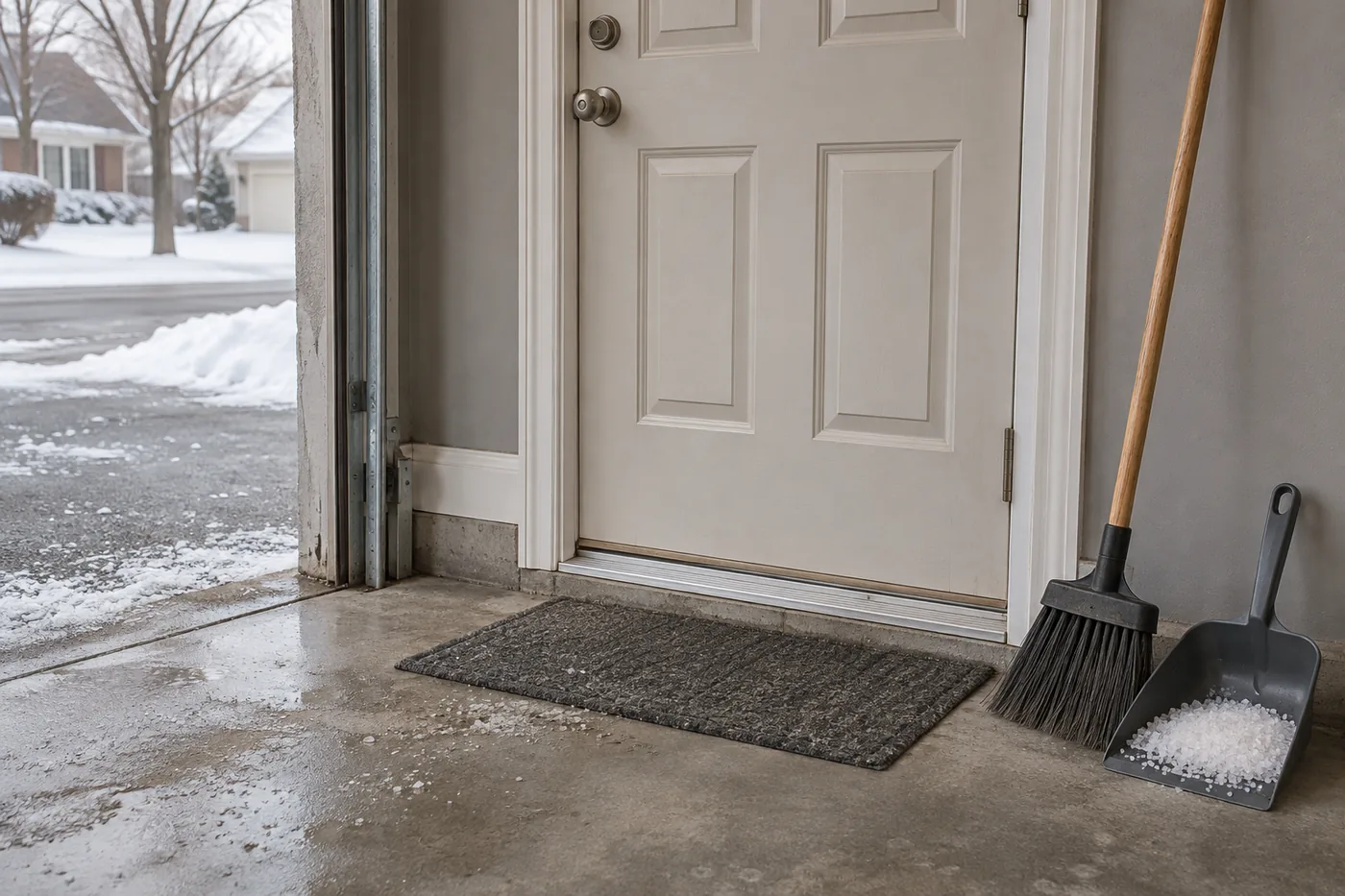 Collected grit stays out of the doorway; remaining residue needs the floor maker's cleaning instructions.
Scotwood links prompt slush removal to reducing freeze-thaw damage and flaking. So the job ends with collected residue and liquid, not merely a tidier-looking patch of wet concrete.
Part 2Size the garage heater for the building
The example floor works out to 400 sq ft: 20 × 20. But floor area is only the starting measurement, because ceiling height, insulation, climate, and an opening overhead door all change the heating problem.
King Electric's general room guidance gives 5–10 W per sq ft. Applied to this example, that produces 2,000–4,000 W on paper; it does not establish what will bring this garage up from 25°F, or what that process will cost each month.
King's garage-specific sizing page asks for climate zone, insulation, ceiling height, length, width, voltage, and installation type. Its stated comfort target is 70°F, so someone wanting only a cooler workshop needs sizing for that actual target rather than assuming the calculator answers a different question.
How warm does this garage really need to be? That answer belongs beside the dimensions before shopping, because the desired temperature changes the job you are asking the heater to do.
The King PGH2440TB illustrates the next check, without becoming a purchase recommendation. King lists 3,750 W at 240 V and 2,813 W at 208 V, so the available voltage changes its published output as well as the electrical requirements.
Those ratings still need comparing with the garage's calculated heat loss. Until that comparison is made, a model number is not a sizing answer, even when the manufacturer calls it a garage heater.
Measure the building and choose the target temperature before choosing the wattage.
Part 3Check what the electrical supply can support
King recommends a new dedicated 240 V circuit for a new garage-heating installation. Its guidance also says to confirm voltage and phase, so an outlet's appearance is not enough to establish compatibility.
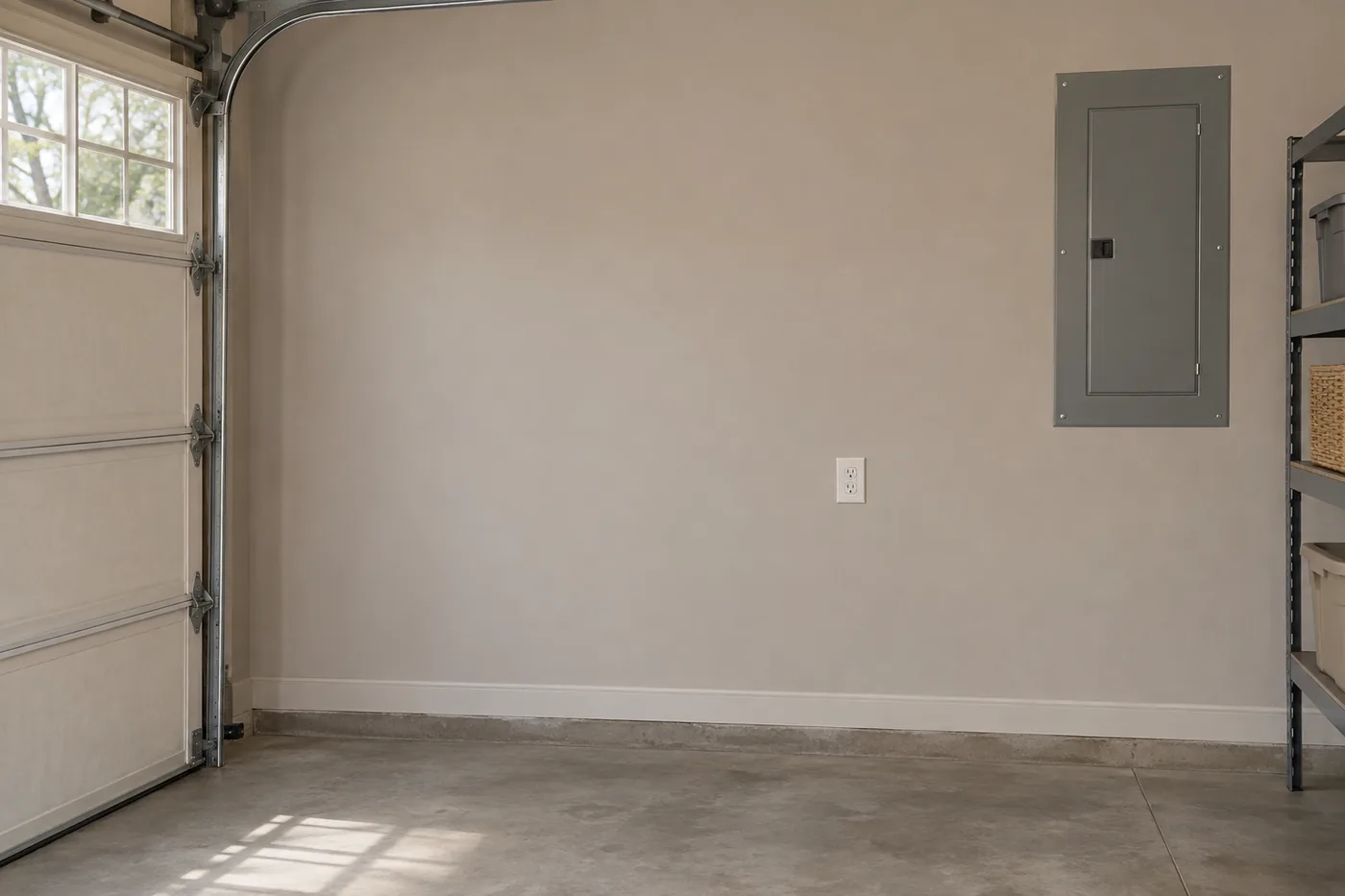 Supply checks belong with a licensed electrician, without opening the panel for a shopping checklist.
For the PGH2440TB, King specifies a 20 A, 240 V NEMA 6-20P plug and a 6 ft cord. That is not a standard household connection, so have a licensed electrician confirm the matching receptacle, circuit, grounding, and required protection before considering this model.
The cord length also affects placement. So check the intended location against the manufacturer's instructions rather than planning around an improvised adapter or an extension.
King's circuit-sizing guide describes fixed electric heating as normally requiring circuit capacity of at least 125% of the heater load. But that planning rule is not a portable-heater wiring recipe: King says the nameplate, installation instructions, and local requirements take priority.
Leave panel measurements and wiring decisions to the electrician. That keeps the homeowner's task straightforward: provide the model information, intended location, and any history of breaker trips instead of trying to infer circuit capacity from the breaker handle.
Part 4Put the running cost ahead of the sale
Start with the electricity rate on your own bill. The U.S. Energy Information Administration's opened table lists a preliminary national residential average of 18.16 cents per kWh for August 2026, checked November 24, 2026; that is a reference, not a quote from your utility.
For King's published 3,750 W rating, the reference calculation is 3.75 × $0.1816, or about $0.68 per full-power hour. So monthly energy cost needs actual operating hours: multiply 3.75 kW by the month's full-power-equivalent hours and your own dollars per kWh.
King's cost guidance explains that thermostat cycling changes runtime. That means the hourly calculation cannot promise a monthly bill, and it excludes fixed utility charges or electrical installation work.
The opened King product page does not display a purchase price, checked November 24, 2026. So ask for the heater price and any electrical work separately; a sale cannot settle whether this model fits the building or the supply.
I'd finish the doorway and floor work first, then take the dimensions and target temperature to the sizing conversation. That leaves the heater purchase last, where its capacity and total cost can finally be compared with the actual garage.
Sources and method: Frost King, Scotwood Industries, and King Electric pages establish the repair sequence, sizing inputs, and electrical specifications; EIA supplies the dated electricity reference. Area and energy costs are calculations, not measured heating results. No purchase links or selected products are included. Sources last checked November 24, 2026.
In one sentence
Clear the doorway and deicer residue, then size the heating load and confirm the electrical supply before buying.
Frequently asked questions
What size garage heater does a two-car garage need?
Floor area alone cannot settle it. King's garage sizing process also considers climate, insulation, ceiling height, voltage, and installation type, with a stated comfort target of 70°F. Ask for sizing against your actual desired temperature rather than treating a general watts-per-square-foot estimate as a guarantee.
How should I clean tracked-in ice melt from the garage floor?
Collect loose granules with the heater off, then follow the deicer label and the floor or coating maker's cleaning instructions for residue. Scotwood Industries advises removing resulting slush promptly to reduce freeze-thaw damage; avoid leaving cleanup water to refreeze.
Can the King PGH2440TB plug into a regular outlet?
King specifies a 20 A, 240 V NEMA 6-20P plug, not a standard household connection. Have a licensed electrician confirm a matching, correctly supplied receptacle and the installation requirements rather than relying on an adapter. The published specifications do not establish that this heater can meet your garage's heat loss.
How do I calculate monthly electric garage heater cost?
Multiply the heater's rated kilowatts by monthly full-power-equivalent operating hours and your electricity rate in dollars per kWh. At EIA's preliminary August 2026 national residential reference of $0.1816/kWh, King's published 3.75 kW rating calculates to about $0.68 per full-power hour. Your tariff and thermostat cycling determine the actual energy total; fixed charges and installation costs are separate.
Sources
- Frost King Dual Vinyl Garage Door Side and Top Weatherseal · 2026-11-24
Lists 7 ft and 9 ft lengths and a rigid vinyl base with flexible sweep for door sides and tops. No monthly energy savings figure is claimed.
- Scotwood Industries ice melt FAQ · 2026-11-24
Explains brine formation below 32°F, advises prompt slush removal to reduce freeze-thaw flaking, and says not to apply ice melt to concrete less than one year old.
- King Electric garage heater sizing · 2026-11-24
States a 70°F comfort target and recommends a new dedicated 240 V circuit for new installation. Requests climate zone, voltage, phase, insulation, ceiling height, length, width, and installation type; no calculator result was obtained.
- King Electric heating and cost FAQ · 2026-11-24
Gives general room guidance of 5–10 W per sq ft and a watts-to-kilowatts cost formula dividing by 1,000. Applied to the original assumed 20 × 20 ft floor, 400 sq ft and 2,000–4,000 W are calculations, not a garage-specific capacity result. The page's old example tariff is not used as a current rate.
- King PGH2440TB · 2026-11-24
Lists 3,750 W at 240 V and 2,813 W at 208 V, a 20 A 240 V NEMA 6-20P plug, and a 6 ft cord. No purchase price is displayed. Model is an electrical-specification example, not a selected product or confirmed match for the garage.
- King Electric heater circuit sizing · 2026-11-24
States fixed electric heating is generally sized at at least 125% of heater load, with nameplate, installation instructions, and local requirements governing. The fixed-heater planning rule is not applied as a portable-unit wiring prescription.
- EIA electricity prices, Table 5.6.A · 2026-11-24
Opened table shows August 2026 U.S. residential average 18.16 cents/kWh, marked preliminary. Calculated reference: 3.75 kW × $0.1816/kWh = $0.681 per full-power hour, rounded to $0.68. Monthly cost requires actual equivalent runtime and household tariff.