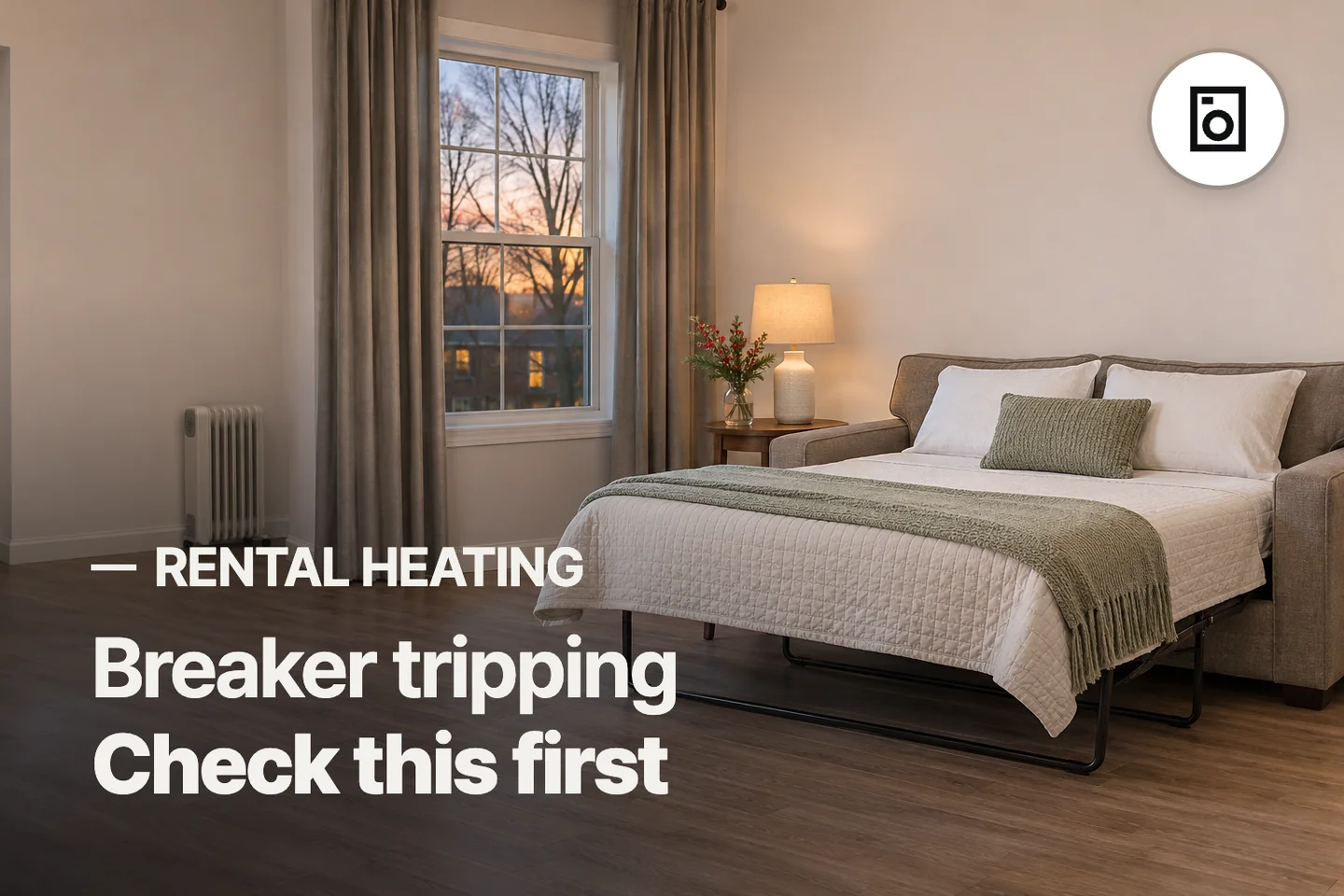
The sofa bed is about to become your guests' bedroom, and the cold corner of your rental living room still needs heat. But every time you switch the electric heater on, the power cuts out. Leave that setup off until management has the cause checked; another reset isn't a guest-room fix.
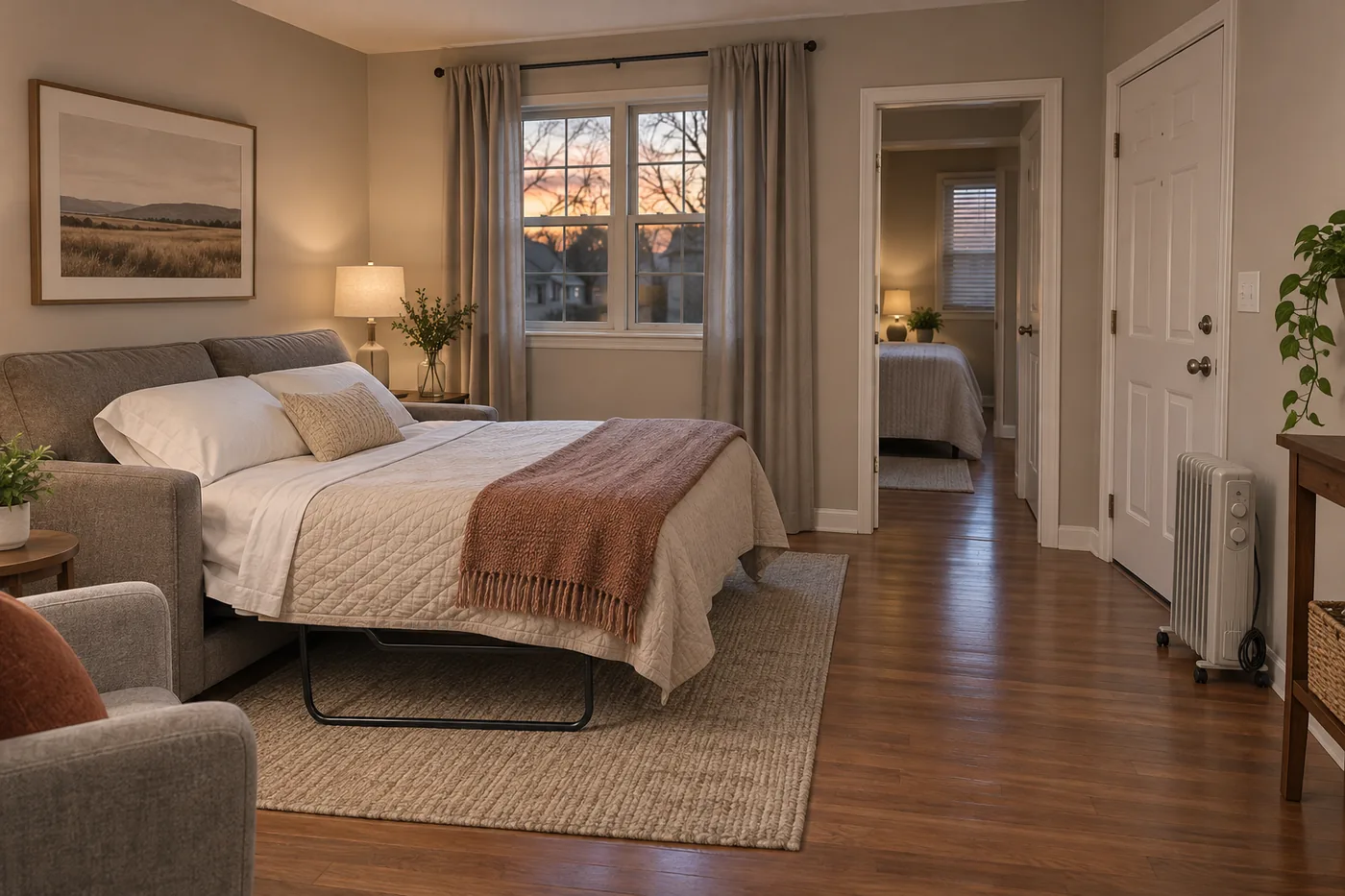 Unfolding the guest bed changes how much clear floor space you actually have.
You don't need a replacement heater to start sorting this out. The Vornado AVH10 appears below only as a documented example of different power settings, not a purchase recommendation or a cure for faulty wiring. Your next move is to identify what stopped working, then send management something more useful than “the heater did it again.”
How we chose
Reviewed Vornado's current US FAQ and AVH10 specifications alongside CPSC and ESFI guidance preserved from the original source check. The sequence prioritizes circuit suitability, documented power settings, and clearance around bedding; the AVH10 illustrates wattage rather than serving as a shopping pick.
Part 1Stop and name the failure
Start with the symptom: did other equipment lose power, or did only the heater stop? Vornado says blocked airflow can activate its heater's automatic safety shutoff. That means a heater going quiet while the room's lights stay on isn't, by itself, proof that a building breaker tripped.
If you see smoke or sparks, or smell burning, stop the investigation and follow your building's emergency procedures. Otherwise, switch the heater off and keep it out of service while the problem is unresolved. Don't reproduce the failure just to confirm it; write down what already happened.
For the maintenance request, note the heater model, selected heat setting, outlet location, and other appliances operating at the time. Then describe whether the lights or neighboring equipment also stopped. Skipping those details makes it harder to separate a shared-load problem from an appliance problem.
Part 2Check the circuit, not the next socket
Ask management or a qualified electrician to establish which circuit serves that outlet, what else it supplies, and whether the outlet and circuit are suitable for the heater. Another socket may share the same circuit, so moving across the room can leave the underlying problem untouched. Leave panel covers, breaker replacement, and wiring work to qualified maintenance.
Vornado calls for a properly functioning wall outlet with a secure plug fit. So a plug that sits loosely isn't something to prop up with furniture or an adapter. Keep the heater off and have the connection checked rather than trying another position until it stays on.
CPSC's portable-heater guidance says to connect directly to a wall outlet, without an extension cord or power strip. Vornado also rules out multi-outlet adapters, timers, and smart plugs for its heaters. That means an accessory isn't a workaround when the built-in cord won't reach a suitable spot.
An outlet move only helps after someone establishes where that outlet's circuit goes.
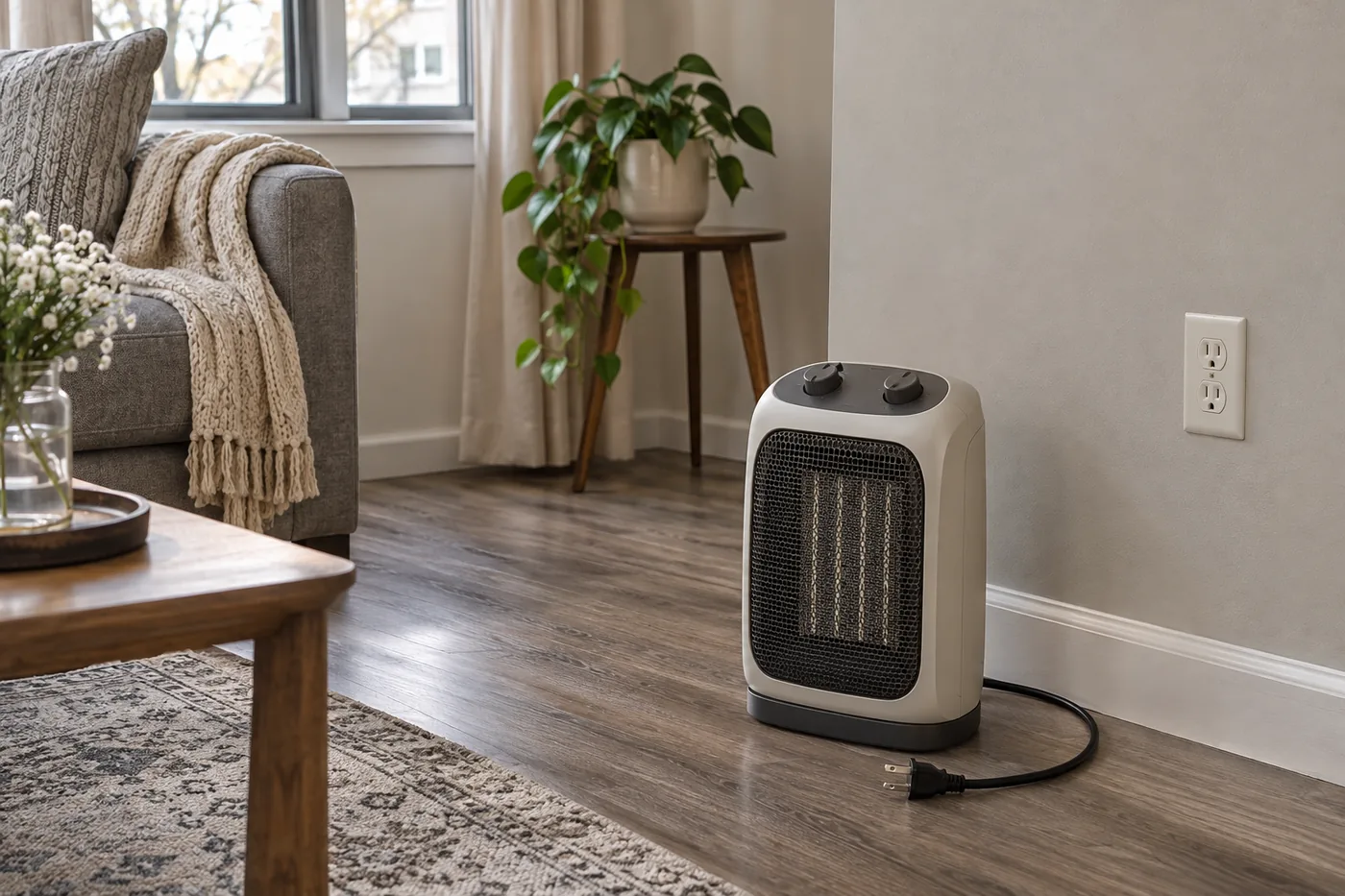 A direct wall connection still needs a suitable circuit and a secure plug fit.
Part 3Read watts before changing the thermostat
Once management has resolved the electrical issue, compare your own heater's documented power settings before using it again. A lower room-temperature target isn't necessarily a lower maximum electrical load. So turning the thermostat down is not interchangeable with selecting a genuinely lower-wattage heat mode.
Vornado's US FAQ gives the AVH10 a Low setting of 750 W and a High setting of 1,500 W. The same FAQ lists corresponding heater current figures of 6.25 and 12.5 amps. Those numbers explain why the mode matters, but they don't certify your rental's circuit.
Swipe sideways to see the full table →
| AVH10 mode | Published input | Corresponding current in Vornado's FAQ | What to take from it |
|---|---|---|---|
| Low | 750 W | 6.25 amps | Lower demand, not permission to ignore a trip |
| High | 1,500 W | 12.5 amps | More demand while other connected loads still count |
Use those figures as a reading example, not as settings to copy onto an unrelated heater. If your model's label or instructions don't explain its modes, ask the manufacturer before assuming “Low” matches the AVH10. Otherwise, you could plan around a power reduction your appliance doesn't actually offer.
Searching for an “energy efficient heater” won't tell you why the breaker operated. Neither will choosing a ceramic heater instead of a fan heater: a ceramic element can be paired with a fan, so those names aren't opposing electrical categories. Compare the exact model's input rather than treating its category as a load limit.
For a running-cost estimate, multiply input in kilowatts by operating hours and your utility's applicable rate. But thermostat cycling changes actual consumption, so that estimate isn't a guaranteed bill. There is no reason to buy a different heater before you've established a usable electrical supply.
Part 4Measure with the bedding spread out
CPSC says portable heaters need at least three feet of clearance from combustible materials, including bedding, curtains, and furniture. Follow any greater distance in the model's instructions. So measure after the sofa bed is open and the blankets are spread out, not while everything is folded neatly on the couch.
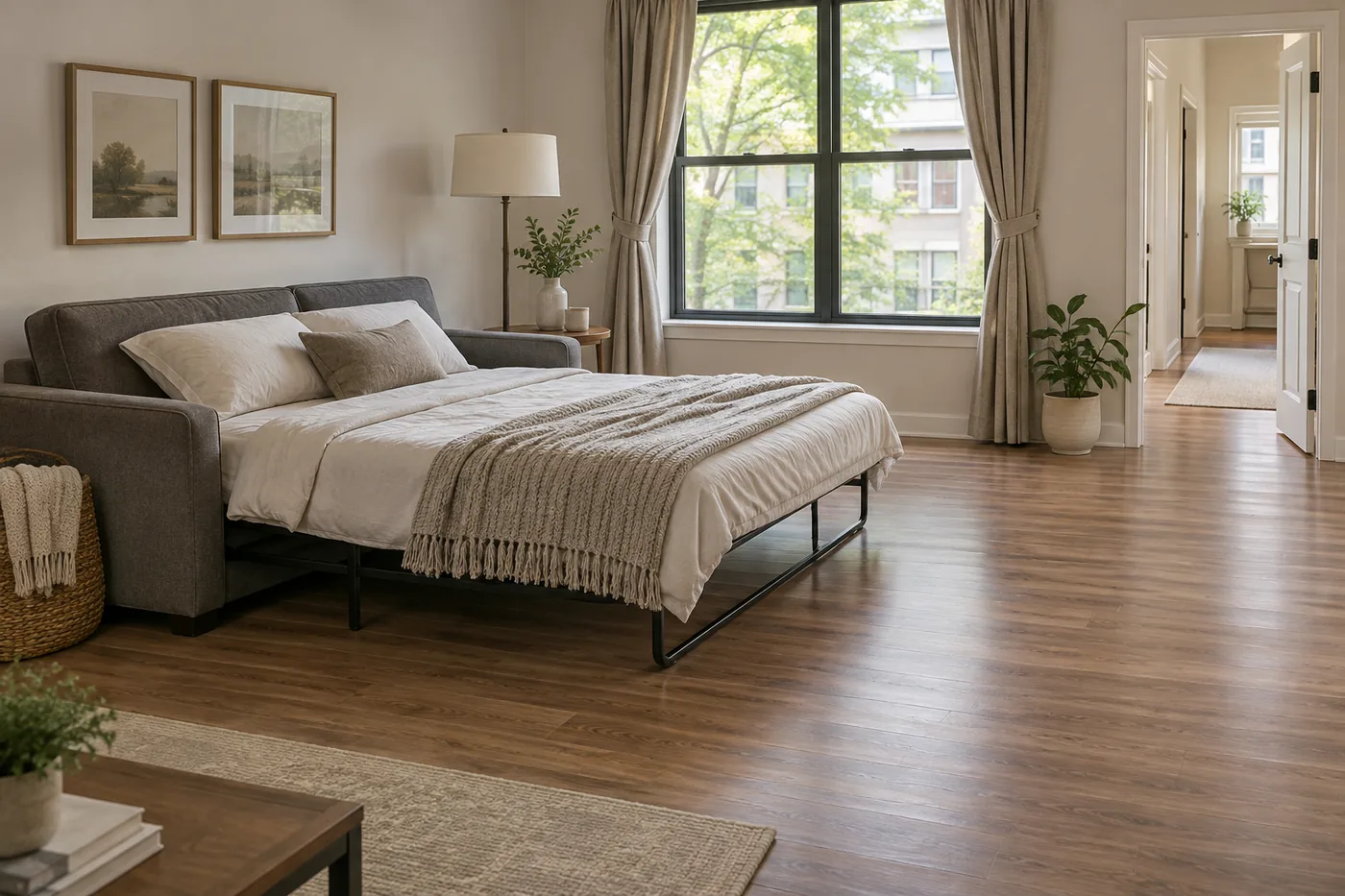 Check the sleeping layout, not just the tidy daytime arrangement.
That change matters at the window, where a curtain or blanket may occupy the very space you wanted to warm. If the required clearance disappears when guests settle in, the location doesn't work. A tip-over switch doesn't create extra room around the heater.
ESFI's guidance calls for a flat, level location away from traffic and warns against placing heaters on furniture or carpet. Vornado also requires unobstructed airflow. So don't solve a cramped floor plan by putting the heater on a stool, squeezing it behind the sofa, or letting bedding hang over its air path.
If there's no position that meets the instructions and reaches a suitable outlet, ask management to address the installed heat or cold window. An unusable floor plan is a reason to change the heating arrangement, not a reason to stretch a cord across the room. Check lease permissions before attaching draft-control materials to rental finishes.
Part 5Shut down before guests sleep
CPSC says not to leave portable heaters operating while you're asleep, and Vornado specifies attended, short-term operation. So make shutdown part of converting the living room into a bedroom. A thermostat doesn't replace an awake person checking the heater and its surroundings.
ESFI advises switching off before sleeping and unplugging when the heater isn't in use. Once it's no longer needed, follow the model's instructions for cooling and storage, keeping the exit route clear. If guests need portable heat throughout the night, the room still needs a heating solution from management rather than a promise to keep resetting the breaker.
Sources and scope: This sequence uses CPSC and ESFI safety guidance retained from the original article's November 10, 2026 source check, plus Vornado's US FAQ and AVH10 specifications rechecked November 24, 2026. The CPSC and ESFI pages were blocked during this update. Circuit suitability, documented wattage, and bedding clearance shaped the advice; no product purchase is required and no purchase links are included.
In one sentence
Keep the heater off until the electrical problem is resolved, then check its power settings and the unfolded guest-bed layout.
Frequently asked questions
Will an energy efficient heater stop breaker trips?
An efficiency claim doesn't establish circuit suitability. Keep a repeatedly tripping setup off and ask management or a qualified electrician to check the circuit, other connected loads, and outlet before considering another heater.
Does lowering the thermostat reduce the heater's maximum wattage?
Not necessarily. Check the model's documented heat modes separately from its target temperature. Vornado lists the AVH10 at 750 W on Low and 1,500 W on High; those settings don't establish that your circuit is suitable.
Is a ceramic heater electrically different from a fan heater?
The terms can overlap because a ceramic heating element can use a fan. Compare the particular model's published power input and instructions rather than assuming either label guarantees lower demand.
Can a portable heater run beside the sofa bed while guests sleep?
CPSC says not to operate portable heaters while sleeping. During attended use, its guidance calls for at least three feet from bedding, furniture, and curtains, with any greater model-specific clearance also followed.
Can I connect a Vornado heater to a smart plug or extension cord?
No. Vornado prohibits extension cords, surge protectors, multi-outlet adapters, timers, and smart plugs for its heaters. Its FAQ calls for a direct connection to a properly functioning wall outlet with a secure plug fit.
Sources
- CPSC winter heating precautions · 2026-11-10
At least three feet from bedding, curtains, and furniture; direct wall connection without extension cords or power strips; no operation while sleeping. Guidance retained from the original article's November 10, 2026 check because the November 24, 2026 access attempt returned Access Denied.
- ESFI space heater safety tips · 2026-11-10
Three-foot combustible clearance; flat, level placement away from traffic, not on furniture or carpet; switch off before sleeping and unplug when unused. Guidance retained from the original article's November 10, 2026 check because the November 24, 2026 access attempt was blocked.
- Vornado US heater FAQs · 2026-11-24
AVH10 Low 750 W and High 1,500 W; corresponding published heater current figures 6.25 and 12.5 amps. Also confirms airflow shutoff, secure direct wall connection, attended use, and prohibited cords, adapters, timers, and smart plugs.
- Vornado AVH10 · 2026-11-24
Specification table confirms 1,500/750 W at 120 V and two heat settings plus fan-only operation. Used to verify the wattage example, not as a required purchase.