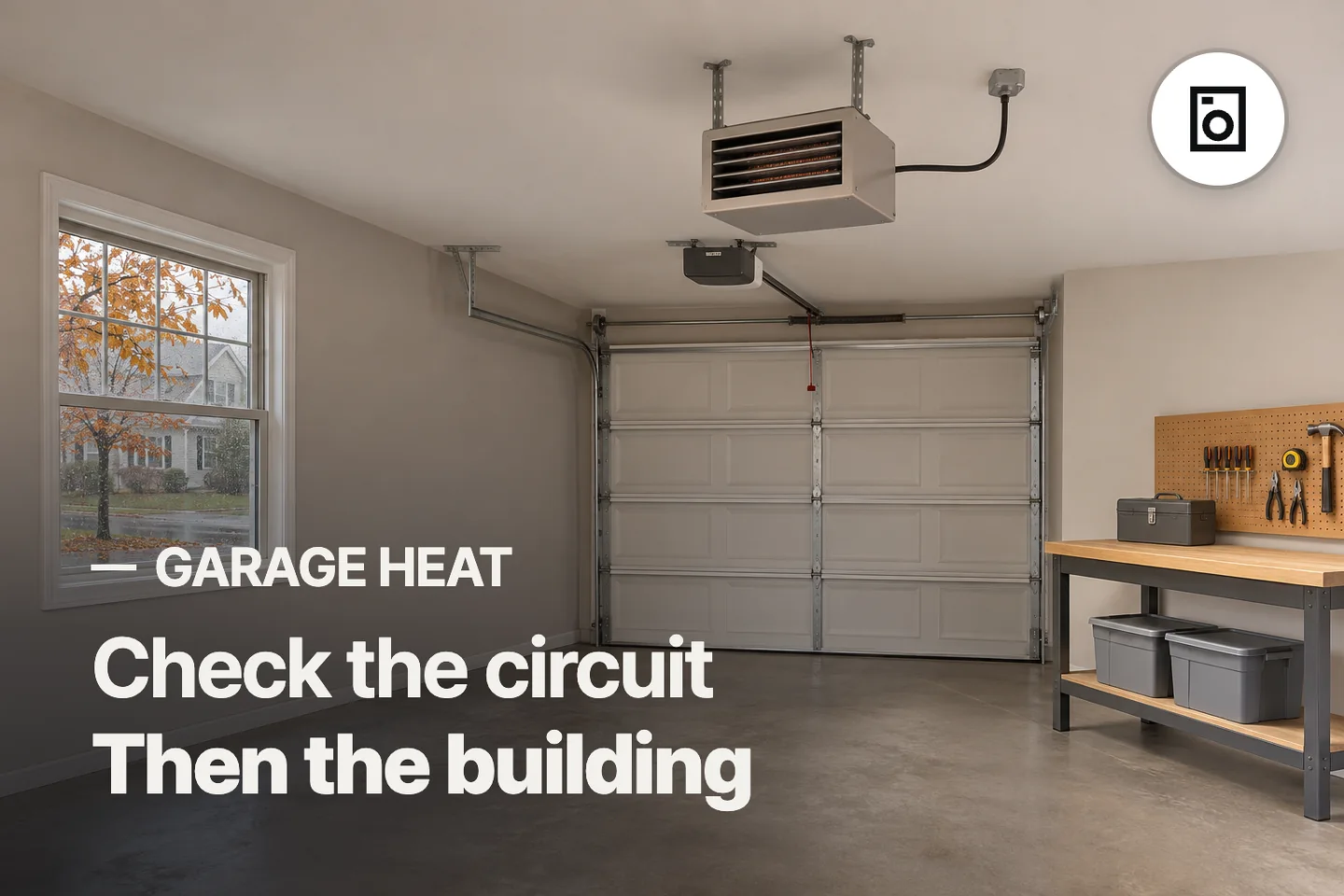
36 inches of clear space in front of a heater can disappear behind a garage shelf. That's the discharge clearance in Marley's FUH54C manual, and it matters to the homeowner turning an attached garage into a winter workshop before ordering an electric garage heater.
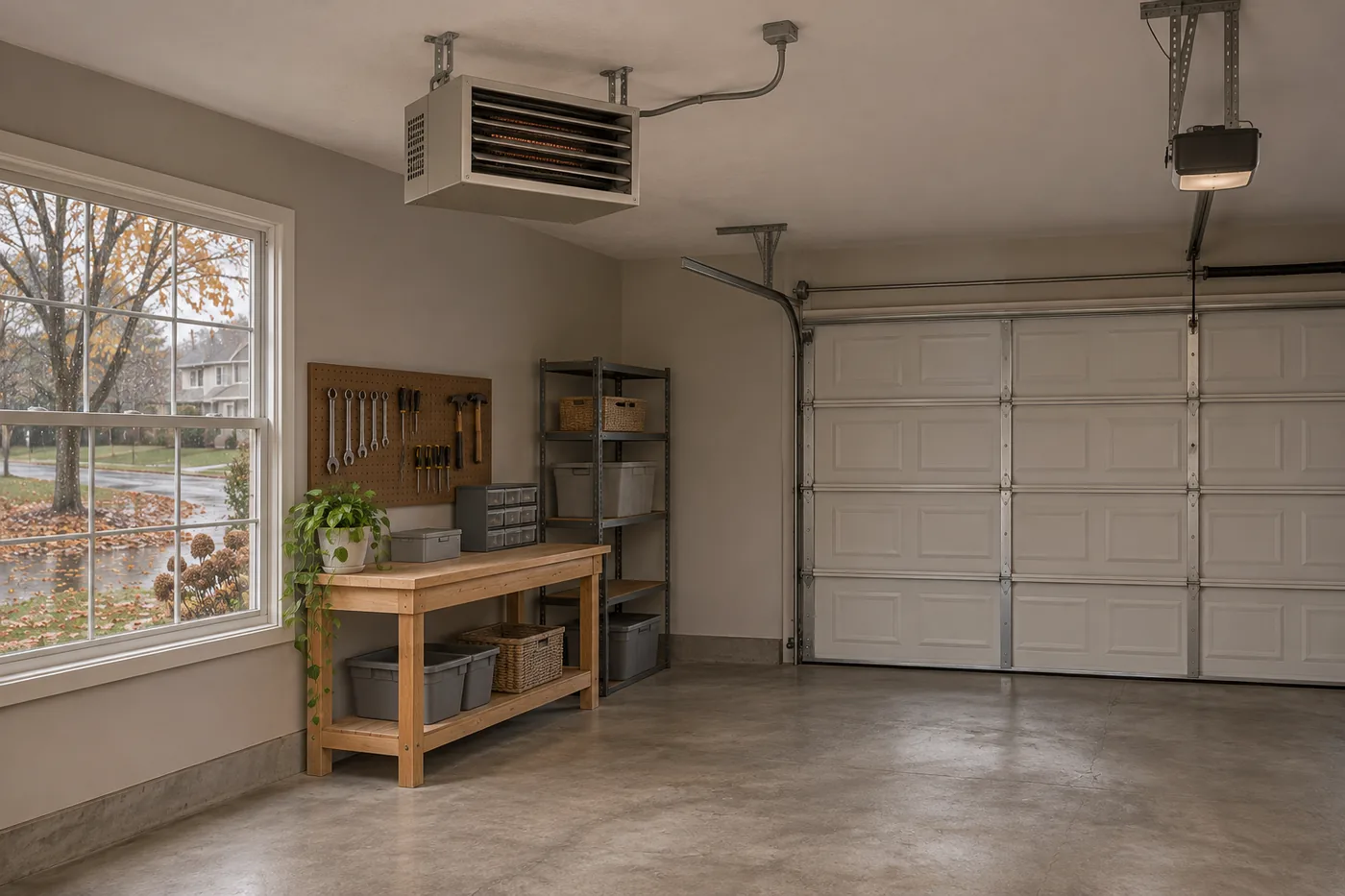 The workbench is only part of the plan; the door tracks and overhead storage need room too.
I'd choose the Fahrenheat FUH54C for an enclosed, insulated workshop only after its storage, electrical supply, and mounting position pass an installer's review. But a garage that still holds gasoline cans, paint, or an unresolved parking arrangement isn't ready for this purchase.
How we chose
Marley's current product page and EPA guidance were checked alongside previously verified FUH54C manual specifications. The three checks were permitted storage and activities, electrical installation requirements, and ceiling clearances; site-specific heating performance remains for the installer to assess.
Toneandroom picks
Best electric garage heater for an assessed workshop: Top 1
An enclosed, insulated workshop with approved activities, suitable power, and installer-confirmed sizing
Fahrenheat FUH54C
US manufacturer price: Not listed by the maker. Checked November 24, 2026; installation requires a site-specific quote.
Published output, an included ceiling bracket, and adjustable airflow suit an assessed workshop without taking up floor space. Storage restrictions and electrical work must be resolved first; manual ratings retain their November 9, 2026 verification.
- Supply
- 240V
- Output
- 5,000W
- Heat
- 17,065 BTU/hr
- Current
- 20.9A
- You need clear floor space
- Your workshop is enclosed
- Hardwired work needs a quote
- Fuel storage can rule it out
What we considered
Room use
Can the planned storage and work meet Marley's restrictions?
Marley's manual prohibits use where gasoline, paint, or flammable liquids are used or stored. I kept this recommendation conditional because a combined storage-and-work garage may fail that requirement before capacity matters.
Electrical work
Has an electrician priced the complete installation?
The FUH54C is hardwired and its full rated output requires the specified supply. I treated the circuit, conductors, and installation work as part of the purchase rather than assuming an existing outlet would do.
Ceiling space
Can the bracket and airflow fit around the door and storage?
Marley gives different mounting heights and wall clearances for different airflow orientations. I favored a workshop with usable overhead space, subject to structural support and an installer checking the complete door path.
Part 1First, check what stays in the garage
Marley Engineered Products lists garages and workshops as applications for the FUH series. But its manual also says not to use this heater where gasoline, paint, or flammable liquids are used or stored. That restriction matters more than the word “garage” on the product page.
Can the room actually stop being the place where those things live? If not, this model doesn't fit the planned use, however tidy the workbench looks. Moving a fuel can away from the heater doesn't settle a warning about the space itself.
A parked vehicle needs its own discussion with Marley and the installer. So don't treat the application list as blanket permission to heat any attached parking garage; describe the vehicles, stored supplies, and activities before anyone quotes the job.
Marley also warns against allowing sawdust or drywall sanding dust into the heater, and against using it to dry paint or plaster. That makes a dusty sanding corner or painting bay a poor match, not merely a spot that needs more frequent tidying.
Clear the intended use with the installer before clearing a place on the ceiling.
Part 2Then price the wiring, not just the box
The Fahrenheat FUH54C supplies 5,000W at 240V, according to Marley's manual, with an output of 17,065 BTU/hr. That gives a properly assessed workshop a fixed source of heat without a portable heater sitting beside the bench. But the useful purchase price includes getting that power to the ceiling.
This is a hardwired installation, so an existing wall outlet isn't the starting point. Under Marley's installation instructions, the electrician needs to assess the panel, branch circuit, grounding, wiring route, and applicable requirements before the heater is ordered.
The manual's full-output table lists 20.9 heater amps and a 30A maximum fuse at 240V. But that maximum isn't a universal instruction to install a particular breaker: the electrician must reconcile the nameplate, manual, conductor installation, and local code.
Swipe sideways to see the full table →
| Published detail | What it changes in the garage |
|---|---|
| 5,000W at 240V | Full rated output depends on the verified supply |
| 3,750W at 208V | A different supply delivers less heat |
| Minimum 10-gauge copper for the 5kW model, rated at least 75°C | Wiring is part of the installation quote; Marley prohibits aluminum wire |
Marley's current product page publishes no purchase price. So ask for the heater, wiring, mounting, electrical work, and required approvals in the quote rather than comparing box prices alone; the unknown cable route can change the purchase considerably.
Part 3Give the bracket real space
The included ceiling bracket and adjustable louvers are the FUH54C's practical attraction. They let an installer direct airflow while keeping the floor free, but ceiling mounting doesn't erase clearance requirements. Shelves above the bench can be just as troublesome as clutter below it.
For horizontal airflow, Marley's manual places the heater bottom 6–8 ft above the floor; for vertical airflow, it gives 6–11 ft. So the installer must choose the orientation and check the corresponding clearances, not copy the position of a heater in a sales photograph.
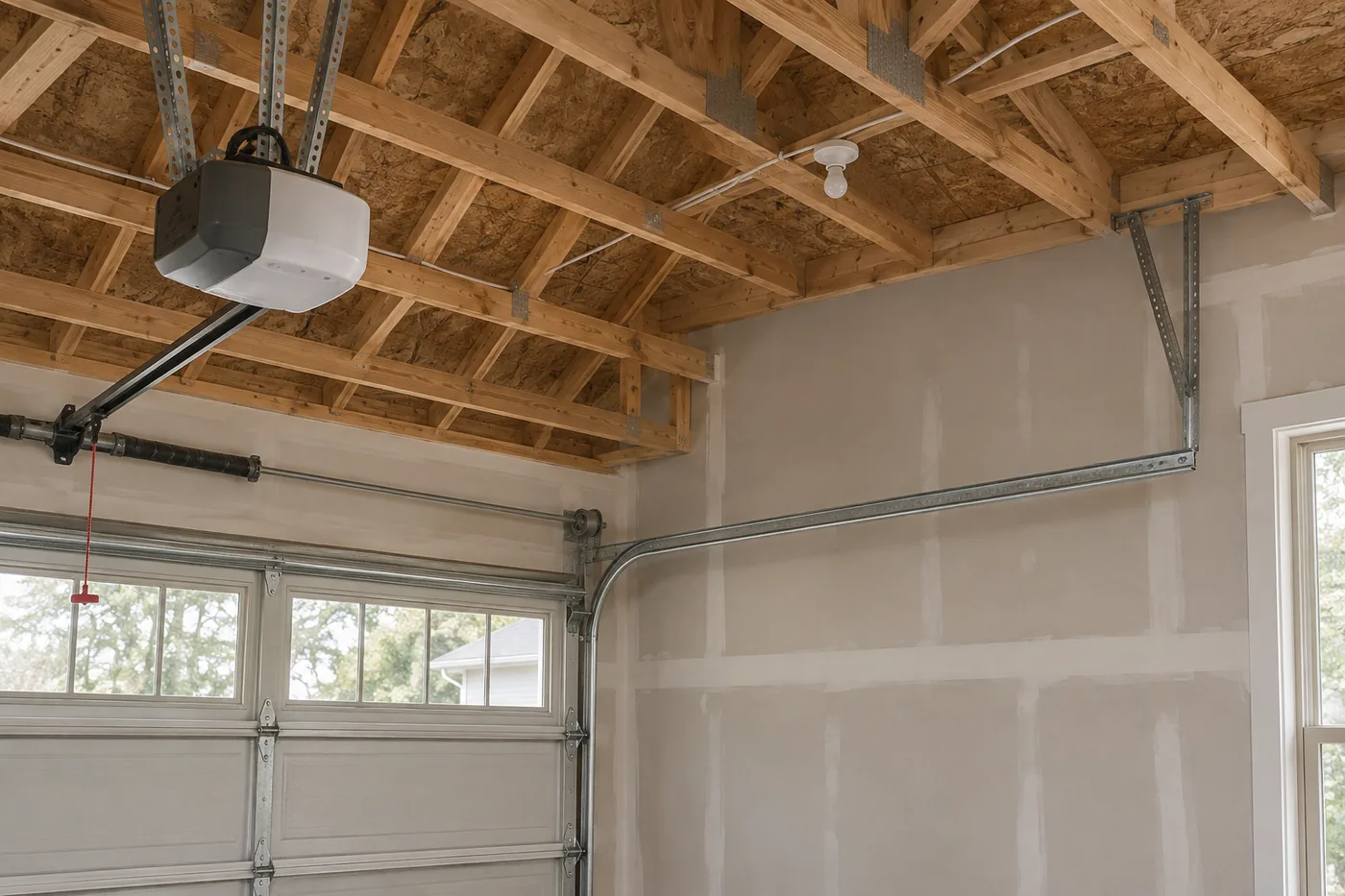 Door travel, structural support, and nearby shelving all belong in the mounting survey.
The manual gives side-to-wall clearances of 13 in or 48 in depending on airflow angle. That difference can move the proposed bracket out of a convenient corner, while the required discharge clearance still has to remain unobstructed. Marley also requires adequate structural support for the bracket.
Fahrenheat describes delayed fan startup and a cool-down run after the thermostat is satisfied. Those features govern when air moves; they don't establish how quickly the garage warms. The published thermostat range of 45–135°F is a control range, not a promise that the building can reach its upper setting.
Part 4Check the shell before buying heat
An insulated workshop with the overhead door mostly closed is the stronger fit. But an uninsulated roof, exposed walls, and regular door openings change what the heater must replace, so floor area alone won't settle the sizing. The opened manufacturer material doesn't establish a warm-up time or a room-temperature guarantee for your garage.
Ask the installer to assess heat loss against the temperature you want and your local winter conditions. That assessment needs to include how often the door opens, because a garage used for repeated parking trips is a different heating job from an enclosed bench space.
A renter also needs the owner's approval before committing to the hardwired installation and ceiling attachment. So the FUH54C makes more sense when the room can remain a suitable workshop, not when the installation has to work around uses that cannot change.
For the attached-garage part of the question, EPA says not to idle a car inside the garage and identifies attached-garage vehicle exhaust as a carbon-monoxide source. That warning still matters when the workshop heater is electric; changing the heater doesn't change the car's exhaust.
Marley notes that the fan may cycle below 50°F during warm-up. But repeated thermal-limit operation or a red overheating alarm is a separate matter requiring investigation under its instructions, not a reason to assume the room is simply cold.
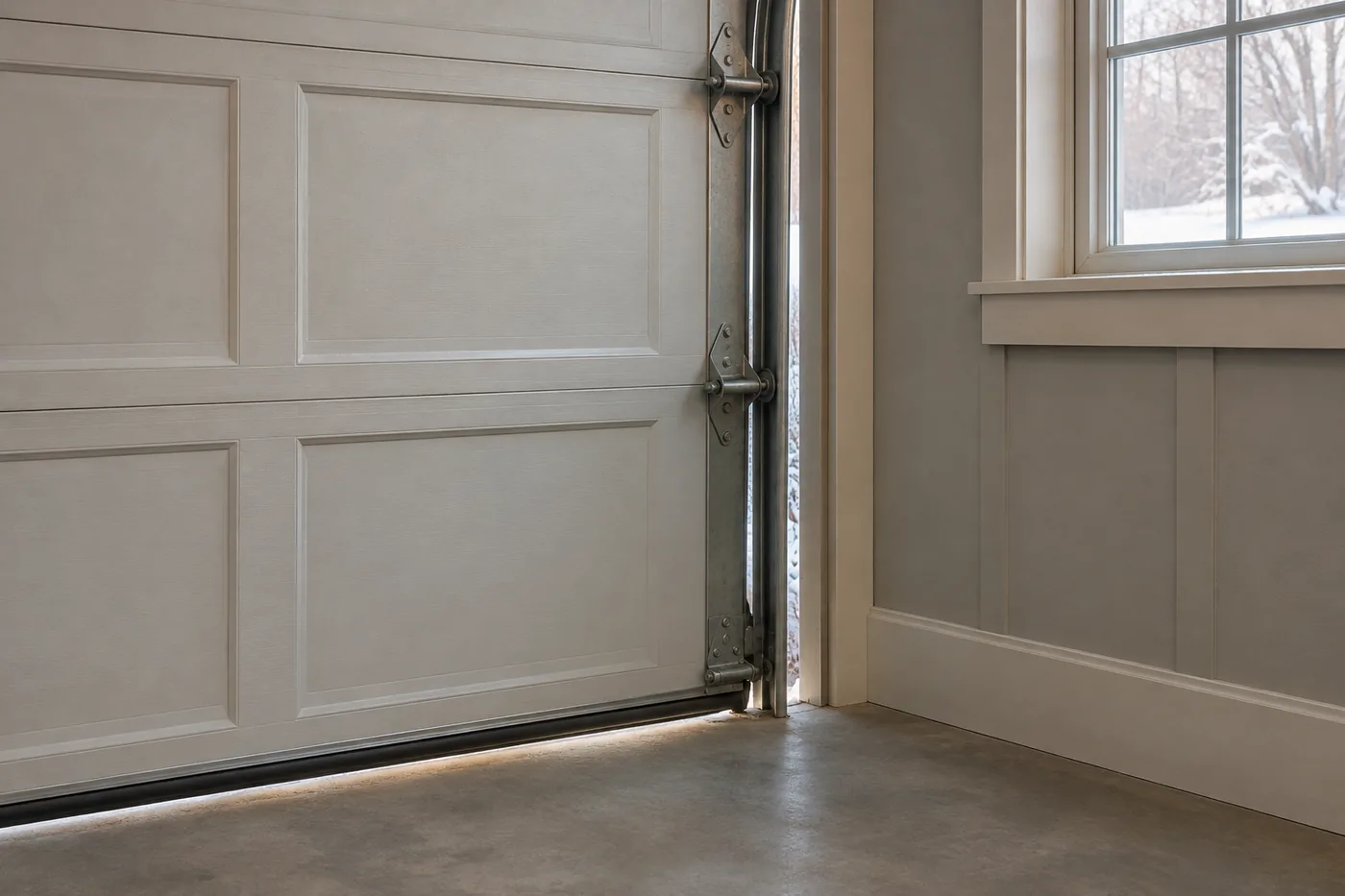 The door and surrounding building shell help determine whether the available heat is enough.
Sources and selection: Marley's product page and EPA guidance were checked November 24, 2026. Manual specifications retain the November 9, 2026 verification from the earlier article. Storage restrictions, electrical requirements, and mounting space guided the choice. Manufacturer price: Not listed by the maker, checked November 24, 2026. Obtain a site-specific installation quote.
The bracket is included; a suitable garage is not.
In one sentence
The FUH54C fits an assessed workshop, not every room with a garage door.
Fahrenheat FUH54C
Frequently asked questions
Will the FUH54C heat an uninsulated garage?
The manufacturer material reviewed does not establish a temperature or warm-up guarantee for a particular uninsulated garage. Have an installer assess heat loss, local winter conditions, the intended room temperature, and door use before selecting capacity.
What circuit does this electric garage heater need?
Marley's manual lists 20.9 heater amps and a 30A maximum fuse at 240V and 5,000W, with minimum 10-gauge copper conductors rated at least 75°C. These are published requirements, not a universal breaker prescription; an electrician must determine the compliant installation for the site. Manual figures retain their November 9, 2026 verification.
Can the FUH54C share a garage with gasoline cans or paint?
Marley's manual says not to use it where gasoline, paint, or flammable liquids are used or stored. Do not assume relocating a can within the same garage satisfies that restriction; confirm the entire intended use with Marley and the installer.
Does the thermostat's 135°F setting mean the garage can reach that temperature?
No. Fahrenheat lists a 45–135°F thermostat adjustment range, but that is not a guaranteed achievable room temperature. Available output and the building's heat loss determine whether the desired workshop temperature is realistic.
Sources
- Fahrenheat FUH54C · 2026-11-24
Thermostat adjustment range 45–135°F; included ceiling bracket, adjustable louvers, delayed fan startup, and fan cool-down. No listed purchase price.
- Marley FUH54C installation manual · 2026-11-09
PDF retrieved again November 24 but text could not be independently extracted; figures retain the original article's November 9 verification: 5,000W, 17,065 BTU/hr, 20.9A, 30A maximum fuse at 240V; 3,750W at 208V; minimum 10-gauge copper rated at least 75°C. Mounting heights 6–8 ft horizontal and 6–11 ft vertical; discharge clearance 36 in; side clearances 13 or 48 in by orientation; fan cycling below 50°F. Also supplies flammable-liquid, dust, structural-support, and overheating warnings.
- EPA carbon monoxide and indoor air quality · 2026-11-24
Identifies automobile exhaust from attached garages as a carbon-monoxide source and says not to idle cars in garages. No numerical heater rating or sizing figure taken from this page.