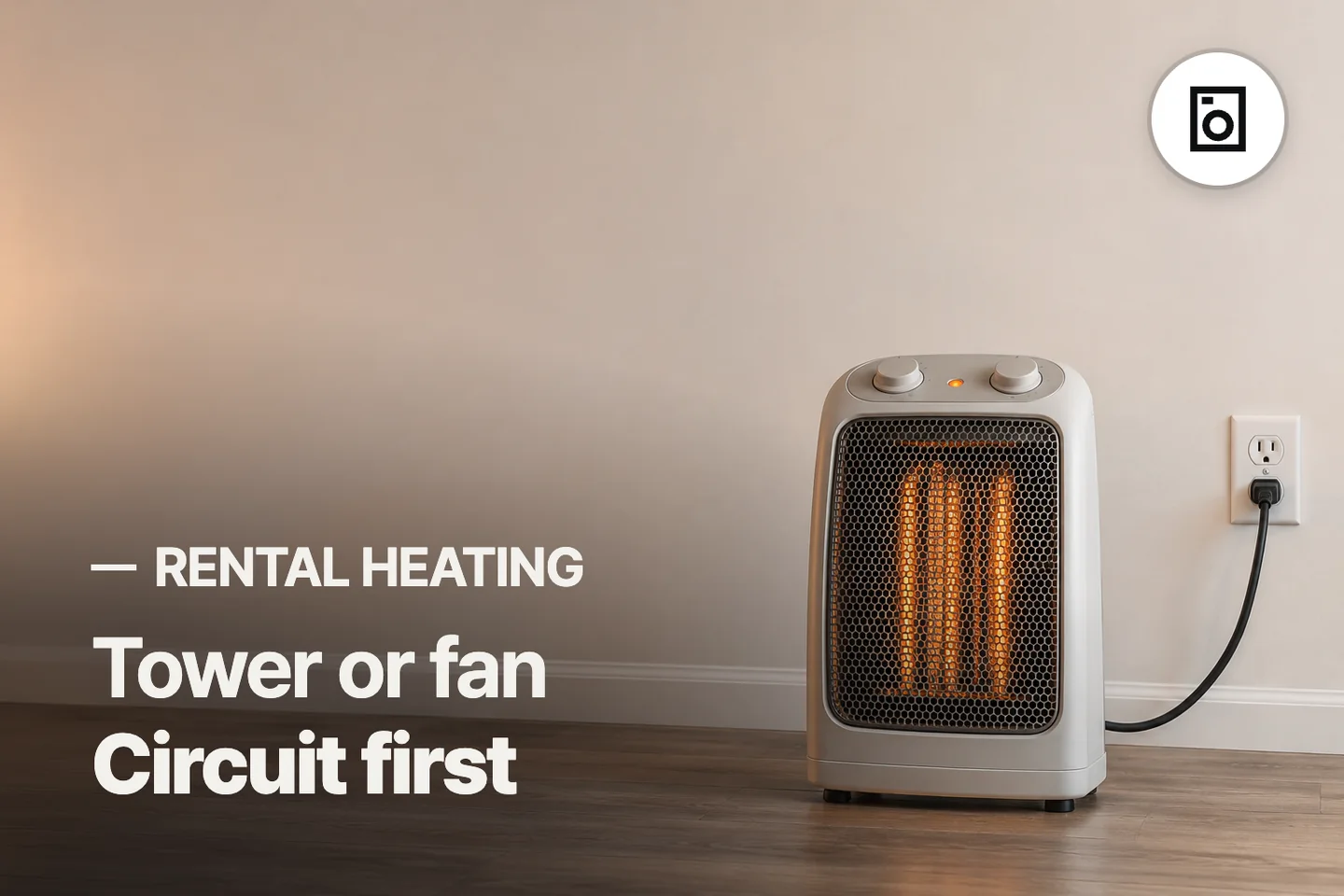
The folding drying rack has claimed the warm corner of your studio, leaving the reading chair beside a chilly window. Now you’re rearranging laundry to make room for a heater, which is a fairly convincing sign that floor space belongs in this decision.
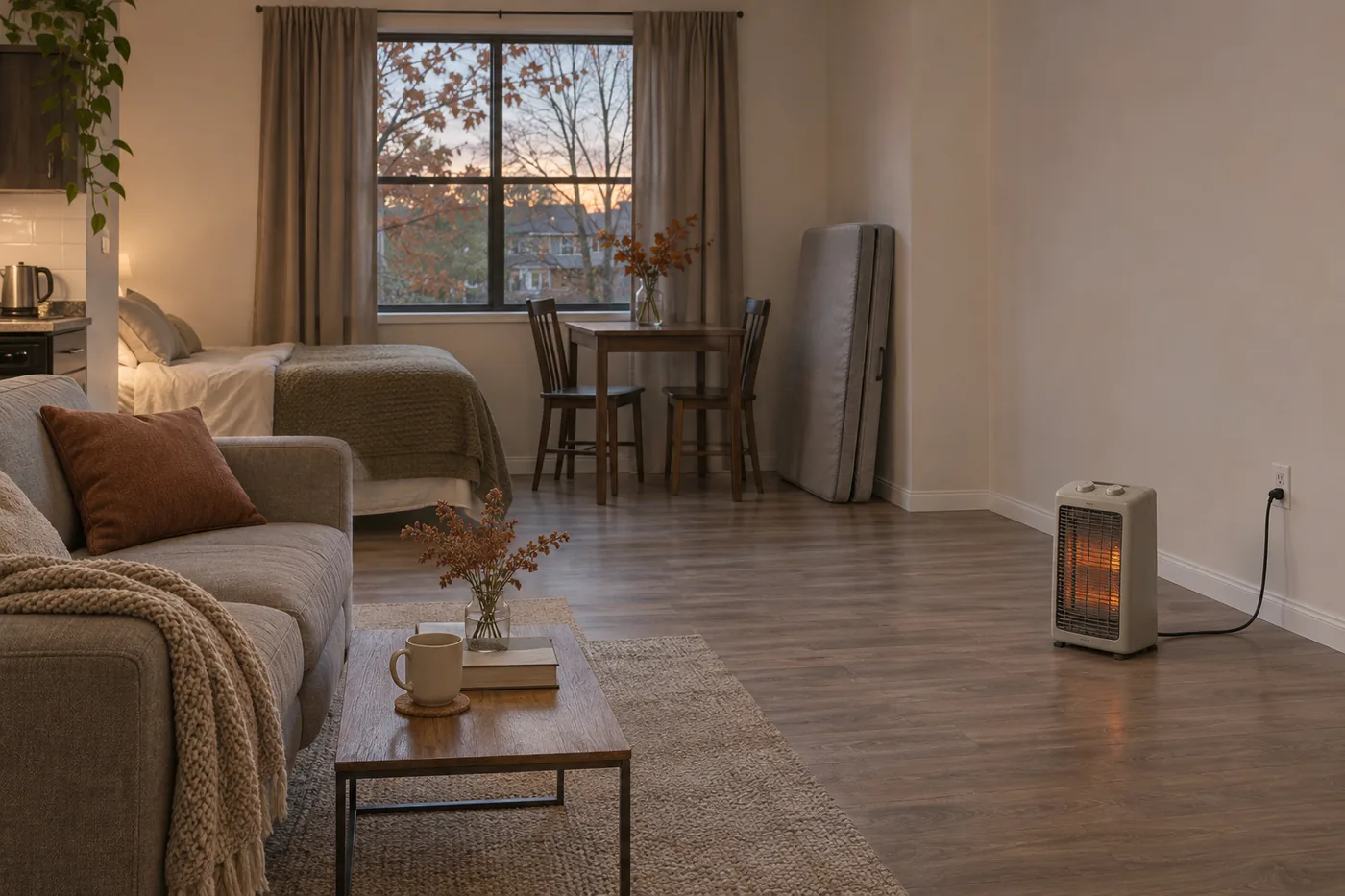 The chair needs warmth; the laundry needs somewhere else to stand.
I’d choose the Honeywell HCE317B Slim Ceramic Tower Whole Room Heater for shifting between the chair and sofa, but only after management confirms a suitable electrical setup. The Honeywell HHF250 Two Position Heater and Fan makes more sense for a fixed sitting spot if you already own one; its store listing now says discontinued. That changes the shopping conversation considerably.
How we chose
Compared Honeywell model manuals, current Honeywell Store listings, and EIA electricity prices using circuit demand, required placement, and useful controls as the three criteria. HHF250 manual details retain their earlier check date; no room-heating or noise measurements are claimed.
Toneandroom picks
Best space heater for rental seating areas: Top 2
Changing seats during an awake evening, after electrical and placement checks
See all specsHoneywell HCE317B Slim Ceramic Tower Whole Room Heater
Honeywell Store: $74.95 before tax and shipping, checked November 24, 2026; in stock. Price varies; check Amazon.
My choice when oscillation and digital controls match the seating pattern, provided Honeywell’s installation requirements are met.
- Low heat
- 750 W
- High heat
- 1,500 W
- High draw
- 12.5 A
- Controls
- Digital; oscillation
- You move between seats
- You want digital controls
- Confirm the circuit first
- Keep required clearance
Existing owners wanting localized supplemental warmth at a fixed seat
See all specsHoneywell HHF250 Two Position Heater and Fan
Honeywell Store: discontinued; no current purchase price shown, checked November 24, 2026. Price varies; check Amazon.
A comparison option for existing owners who stay in one seating area; lower rated input is not clearance to use an unknown shared circuit. Low-setting manual data was last checked November 6, 2026.
- Low heat
- 550 W
- High heat
- 1,100 W
- Controls
- Mechanical thermostat
- Position
- Upright or sideways
- You stay in one seat
- You prefer simple knobs
- Store lists it discontinued
- Lower draw is not approval
Compare 2 products at a glance
Controls, heat input, and availability
| Compare | Top pickHoneywell HCE317B Slim Ceramic Tower Whole Room HeaterHoneywell Store: $74.95 before tax and shipping, checked November 24, 2026; in stock. Price varies; check Amazon. | Honeywell HHF250 Two Position Heater and FanHoneywell Store: discontinued; no current purchase price shown, checked November 24, 2026. Price varies; check Amazon. |
|---|---|---|
| Low / high input | 750 W / 1,500 W | 550 W / 1,100 W |
| Controls | Digital thermostat; oscillation | Mechanical thermostat; upright or sideways |
| Store status, November 24, 2026 | $74.95 before tax and shipping; in stock | Discontinued; no current purchase price shown |
| Comparable sound measurement | Not listed by the maker | Not listed by the maker |
Swipe sideways to see the full table →
What we considered
Circuit demand
Has management established a suitable electrical setup?
Honeywell warns against connecting the tower to a circuit with other appliances operating. Lower compact-model wattage is not a substitute for identifying the circuit and checking the outlet.
Open floor
Will the required space remain clear during use?
Honeywell specifies open, stable placement and clearance from walls and combustibles. A heater that fits an empty corner still fails this check if curtains or guest bedding enter that space.
Seating pattern
Do you move between seats or stay in one spot?
The tower adds oscillation and a digital thermostat for changing seating positions. The compact model offers directional warmth and simple knobs, but its discontinued status limits its usefulness as a new purchase.
Part 1Start with the outlet, not the empty corner
Honeywell’s tower manual lists 12.5 amps on high and warns against using a circuit with other appliances operating on it. So the apparent vacancy beside the chair tells you nothing about whether that outlet shares its circuit with the kitchen. Ask management to identify the circuit and have the load and outlet assessed, rather than assuming an outlet across the room solves it.
Honeywell’s placement instructions require a firm, level, open surface and at least 3 feet from walls or combustible materials. That means a substantial empty buffer, not the little slot between a curtain and an armchair. Can that space stay clear when the drying rack comes back out?
Honeywell also requires a direct wall connection, forbids extension cords and power strips, and warns against unattended operation. So a longer cable is not the fix for an awkward outlet, and a thermostat does not make this an overnight heating plan. If the apartment cannot meet the instructions, neither heater belongs in that spot.
Part 2Ceramic and fan are not opposite teams
Honeywell describes the HCE317B’s fan moving air through a ceramic heating element. So ceramic does not mean fan-free; the meaningful comparison is an oscillating tower against a compact directional heater. Neither label tells you how quiet your next video call will be.
The Honeywell HCE317B Slim Ceramic Tower Whole Room Heater offers a digital thermostat and oscillation. That combination is useful when you move between seats during an awake evening, because the airflow can sweep rather than remain aimed at the same chair. Its published settings are 750 W low and 1,500 W high: low uses half the rated power, with less heat input to match.
The Honeywell HHF250 Two Position Heater and Fan uses a mechanical thermostat and can stand upright or lie sideways. That suits a settled reading spot more than a request to warm every corner of the studio. Its manual’s settings are 550 W low and 1,100 W high, again half the rated input on low; those manual figures retain their original November 6, 2026 check date, while the current store page confirms the high setting.
Swipe sideways to see the full table →
| Compare | Honeywell HCE317B Slim Ceramic Tower Whole Room Heater | Honeywell HHF250 Two Position Heater and Fan |
|---|---|---|
| Heat input | 750 W / 1,500 W; low halves rated input | 550 W / 1,100 W; low halves rated input |
| Controls | Digital thermostat; oscillation | Mechanical thermostat; upright or sideways |
| Numerical room coverage | Not listed by the maker | Not listed by the maker |
| Comparable sound measurement | Not listed by the maker | Not listed by the maker |
| Honeywell Store, November 24, 2026 | $74.95 before tax and shipping; in stock | Discontinued; no current purchase price shown |
Part 3What an evening of heat actually costs
Honeywell’s operating-cost method is straightforward: kilowatts × running hours × your electricity rate. So the useful question is how long the heating element runs, not whether the packaging says ceramic. Thermostat cycling changes that on-time, and a drafty chair may need a different setting from an interior sofa.
For an illustration, the EIA table opened on November 24, 2026 shows a preliminary August 2026 US residential average of 18.16 cents per kWh. That is roughly eighteen cents per billed energy unit, not a quote from your utility. Replace it with your own applicable rate before treating these examples as a household budget.
Take four continuous hours, an evening of reading and dinner rather than an overnight run. The tower on high works out as 1.5 × 4 × $0.1816 = about $1.09, while the compact model gives 1.1 × 4 × $0.1816 = about $0.80. So this example is roughly a dollar versus less than a dollar for the evening, not a demonstration of equal warmth for less money.
At low, the same calculation gives about $0.54 for the tower and $0.40 for the compact model, roughly half a dollar or less for that evening. But their heat inputs differ, so the lower bill does not establish which heater gets your chair comfortable more cheaply. These are calculated continuous-operation examples, not measured bills.
Lower input reduces electricity use for equal running time; it does not promise equal comfort.
 Your bill’s electricity rate belongs in the calculation; the national average is only an illustration.
Part 4Pay for controls, not a whole-room promise
The HCE317B’s $74.95 store price, checked November 24, 2026 before tax and shipping, buys the digital controls and oscillating format discussed here. So I’d pay for it if changing seats is the problem and the electrical and placement checks pass. The price does not buy a verified whole-studio heating time.
Honeywell’s tower manual allows 5–10 minutes to reach maximum heat output, a brief start-up period rather than a deadline for warming the apartment. But the reviewed material gives no matching compact-model timing or comparable sound figures. If quiet matters, a documented sound specification and return terms are more useful than assuming ceramic means silent.
The discontinued HHF250 is not a current bargain just because an older listing once had a clearance price. So an existing owner can use its lower rated demand and directional format in this comparison, while a shopper needs to establish availability and return terms elsewhere. Amazon pricing remains: Price varies; check Amazon.
 Put the bedding away before reassessing whether the open floor area is genuinely available.
If the chair, curtains, or unfolded guest bedding erase Honeywell’s required clearance, the right answer is neither heater there. So management’s repair of inadequate primary heat may be the next conversation, not another furniture shuffle. That is less exciting than ordering a tower, but considerably more useful.
Sources and method: Compared Honeywell model manuals, current Honeywell Store listings, and the EIA electricity-price table for circuit demands, usable placement, and controls. Current pages were checked November 24, 2026; HHF250 manual details are from the earlier November 6, 2026 check. Store prices exclude tax and shipping, and cost examples are calculated rather than measured.
In one sentence
Choose the tower for changing seats, or compare an existing compact heater for a fixed spot, only after the circuit and clearances work.
Honeywell HCE317B Slim Ceramic Tower Whole Room Heater
View on Official storeHoneywell HHF250 Two Position Heater and Fan
View on Official storeFrequently asked questions
Is a ceramic heater also a fan heater?
It can be. Honeywell describes a fan moving air through the HCE317B’s ceramic element, so ceramic and fan are overlapping descriptions rather than opposite technologies.
Which heater costs less to run?
For equal continuous running time, the HHF250’s lower rated input uses less electricity but also supplies less heat input. At the EIA benchmark discussed here, a four-hour high-setting example calculates to about $1.09 for the tower and $0.80 for the compact model; this is not an equal-comfort comparison.
Can low heat solve a shared-circuit problem?
Not by itself. Honeywell’s tower manual warns against a circuit with other appliances operating, so management needs to establish a suitable outlet and circuit rather than relying on a lower setting.
Is the Honeywell HHF250 still available from Honeywell Store?
The page opened November 24, 2026 marks it discontinued and shows no current purchase price. Existing owners can compare its settings, but shoppers need to establish any other seller’s availability and return terms.
Will either heater warm an entire studio quickly?
The reviewed sources do not establish numerical room coverage or comparable room-heating times. Honeywell’s tower instruction of 5–10 minutes concerns reaching maximum heater output, not warming the entire apartment.
Sources
- Honeywell HCE317B Slim Ceramic Tower Whole Room Heater · 2026-11-24
HCE317 series: 750 W low, 1,500 W high, 12.5 A; 5–10 minutes to maximum heat output; at least 3 ft from walls or combustible materials. Direct wall connection, no extension cords or power strips, supervision, and no circuit already serving operating appliances. Provides wattage-based operating-cost formula.
- Honeywell HHF250 Two Position Heater and Fan · 2026-11-06
Original article’s manual check: 550 W low, 1,100 W high; upright or sideways operation, mechanical thermostat, and at least 3 ft clearance. PDF was opened again November 24, 2026 but its text could not be re-read, so these manual details retain their original check date. Current store page separately confirms 1,100 W maximum.
- EIA residential electricity prices, Table 5.6.A · 2026-11-24
Opened table shows preliminary August 2026 US residential average of 18.16 cents/kWh. Calculated four-hour continuous-operation examples at $0.1816/kWh: tower high $1.09, compact high $0.80, tower low $0.54, compact low $0.40, rounded. Four hours is an illustrative duration, not a measured heating time; national average is not the reader’s tariff.