Conclusion
The cheaper FORLIM suits one pair when a timed warm-air cycle meets your needs. Choose the higher-priced DryGuy for two pairs at once and a heat-off setting, or PEET for quiet overnight drying.
3 selected products
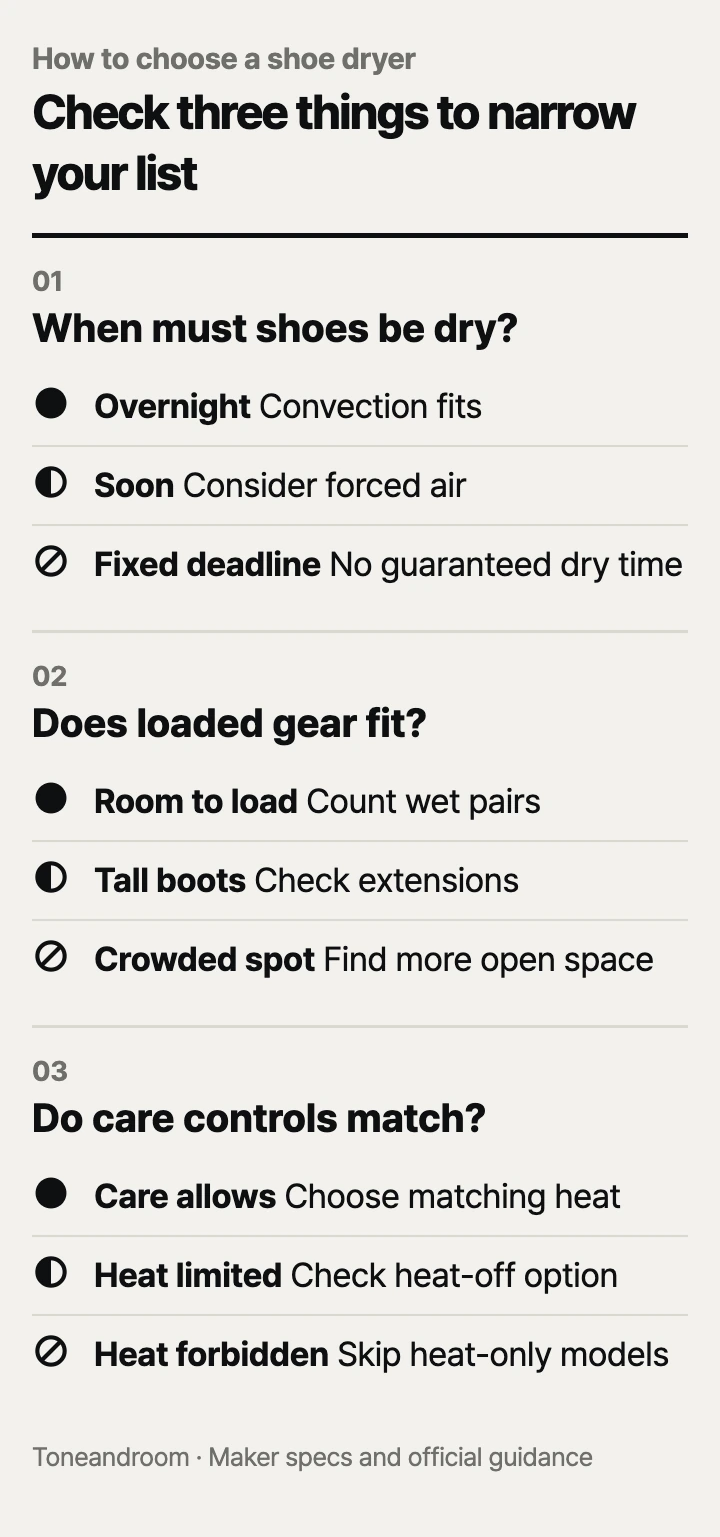
The common mistake is buying a shoe dryer for its heat rating without matching it to when your shoes need to be ready. Before choosing one, check these three things, in order.
How soon do you need your shoes dry?
Choose around your next wear time: overnight drying and a short turnaround call for different designs.
PEET's operating instructions describe the Original as a fanless dryer that uses natural thermal convection. Its product guidance recommends leaving footwear on overnight, with results depending on material and saturation. That suits work boots parked after an evening shift, but gives you little reason to expect soaked footwear ready before another outing. PEET Original guidance
FORLIM advertises roughly 1–2 hours for its forced-air model, with an automatic shutoff timer running up to 2 hours. DryGuy's Amazon listing advertises 1–3 hours and a 3-hour timer. Treat both as advertised drying windows, not promises for every lining or level of wetness. FORLIM details, DryGuy details
Swipe sideways to see the full table →
| If your home … | Our take | What to check |
|---|---|---|
| Has damp work boots to dry every night | Worth it | Whether an overnight routine fits your shift |
| Needs sneakers again soon after practice | Only some models | Forced air, cycle length, and lining thickness |
| Has several pairs arriving wet together | Only some models | Simultaneous pair capacity and room for loaded shoes |
| Gets wet footwear only occasionally | It depends | Whether existing air drying finishes before the next wear |
| Needs a guaranteed short cycle for soaked boots | Skip it | No advertised time guarantees every wet boot will finish |
Think through a normal weekday before paying for speed. If you put shoes down after dinner and leave in the morning, silence may matter more than a fan. If cleats come home shortly before another practice, a timed blower makes more sense. A timer ends the cycle; it does not measure whether the toe lining is dry. Leave room in your schedule to check the result and run another cycle if needed.
Will your boots and the loaded dryer fit?
Measure the dryer with footwear in place, and count the pairs that need to dry together.
PEET lists the Original's assembled size as 9.5 inches long by 9.5 inches wide by 22 inches high. The small base can be appealing beside an entry bench, but the height deserves attention under shelving. Shoes and boot shafts also change how much room the setup occupies. PEET sells extensions separately for taller footwear. PEET dimensions and extensions
DryGuy says the Force Dry DX handles two pairs at once and includes extension tubes for boots up to 16 inches tall. That makes its extra capacity useful when work boots and sports shoes arrive together. FORLIM's dual ports instead serve one pair, with telescoping, bendable supports and an adjustable rack. Adjustability helps positioning; it does not make a single-pair dryer a family drying station. DryGuy capacity, FORLIM port design
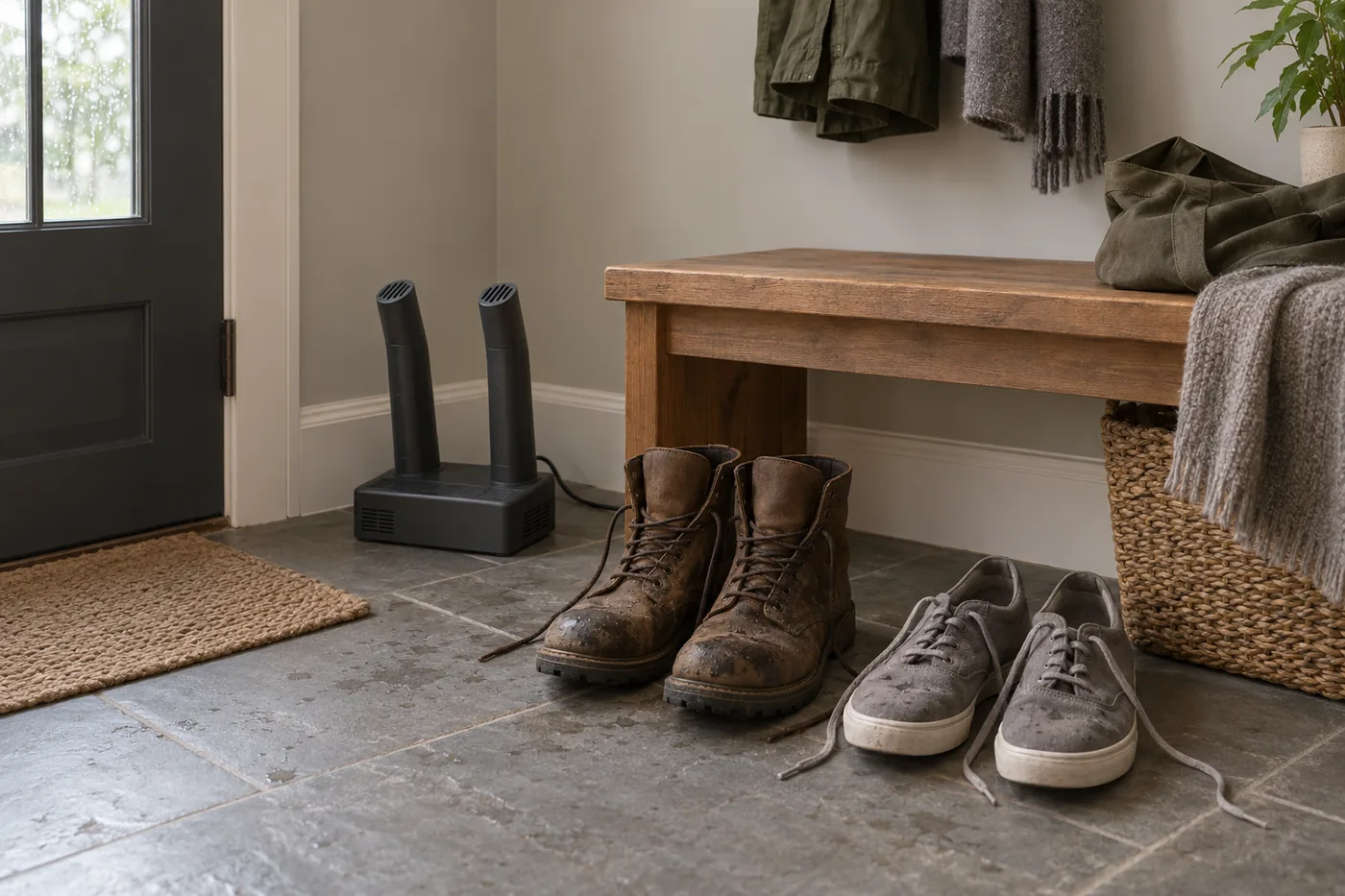 AI-generated illustration for explanation. Not a specific product.
- Measure the intended spot with your tallest boots nearby.
- Allow space to lift footwear off the supports without moving a shelf.
- Count the pairs that arrive wet together, rather than everyone who lives at home.
- Check whether glove or tall-boot attachments are included or sold separately.
The best location is one you can use as part of your normal arrival routine. A dryer buried behind storage bins is another appliance to retrieve. In an apartment entryway, consider whether the loaded setup competes with the shoe rack or the door swing. In a mudroom, compare simultaneous capacity before buying a cheaper unit that would leave another pair waiting. Those are practical reasons to choose a larger model even when you do not need a faster advertised cycle.
Do the heat controls and upkeep match your footwear?
Check material instructions, heat options, and vent access before treating a dryer as a daily fixture.
DryGuy lists 105°F heat and a heat/no-heat switch for the Force Dry DX. FORLIM's official page lists a 105–140°F range and says the temperature marking on its timer is decorative, rather than a temperature setting. The dial controls duration; do not assume it gives you adjustable heat. PEET describes slightly warmed convection air rather than a forced-air blower. DryGuy controls, FORLIM timer explanation, PEET design
FORLIM's material-care guidance says to follow footwear care labels. A heat-off option is useful when those instructions permit airflow but restrict added heat. It still takes a check of the footwear's instructions to decide what drying method fits a particular liner or construction. FORLIM material guidance
For daily placement, PEET's operating instructions say to keep the base vents unobstructed, use the footwear DryPort attachments, and avoid placing the dryer near another heat source such as a furnace register. PEET also recommends loosening tongues and laces for circulation. FORLIM's safety guidance says not to immerse its dryer in water or another liquid. These maker instructions matter when choosing a spot and planning cleanup. PEET operating instructions, FORLIM care guidance
- Decide whether you want a timed cycle or PEET's plug-in operating routine.
- Leave vents visible and accessible when organizing the surrounding shoes.
- Plan where removed insoles and loose laces will go.
- Keep the included manual available for model-specific cleaning directions.
Noise also deserves a realistic check. PEET's fanless design removes blower noise from the decision. DryGuy describes its blower as quiet, but a measured noise level in dBA is not listed by the maker on its product page. FORLIM likewise provides no measured dBA figure there. If the entryway opens directly into your sleeping area, a fanless overnight design is the clearer fit for that priority.
How do the popular picks compare side by side?
FORLIM fits a budget timed cycle, PEET fits a quiet overnight routine, and DryGuy fits two pairs drying together.
Swipe sideways to see the full table →
| Model | Pair capacity | Heat and cycle controls | Published drying guidance | Price (Amazon.com, Oct 14, 2026) | Buy |
|---|---|---|---|---|---|
| FORLIM Shoe & Boot Dryer SD-002A-B, Black | One pair; dual adjustable ports | Forced-air heat; up to 2-hour shutoff timer | About 1–2 hours; varies with wetness | about $26.59 on Amazon.com (Oct 14, 2026) | View on Amazon |
| PEET Original Shoe & Boot Dryer M97-FSB | One pair | Warm thermal convection; plug in to operate | Overnight recommended | about $49.99 on Amazon.com (Oct 14, 2026) | View on Amazon |
| DryGuy Force Dry DX 02129 | Two pairs; four ports | Heat/no-heat switch; 3-hour shutoff timer | Amazon listing: 1–3 hours | about $83.95 on Amazon.com (Oct 14, 2026) | View on Amazon |
Prices are what Amazon.com showed on Oct 14, 2026 and change often.
The FORLIM, PEET, and DryGuy models cover distinct routines. Start with FORLIM if one pair and a timed warm-air cycle meet your needs. Pay more for PEET when overnight drying and a fanless design matter, or for DryGuy when simultaneous capacity and a heat-off setting solve your daily bottleneck. More heat alone is a weak reason to spend more.
A closer look at each product
If you dry two pairs together · DryGuy Force Dry DX 02129
Four ports handle two pairs at once. A heat/no-heat switch and a 3-hour timer suit households juggling several wet items.
- Two-pair simultaneous capacity
- Heat/no-heat switch
- Included extensions for boots up to 16 inches tall
- Costs more than the single-pair options
- Measured noise level: Not listed by the maker
If you want a budget timed cycle · FORLIM Shoe & Boot Dryer SD-002A-B, Black
Dual telescoping, bendable ports position warm airflow inside one pair. The shutoff timer runs up to 2 hours, with advertised drying of about 1–2 hours depending on wetness.
- Up to 2-hour automatic shutoff timer
- Telescoping, bendable ports
- Adjustable 180-degree rack
- One-pair capacity
- Timer temperature marking is decorative
If you dry boots overnight near living space · PEET Original Shoe & Boot Dryer M97-FSB
Fanless thermal convection suits an overnight routine without blower noise. PEET lists 36 watts and recommends overnight drying depending on material and saturation.
- Fanless thermal convection
- 36-watt power rating
- 9.5-by-9.5-inch base
- Overnight drying recommended
- Tall-footwear extensions sold separately
In one sentence
Match a shoe dryer to your next wear time, loaded space, and footwear care instructions.
DryGuy Force Dry DX 02129
View on AmazonFORLIM Shoe & Boot Dryer SD-002A-B, Black
View on AmazonPEET Original Shoe & Boot Dryer M97-FSB
View on AmazonWhat to check
- Drying schedule · Overnight convection or a timed forced-air cycleCompare when shoes come home with when you need to wear them again.
- Loaded fit · Pair capacity, boot fit, and room around loaded footwearMeasure the intended spot with your tallest boots and count the pairs that arrive wet together.
- Care controls · Material instructions, heat options, and vent accessCheck footwear care labels and whether the dryer gives you the heat option and operating routine you need.
- Drying schedule
- Loaded fit
- Care controls
Frequently asked questions
How long does a shoe dryer take to dry work boots?
PEET recommends overnight drying for the Original. FORLIM advertises about 1–2 hours, while the DryGuy Amazon listing gives 1–3 hours; material and saturation affect the result.
Can I leave a PEET Original dryer on overnight?
PEET says the Original is designed for continuous operation and recommends overnight drying. Its operating instructions require unobstructed vents, the proper DryPort attachments, and placement away from another heat source.
Can I use a shoe dryer on leather boots?
PEET lists leather among the materials suitable for the Original. FORLIM also lists leather but says to follow footwear care labels, so check the boot maker's drying instructions before choosing added heat.
Does a shoe dryer work without a fan?
PEET's Original uses natural thermal convection without a fan or moving parts. PEET recommends an overnight routine rather than treating it as a short forced-air cycle.
Sources
- DryGuy Force Dry DX specifications · Oct 14, 2026
Two-pair capacity, 105°F heat, 3-hour timer, heat/no-heat switch, and included extensions for boots up to 16 inches tall.
- FORLIM black adjustable boot dryer · Oct 14, 2026
1–2-hour drying claim, 2-hour shutoff timer, 105–140°F range, decorative temperature marking, and guidance against immersion.
- PEET Original specifications · Oct 14, 2026
36 watts, 9.5-by-9.5-by-22-inch assembled size, overnight recommendation, continuous operation, and separately sold tall-footwear extensions.
- PEET operating instructions · Oct 14, 2026
Original plug-in operation, fanless convection, DryPort attachment requirements, unobstructed vents, and placement away from a furnace register.
Read next
Best Fabric Shavers on Amazon.com (2026): Check Fabric Fit, Power Setup, and Cleanup First
Best IPL Hair Removal Devices on Amazon.com (2026): Check Skin Fit, Treatment Routine, and Setup First
Best Water Flosser on Amazon.com (2026): Check Sink Space, Tank and Controls, and Upkeep First
Best Foot Massager on Amazon.com (2026): Check Massage Style, Fit, and Cleanup First
Other topics
Best Pet Cameras on Amazon.com (2026): Check View, Setup, and Upkeep First
Best computer speakers on Amazon.com (2026): check connections, desk space, and daily controls first
Best baby play gym on Amazon.com (2026): Check floor space, play setup, and daily care