Conclusion
The cheaper YISSVIC racket suits people who want occasional manual control and can keep it charged. The higher-priced GOOTOP suits people who prefer a stationary plug-in setup with a replaceable conventional bulb.
3 selected products
Buying the highest-voltage indoor bug zapper is a common mistake when the real problem is where insects gather and how you plan to catch them. Before choosing a model, check these three things, in order.
Does a zapper match the insects and the job?
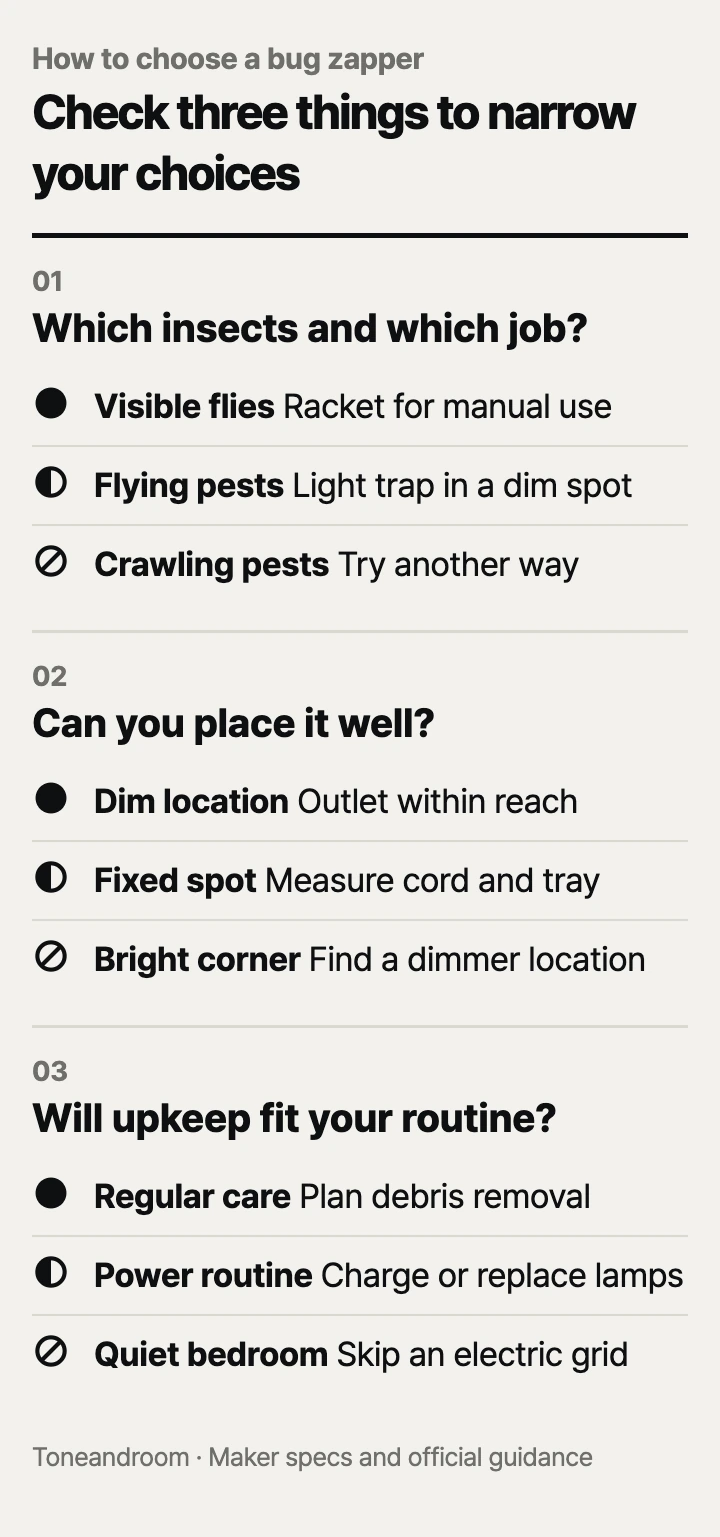
Choose a racket for insects you can see and reach, or a light-and-grid unit for a fixed location where flying insects gather.
YISSVIC describes its WD-981 as a rechargeable racket with manual and automatic modes; GOOTOP's Zap T6 Pro and Buzbug's MO-008C use light to attract insects to an electric grid. That difference matters more than comparing the voltage printed in their titles. A racket puts you in charge of making contact, while a stationary unit depends on insects approaching its light. YISSVIC product details, GOOTOP product details.
Swipe sideways to see the full table →
| If your home ... | Our take | What to check |
|---|---|---|
| Gets occasional visible flies near an entry | Worth it | A handheld racket and a place to charge it |
| Has recurring flying insects in a dim utility area | It depends | A fixed light trap, outlet access, and tray cleanup |
| Needs a quiet bedroom at night | Only some models | Whether a glue trap would fit better than an electric grid |
| Has crawling pests or needs mosquito bite prevention alone | Skip it | The pest source and an appropriate prevention plan |
These recommendations apply to actual electric zappers. An ultrasonic repeller has no insect-killing grid, and a plug-in glue trap catches insects without zapping them. Those products can appear beside zappers, but they serve different jobs. If avoiding the snap of an electric grid is your priority, consider the glue-trap category before comparing grid voltage.
For mosquito bite prevention, EPA recommends repairing screens, closing gaps, removing standing water, and using EPA-registered repellents when needed according to their labels. Treat those steps as the starting point rather than treating a zapper's coverage claim as a bite-prevention promise. EPA mosquito guidance.
Also read regulatory wording carefully. GOOTOP's Amazon description uses “EPA Registered,” but EPA explains that an establishment number does not mean a device has been approved or reviewed for safety or effectiveness. That distinction prevents a label from carrying more weight than it deserves. EPA's device guide.
Can you give it a practical spot at home?
Choose the location before the model, because outlet access, competing light, and room layout determine whether the setup makes sense.
GOOTOP instructs users to operate its Zap T6 Pro at night and in the dark. Buzbug also advises avoiding nearby competing lights. A bright kitchen with ceiling lights running all evening is a different setting from a dim laundry room or garage, even when both fit within a seller's advertised area. GOOTOP product details, Buzbug placement guidance.
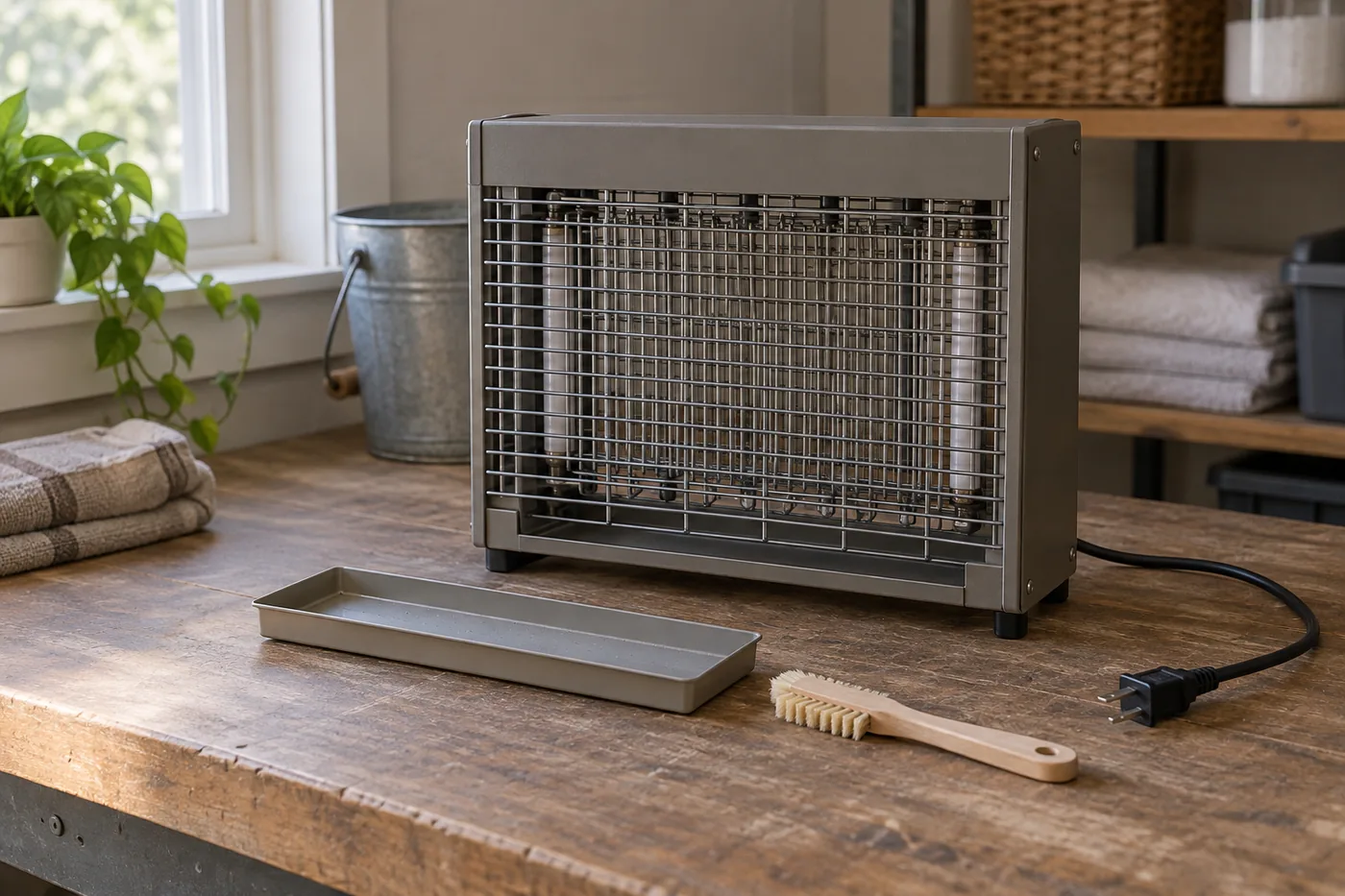 AI-generated illustration for explanation. Not a specific product.
Buzbug lists a 5.6-foot cord and dimensions of 7 by 7 by 13.4 inches for the MO-008C. Measure from the intended location to the outlet along the route the cord would actually take. Leave enough room to remove the collection tray without moving a shelf full of household supplies. Buzbug product details.
GOOTOP lists dimensions of 7.5 by 6.7 by 12 inches and a three-prong plug for the Zap T6 Pro. Cord length: Not listed by the maker. If the outlet is across the room, resolve that missing detail before ordering instead of assuming this model will reach as far as the Buzbug. GOOTOP product details.
YISSVIC's WD-981 suits a different routine. Its manual mode lets you take the racket to a visible insect, while automatic mode uses its base and purple attractant light. The listed 59-inch cable is for charging; it does not establish a stationary room coverage area. Runtime per charge: Not listed by the maker. YISSVIC product details.
- Identify where flying insects actually appear before picking a location.
- Check whether that location stays dim during the hours you want the unit running.
- Measure the appliance's footprint and the space needed for maintenance.
- Decide whether a fixed appliance or a tool you retrieve for occasional use fits your routine.
Buzbug advertises up to 2,100 square feet indoors, while GOOTOP advertises up to half an acre. These are maker claims, not matching measurements of performance across separate rooms. For an apartment with bedrooms behind closed doors, prioritize the problem area instead of assuming one light can serve the entire floor plan. Buzbug specifications, GOOTOP specifications.
Will you keep up with cleaning and replacement parts?
Buy a grid zapper only if its noise, debris removal, and power routine fit the way you maintain your home.
Buzbug recommends weekly removal of insect buildup from the tray, lamp, and exterior, and advises avoiding indoor operation during rest periods because zapping makes noise. That makes an LED model a poor match for someone expecting silent overnight operation beside a bed. Buzbug care guidance.
GOOTOP lists a removable collection tray, an included cleaning brush, and a replaceable 15-watt bulb. That wattage describes the bulb, not a verified total power draw for the appliance. Before choosing it for a garage or utility room, check the availability of the correct replacement bulb and whether you can easily reach the tray. GOOTOP product details.
Buzbug lists replaceable UV-LED tubes with a claimed lifespan of 25,000–50,000 hours. Treat that as the maker's lamp-life estimate, not a promise that the complete appliance will last that long. Total operating wattage: Not listed by the maker. “LED” alone is not enough to calculate an electricity bill. Buzbug product details.
YISSVIC lists a built-in, nonremovable 1,500 mAh battery and a charge-level indicator. That saves you from buying disposable batteries, but charging becomes part of the routine and battery serviceability is limited. Pick it if you want occasional manual control, rather than assuming automatic mode replaces a dedicated stationary unit. YISSVIC product details.
For electrical care, Buzbug's safety guidance says to unplug the unit before bulb replacement and not to touch the grid with hands or metal objects during inspection. EPA recommends following each device's precautions and contacting the maker about unclear instructions; use the model's own care directions rather than a generic cleaning shortcut. Buzbug safety guidance, EPA device guidance.
How do the popular picks compare side by side?
Choose YISSVIC for occasional manual control, Buzbug for a fixed LED setup, or GOOTOP for a plug-in unit with a replaceable conventional bulb.
Amazon's “bought in past month” labels on Oct 14, 2026 showed 20K+ for GOOTOP and 10K+ each for Buzbug and YISSVIC. Those labels indicate purchase activity, not comparable insect-catching results.
Swipe sideways to see the full table →
| Model | Operation | Power and lamp | Placement and upkeep | Price (Amazon.com, Oct 14, 2026) | Buy |
|---|---|---|---|---|---|
| YISSVIC WD-981, black | Manual racket or automatic base mode | 4,000V grid; built-in 1,500 mAh battery | 59-inch charging cable; charge-level indicator | about $18.99 on Amazon.com (Oct 14, 2026) | |
| Buzbug MO-008C | Stationary light-and-grid zapper | Replaceable UV-LED tubes; claimed 25,000–50,000-hour lamp life | 5.6-foot cord; collection tray and brush | about $19.99 on Amazon.com (Oct 14, 2026) | View on Amazon |
| GOOTOP Zap T6 Pro, black | Stationary light-and-grid zapper | 4,200V grid; replaceable 15W bulb | Three-prong plug; collection tray and brush | about $37.99 on Amazon.com (Oct 14, 2026) |
Prices are what Amazon.com showed on Oct 14, 2026 and change often.
The comparison uses published details from YISSVIC, Buzbug, and GOOTOP. Paying more for GOOTOP makes sense when its replaceable-bulb setup is what you want; the higher price does not establish better performance in your room.
A closer look at each product
If you want to handle occasional visible flies · YISSVIC WD-981 Electric Fly Swatter, black
Manual and automatic modes let this rechargeable racket serve as a handheld tool or sit in its base. Its built-in 1,500 mAh battery suits a routine that includes charging.
- Manual and automatic modes
- Built-in 1,500 mAh rechargeable battery
- Charge-level indicator
- Battery is nonremovable
- Runtime per charge: Not listed by the maker
If you want a fixed LED setup near an outlet · Buzbug MO-008C LED Bug Zapper
A 5.6-foot cord supports a fixed placement, and the replaceable UV-LED tubes avoid dependence on a conventional bulb. Its collection tray and included brush support regular debris removal.
- 5.6-foot power cord
- Replaceable UV-LED tubes
- Collection tray and cleaning brush
- Buzbug advises avoiding operation during rest periods
- Total operating wattage: Not listed by the maker
If you prefer a stationary unit with a replaceable conventional bulb · GOOTOP Zap T6 Pro Bug Zapper, black
GOOTOP lists a replaceable 15-watt bulb, a collection tray, and an included brush. The stationary design fits a dim utility area where you can accommodate its three-prong plug.
- Replaceable 15-watt bulb
- Removable collection tray and included brush
- Listed for indoor and outdoor use
- GOOTOP specifies nighttime or dark operation
- Cord length: Not listed by the maker
In one sentence
Match the zapper to the insects, its placement, and the care routine before comparing voltage.
YISSVIC WD-981 Electric Fly Swatter, black
View on AmazonBuzbug MO-008C LED Bug Zapper
View on AmazonGOOTOP Zap T6 Pro Bug Zapper, black
View on AmazonWhat to check
- Insect type · Manual contact or light attractionIdentify the insects and decide whether you will pursue visible flies or use a fixed light trap.
- Placement · Dim location, outlet reach, and maintenance spaceMeasure the intended spot and outlet route, then check competing lights and access to the tray.
- Upkeep · Noise, debris removal, and power routinePlan when you will clean the unit and whether charging or replacement lamps fit your routine.
- Insect type and manual versus stationary use
- Placement, outlet reach, and competing lights
- Noise, cleaning, and replacement parts
Frequently asked questions
Do indoor bug zappers prevent mosquito bites?
Do not treat a zapper as your entire bite-prevention plan. EPA recommends screens, closing gaps, removing standing water, and using EPA-registered repellents when needed according to the label.
Where should I put an indoor bug zapper?
Choose a location near recurring insect activity with practical outlet access. Buzbug advises avoiding competing lights, and GOOTOP specifies nighttime or dark operation.
Can I leave a bug zapper on in my bedroom at night?
Consider the noise before choosing an electric grid model. Buzbug advises avoiding indoor operation during rest periods because insects contacting the grid make noise; a glue-trap design may fit a quiet bedroom better.
How often should I clean an indoor bug zapper?
Buzbug recommends weekly cleaning of its collection tray, lamp, and exterior. EPA advises following each device’s own precautions and contacting the maker about unclear care instructions.
Sources
- Buzbug MO008C official product and care page · Oct 14, 2026
Verifies the MO-008C product, 5.6-foot cord, 2,100-square-foot indoor coverage claim, replaceable LED tubes and claimed lamp life; weekly cleaning and advice about noise during rest periods.
- Buzbug official setup and safety FAQ · Oct 14, 2026
Competing-light placement advice, MO-008C bulb replaceability, unplugging before bulb replacement, and grid inspection precautions.
- EPA tips to prevent mosquito bites · Oct 14, 2026
Official guidance on screens, gaps, standing water, and labeled use of EPA-registered repellents; no product specifications or prices.
- EPA pesticide device guide for consumers · Oct 14, 2026
Distinguishes establishment numbers from product approval and explains device precautions; no product specifications or prices.
Read next
Best Electric Foot Warmers on Amazon.com (2026): Check Fit, Power, and Care First

Best Portable Air Conditioner on Amazon.com (2026): Check Window Fit, Cooling Capacity, and Upkeep First
Best oil-filled radiator heaters on Amazon.com (2026): check room fit, outlet placement, and controls first
Best Desk Fan on Amazon.com (2026): Check Desk Fit, Power, and Cleaning First
Other topics
Best Dog Deshedding Brushes on Amazon.com (2026): Check Coat Fit, Grooming Setup, and Cleanup First
Best wireless chargers on Amazon.com (2026): 3 things to check first
Best baby teethers on Amazon.com (2026): check age and grip, cleaning, and cooling first