Does that salty dog coat need a wash or another bottle of waterproofing spray? In the store aisle before a holiday drive, a Lab owner with a damp jacket back at the apartment has a more useful first purchase to consider: nothing until the care label is readable. Clean before adding treatment, and let the coat's instructions decide how.
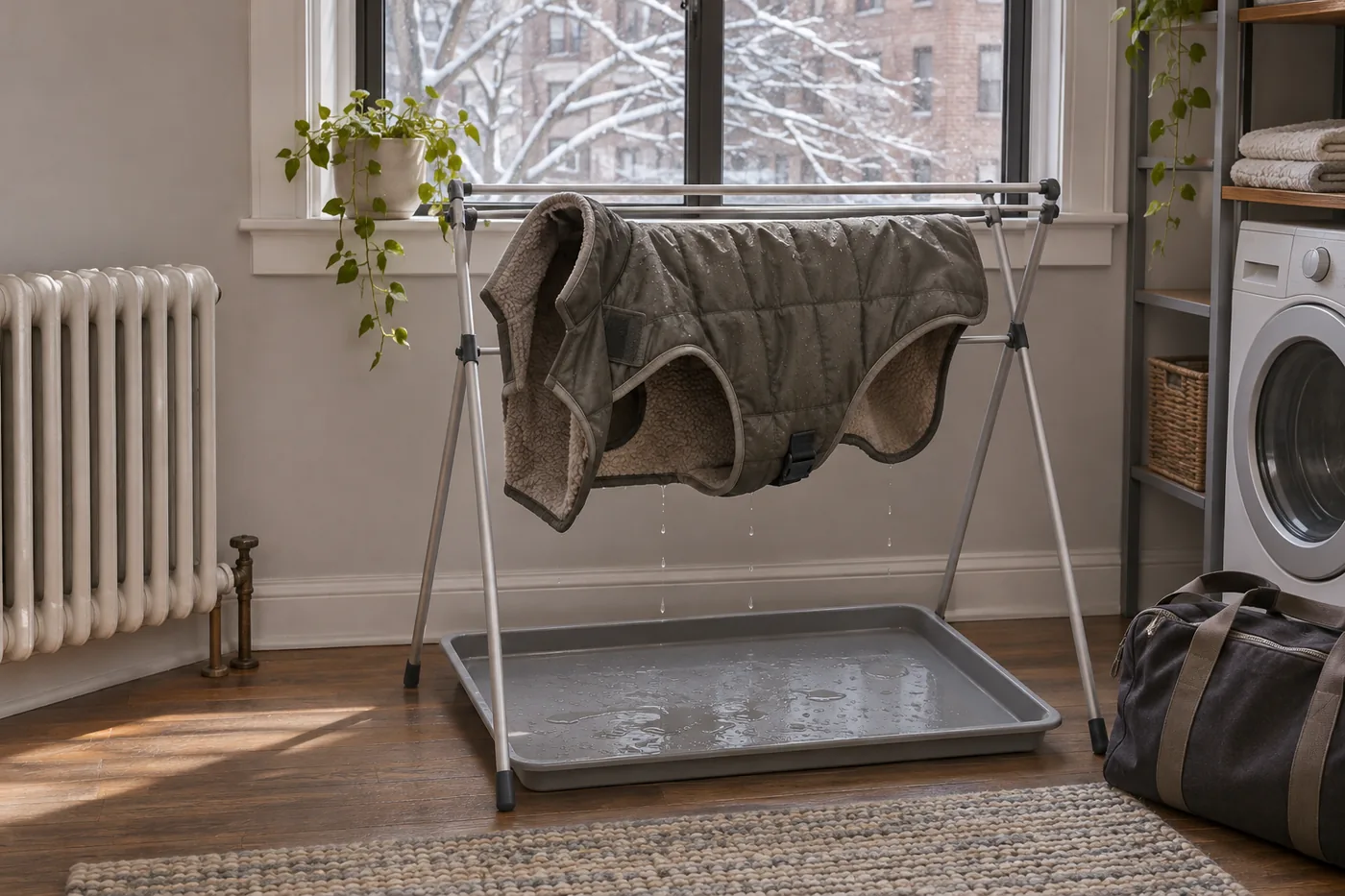 A winter coat waiting for a care-label check before the holiday packing starts.
I'd start with the cleaning instructions, not the spray display. Nikwax Tech Wash is worth considering only if the coat maker permits that cleaner for its fabric; Nikwax TX.Direct Spray-On comes later, if compatible cleaning leaves the shell needing treatment. Neither product takes priority over a missing label or damaged lining.
How we chose
Reviewed Hurtta garment-care guidance, Nikwax cleaner and spray instructions, and the Center for Pet Safety certified-product directory. The checks prioritize material compatibility, label-permitted washing and drying, and the distinction between walking equipment and vehicle restraints.
Part 1Check A: Read the label before choosing a cycle
Before washing: Lay the removed coat open and check the belly panel, closures, lining, and seams. Then jot down what needs attention: crusty patches, trapped hair, an odor, or peeling material. This gives you something concrete to compare after cleaning without mistaking every change in feel for failed waterproofing.
Hurtta's care page tells owners to remove loose hair, loosen drawstrings, and close buckles and zippers before washing. It also says to leave out fabric softener because it reduces the breathability of film-coated fabrics. So a routine laundry load with softener is not the starting point for that gear.
For Hurtta's foil- and film-coated products, the maker specifies hand washing or a mesh bag on a gentle-care machine setting, and says not to turn them inside out. But that exception belongs to those materials, not every dog jacket. An unreadable label is a reason to contact the maker, especially when the lining is already flaking.
Part 2Check B: Remove dirt before blaming the finish
Cleaning check: Nikwax explains that dirt and residues from conventional detergent can mask durable water repellency, the finish that helps water bead on the surface. That means a dirty shell absorbing water does not, by itself, prove that its waterproof construction has failed. Start by getting the dirt out using the permitted method.
For a compatible coat, match the cleaner's bottle directions to your machine rather than borrowing a dose from another washer type. Nikwax publishes different front-loading and top-loading instructions, so the machine matters. But if the cleaner's suggested cycle conflicts with the garment label, pause and ask the coat maker instead of choosing the harsher instruction.
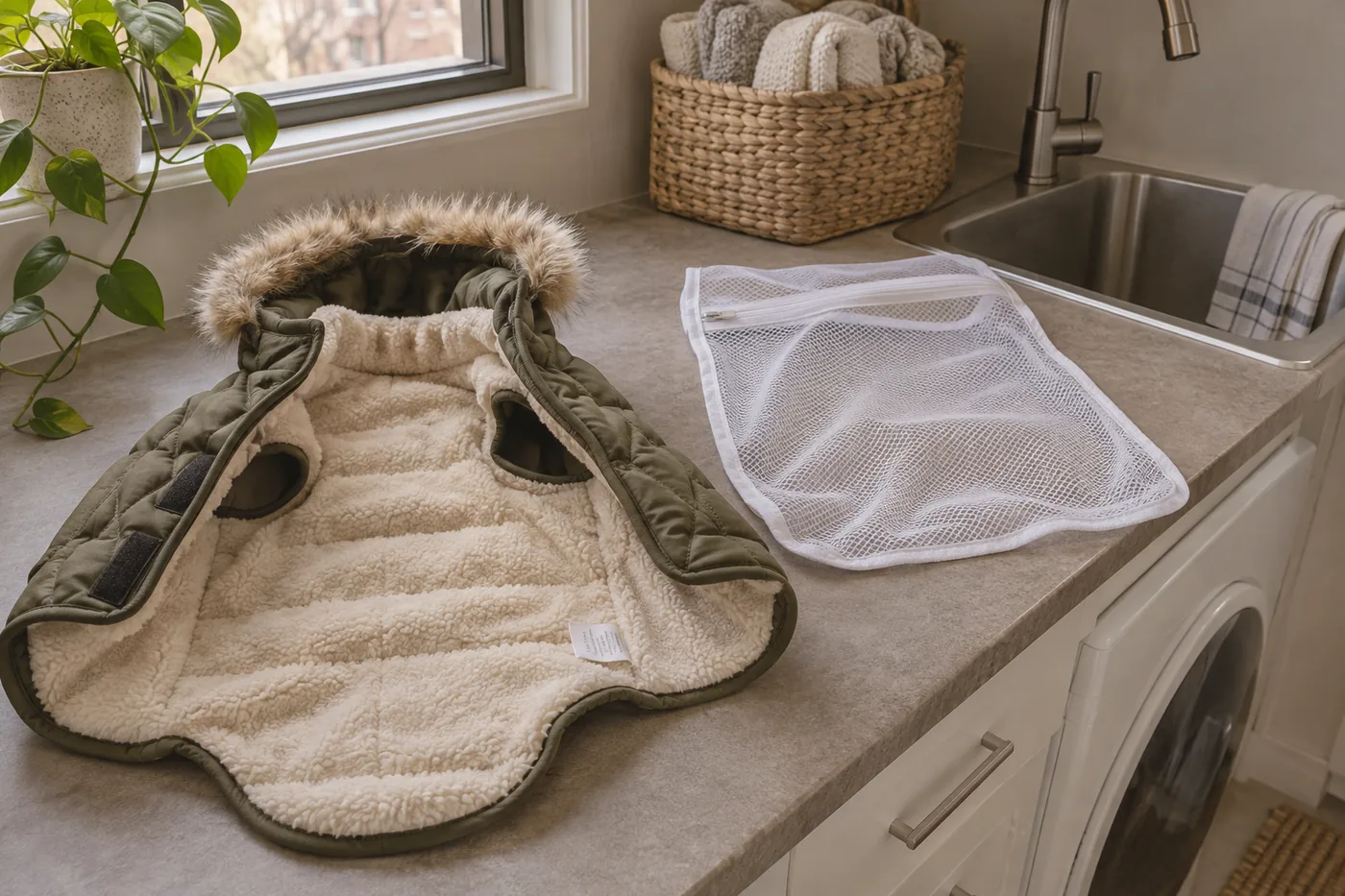 The coat label and the cleaner directions need to agree before washing begins.
After rinsing: Compare the coat with your notes. Check whether the crust has lifted and whether the lining still smells, rather than reaching straight for a fragrance or another coating. If an odor remains after appropriate washing and complete drying, ask the maker about the next step; repeated detergent increases are not a model-specific care plan.
Nikwax says cleaning can restore existing water repellency on fairly new or recently treated gear. So a cleaned shell deserves another look before re-treatment. Surface beading and a leak through a seam are different observations, and a spray does not establish that a damaged seam has been repaired.
Cleaning addresses contamination; re-treatment addresses a compatible shell whose water repellency still needs restoring.
Part 3Check C: Let the label set the drying method
Drying check: Hurtta warns that dryer heat can harm films or tapes and directs owners to drip-dry its products on a line or hanger. That makes a separate drying rack the practical option for Hurtta gear in this apartment. It does not give another brand's insulated coat the same instructions automatically.
Keep the radiator out of the plan: use the separate rack, arrange the coat as its label permits, and leave space around it. This avoids substituting direct heater contact for the maker's drying method just because departure is approaching. There is no reliable departure countdown here, because the cited care pages do not give a drying duration for this coat in this apartment.
A shell can look ready while folds or lining still feel damp. So check the belly overlaps, neck opening, and padded areas before putting the coat in the travel bag. If they remain damp, leave it out of the ready-to-wear pile and take suitable dry gear instead.
Part 4Check D: Add water repellency only if needed
Treatment check: Nikwax describes TX.Direct Spray-On as a treatment for breathable waterproof garments, particularly those with wicking liners. Its spray application targets the outer fabric without compromising the liner's wicking properties, according to Nikwax. But that description is not approval for every pet coat, reflective layer, or filling; confirm compatibility with the garment maker first.
When treatment is both needed and permitted, Nikwax says to work on the clean, wet garment rather than drying it first. Its directions specify spraying from 6 inches away, waiting 4–5 minutes, and wiping surplus product away with a damp cloth. So the useful timing is the application interval on the bottle, not a guessed promise about when the dog can wear it.
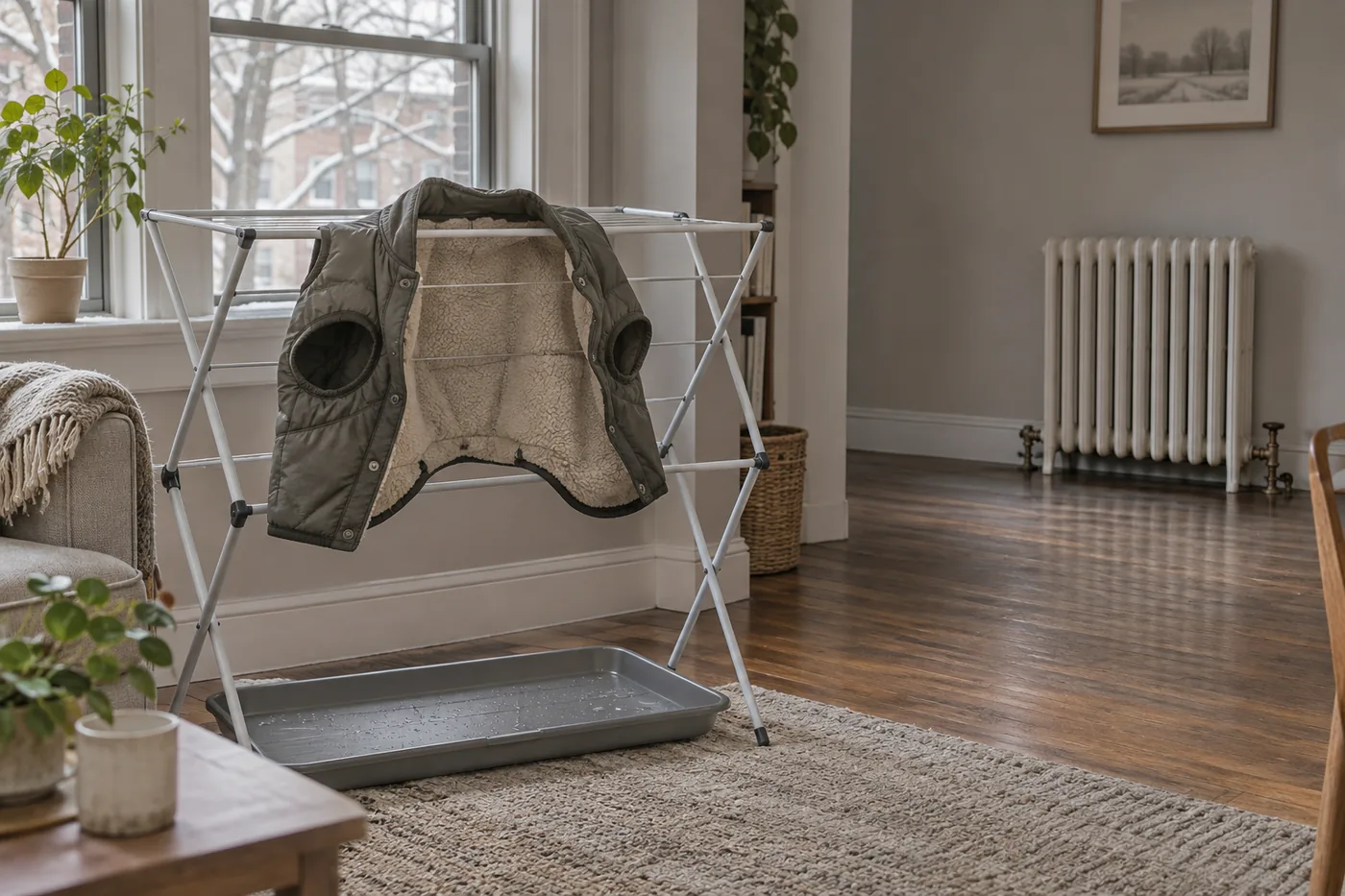 A separate rack keeps the coat's drying method independent of the room heater.
Follow the product's handling instructions with the coat off the dog. Nikwax says this treatment develops repellency through air drying and needs no activation heat, so there is no reason to override a garment's no-dryer instruction for this product. Fresh beading is not a repair certificate for torn fabric or lifting tapes.
Part 5Check E: Pack walking and car gear separately
Equipment check: The coat's wash instructions do not carry over to everything clipped beside it. Hurtta recommends hand washing its collars, harnesses, and leashes with mild detergent because metal parts can damage the washing machine. So those pieces need their own care check rather than a place in the coat's load.
What about the walking harness already by the door? The Center for Pet Safety maintains a directory of certified travel products; use that directory to check the exact restraint, then follow its maker's fit and installation directions. A walking feature is not evidence of crash protection, and adding a tether does not answer that question.
Before loading the car, separate the decisions: a coat that has finished drying, walking equipment cleaned according to its own instructions, and a travel restraint selected for its stated purpose. That keeps the laundry problem from quietly becoming a vehicle-restraint assumption.
Source and selection notes: Hurtta's care page, Nikwax's cleaner and spray directions, and the Center for Pet Safety directory informed these checks. Material compatibility, permitted drying, and separate travel-restraint requirements determined the sequence. Last checked: November 24, 2026.
In one sentence
Wash according to the coat label, finish the permitted drying process, and restore water repellency only when compatible cleaning is insufficient.
Frequently asked questions
Does a waterproof dog coat need treatment after every wash?
Not automatically. Nikwax says cleaning alone can restore existing water repellency on fairly new or recently treated gear. Re-treat only if needed and if the coat maker permits the selected product for its materials.
Can a dog winter coat dry on an apartment radiator?
Use the garment's permitted drying method rather than direct radiator contact. Hurtta specifies drip-drying its products and warns that dryer heat can damage films or tapes. The cited pages do not establish a drying time for an individual coat and apartment.
Can I use fabric softener when washing a dog coat?
Hurtta says not to use fabric softener because it impairs the breathability of film-coated fabrics. Check the exact garment label and maker's instructions before choosing its laundry products.
Should I wash the walking harness with the coat?
Check its separate instructions. Hurtta recommends hand washing its collars, harnesses, and leashes with mild detergent, warning that metal components may damage a washing machine.
Does a no-pull walking harness count as a car restraint?
A walking function does not establish crash protection. Check the exact travel product in the Center for Pet Safety certified-product directory and follow that restraint maker's fit and installation instructions.
Sources
- Hurtta US care instructions · 2026-11-24
No numerical temperature or drying duration quoted. Supplies hair removal, closure preparation, no-softener guidance, drip-drying, foil/film exceptions, and separate harness hand-washing instructions.
- Nikwax Tech Wash · 2026-11-24
No numeric dose or price quoted. Confirms that dirt and detergent residue can mask water repellency, cleaning may restore it, machine types have separate directions, and drying depends on the care label and treatment plan.
- Nikwax TX.Direct Spray-On · 2026-11-24
Directions specify a 6-inch spray distance and a 4–5-minute wait before wiping surplus off the clean, wet garment. Air drying develops repellency without activation heat; product is intended for breathable waterproof garments. No price quoted.
- Center for Pet Safety certified products · 2026-11-24
No numeric crash rating, weight limit, or price quoted. Provides the independent certified-product directory used to distinguish travel-restraint selection from a walking-harness feature.