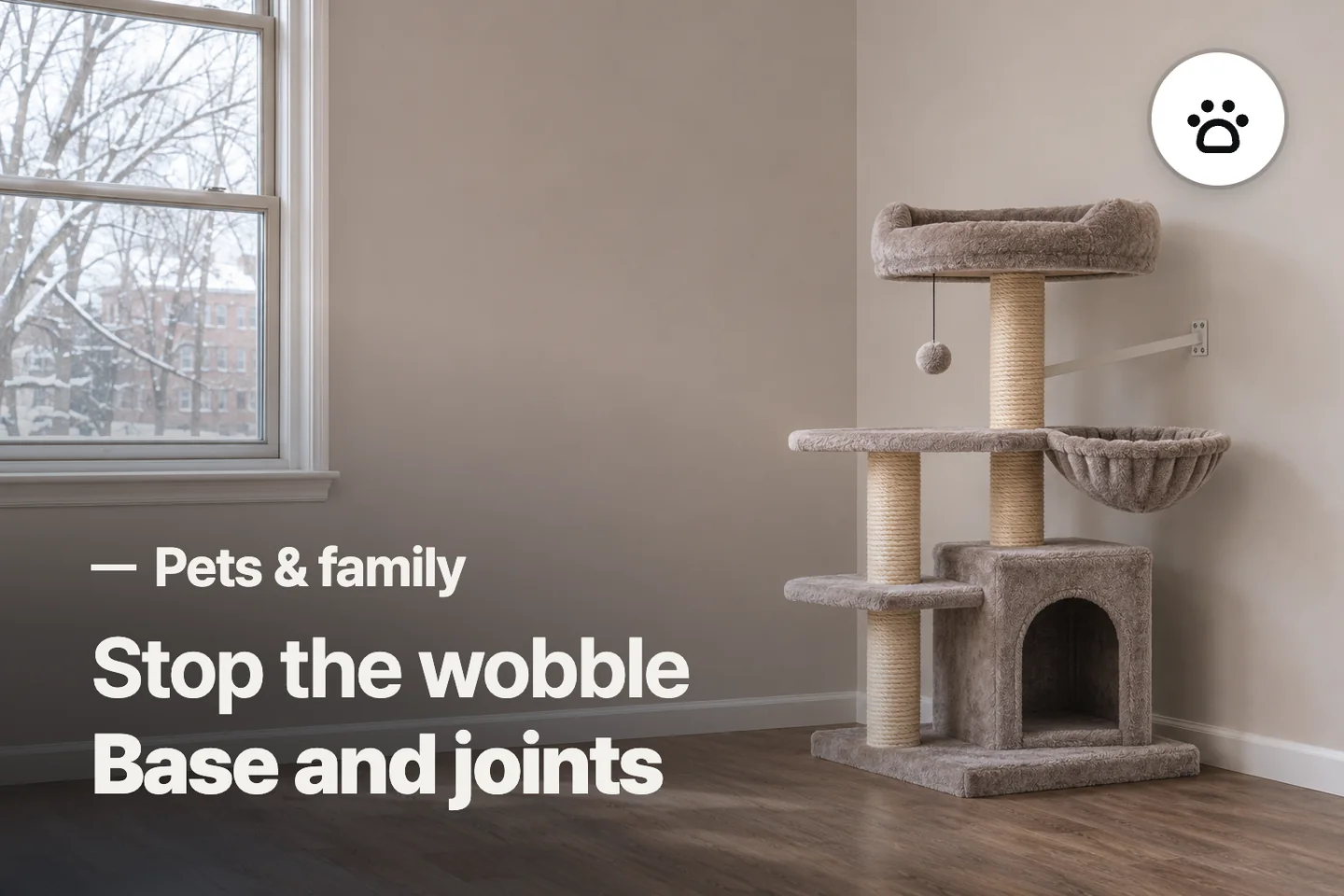
Will a bag of weight actually steady that large cat tree, or are you buying the wrong fix? Before holiday decorations crowd your apartment living room, separate a loose connection from a rocking base. Mau's safety guide says to stop using its furniture when looseness, instability, or damage appears, so keep the tower unavailable during the checks.
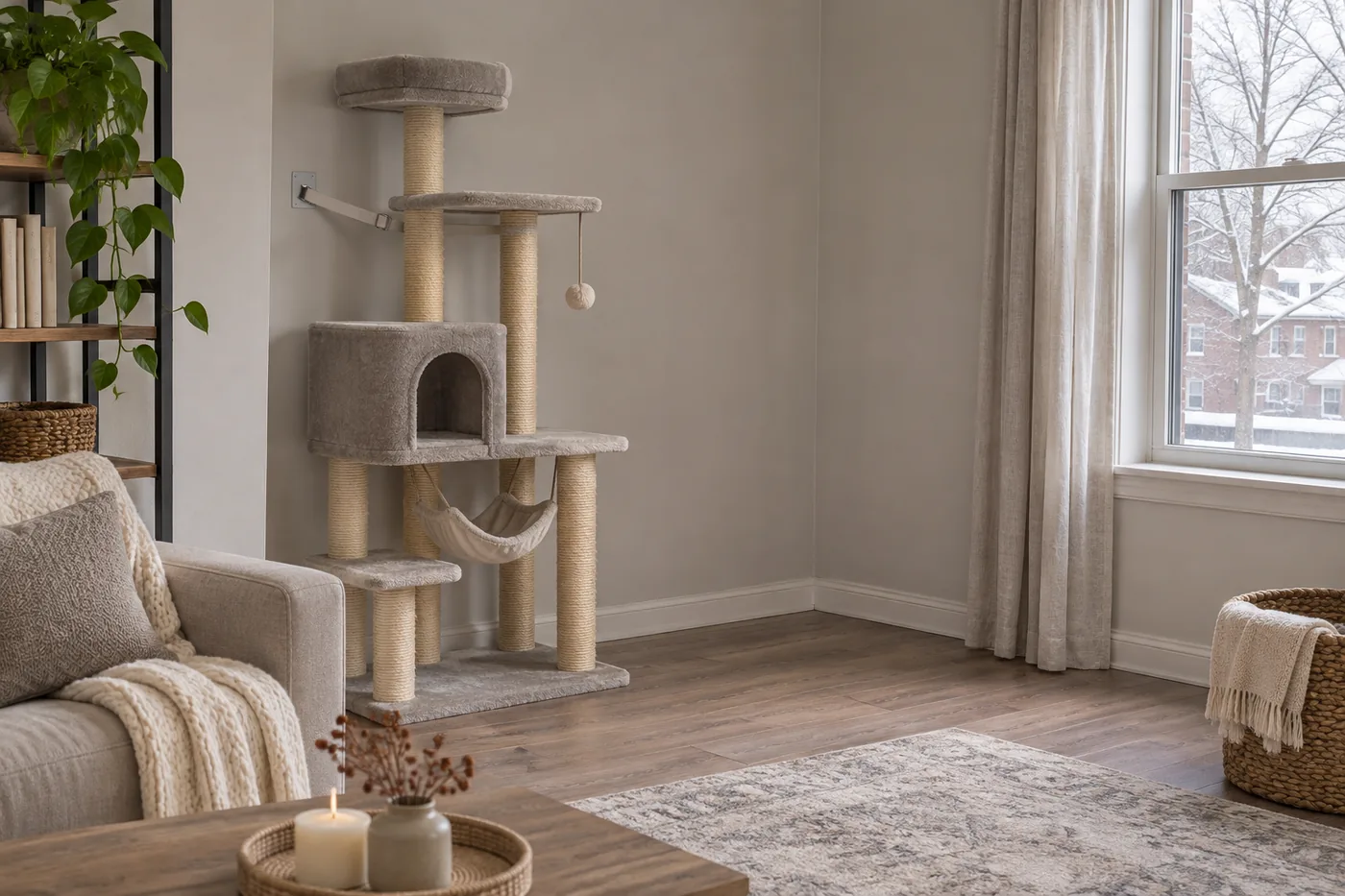 Leave the tower empty while you work out which part is moving.
My starting point would be joints and floor support, not added weight. That order follows Mau's assembly and placement guidance; it also keeps a restraint or heavier base from disguising a broken connection. The log below gives you before-and-after entries to fill in, rather than claiming a repair has already passed a wear test.
How we chose
Reviewed Mau's product safety guide and model-specific assembly index alongside Cat Tree King's parts and warranty FAQ. The inspection order follows connection condition, full base support, and manufacturer-directed securing; it does not assign a universal ballast amount or wall-fastener specification.
Part 1Log A: Locate the movement
Start your entry with the part that moves: base, post connection, or perch. With the tower empty and unavailable to the cat, look for gaps, visibly loose hardware, or a platform sitting out of position. This keeps the description useful when you contact the manufacturer; deliberately tipping the tower adds nothing useful to that record.
Next, find the exact model's assembly directions. Mau's assembly index separates models such as Cento and Ivy, so a video for a similar-looking tower is not enough. Compare the intended post positions and fasteners with your own instructions, then tighten only as that manufacturer directs.
If a connection spins without tightening, or a board or fitting appears damaged, stop there. Mau calls for original or approved replacement parts, which means a longer screw or a substitute board is not an established repair. Photograph the affected area and ask the maker which part belongs there.
Finish the entry with what changed and what remains unresolved. That is more useful than writing “seems better,” because it distinguishes a corrected connection from a tower that still needs attention.
Part 2Log B: Support the whole base
Now record what is underneath the tower. If the base straddles a rug edge or rests on a yielding surface, its support differs across the footprint. Mau specifies a level, stable surface and advises against thick rugs or uneven flooring, so address the location before shopping for ballast.
Move the empty unit only as its instructions allow, then reassess the base in a suitable spot. Mau describes stabilizing pads as support, not an anti-tip substitute. That distinction matters: a pad cannot establish that the tower has the wall restraint its maker recommends.
For ballast, the question is not how much weight looks convincing. Ask whether your exact model accepts ballast, where it goes, and how it must be retained. The opened Mau guide provides no general ballast allowance, so there is no manufacturer-backed amount here to copy onto an unidentified tower.
A more evenly supported base does not repair a damaged joint or replace the maker's securing instructions.
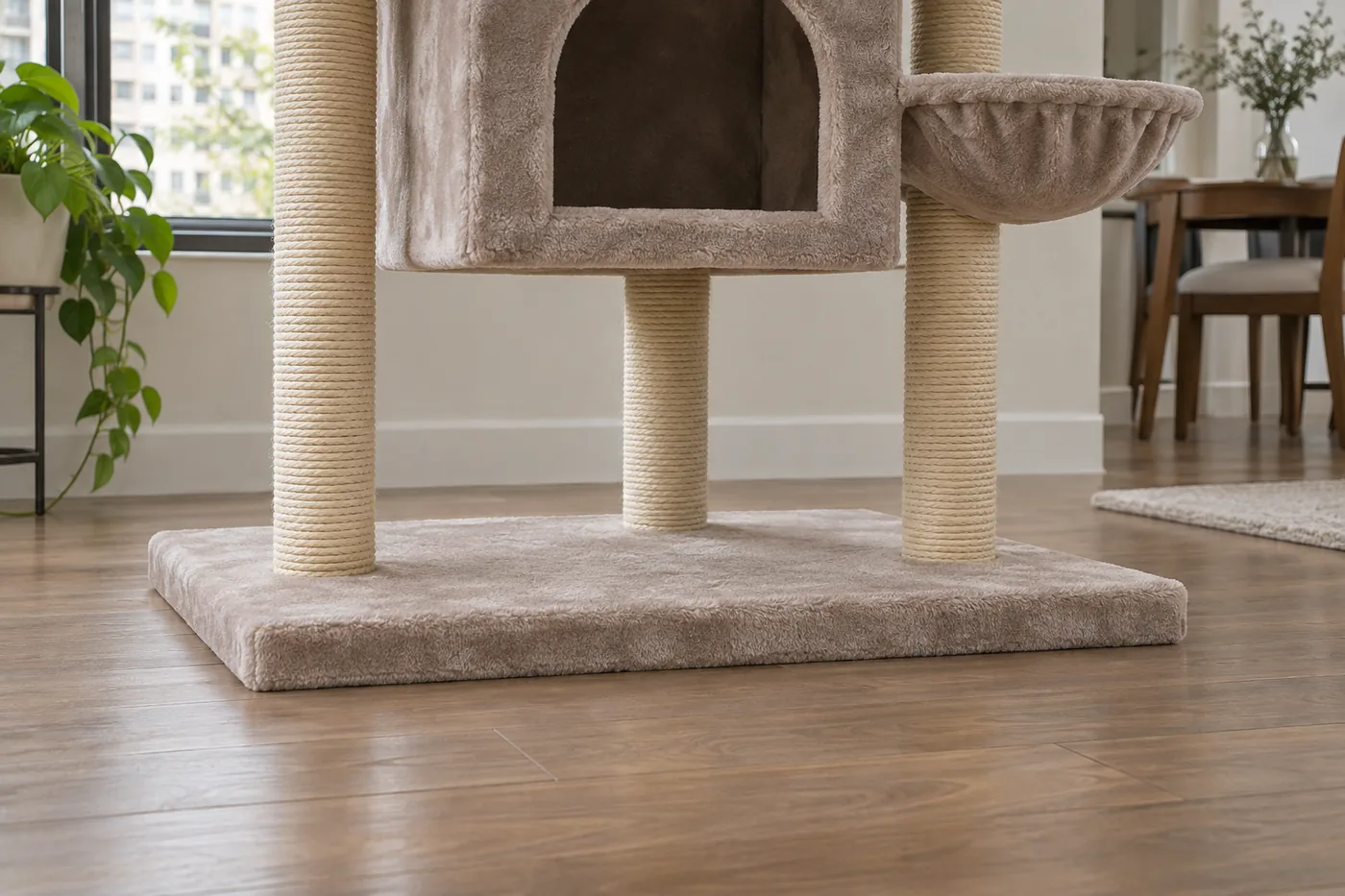 Check the whole footprint, including the edge that previously sat against a rug.
Part 3Log C: Match the wall attachment
Write down the wall construction and the tower's approved attachment location before choosing hardware. Mau recommends wall securing for its products taller than 20 inches; that is a Mau instruction, not a height threshold established for every cat-tree brand. Its guide also strongly recommends securing all its products in homes with children, infants, dogs, or other large or active pets.
For Mau furniture, the guide recommends drilling into studs or using heavy-duty drywall anchors rated for the load, and it identifies masonry anchors for brick or concrete. But those categories do not identify the right fastener for your apartment. The restraint instructions, wall construction, and unit attachment point still have to agree.
Mau explicitly says not to rely on adhesive-only fasteners. So a renter who cannot get drilling permission should ask the landlord and tower maker about a suitable arrangement, rather than swap in an adhesive hook. If the required installation is unavailable, the unstable tower remains out of use.
Complete this entry with the restraint instructions followed and the attachment location used. If either is uncertain, Mau recommends a qualified professional installer. That is a better next step than guessing a screw length or attaching a strap to a removable basket.
Part 4Log D: Keep the holiday layout workable
Before placing the holiday tree, leave room for the cat tower's full base and its required wall attachment. Mau favors a corner and advises avoiding high-traffic paths, so a quiet corner is worth checking first. But a corner is placement, not a restraint; the wall connection still needs its own plan.
Look at the route through the room as well as the empty floor beside the tower. If decorations would force the tower onto a rug edge or away from its fixing point, change the decorating layout instead. That keeps the floor and wall decisions consistent rather than undoing them at the last minute.
A nearby holiday tree is a separate concern from wobble. These manufacturer instructions address furniture stability, not whether a cat will leave ornaments alone. So treat the cleared space as a practical layout decision, not a promise about your cat's behavior.
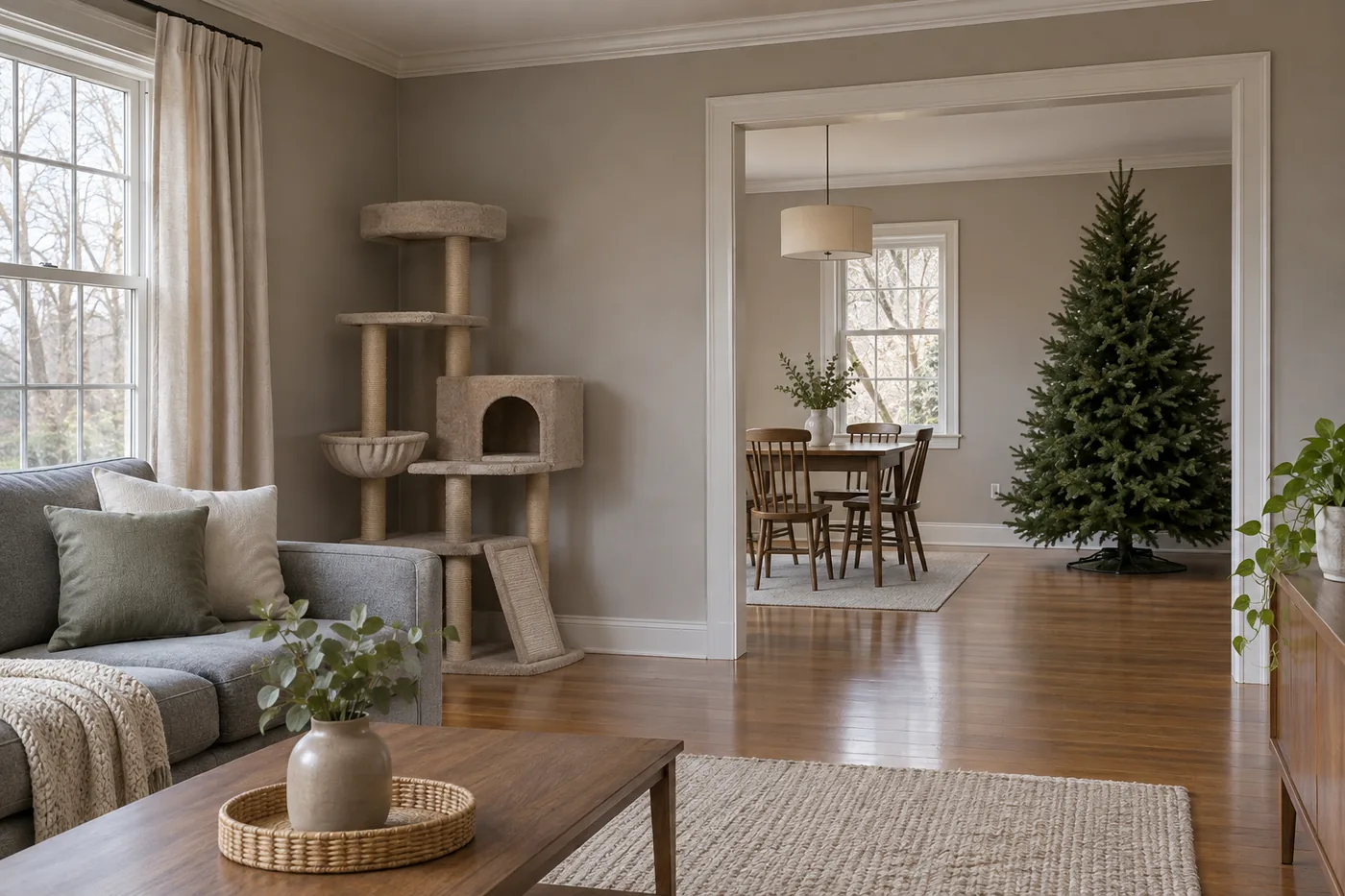 Reserve the decorating space without displacing the tower's base or wall attachment.
Part 5Log E: Close the repair entry
Record unresolved movement or damage before making the tower available again. Under Mau's stop-use guidance, persistent looseness leaves the repair unfinished. That means returning to the maker for approved parts or a replacement decision, not compensating with another improvised weight.
For an existing Cat Tree King tower, its FAQ offers help with damaged or missing parts and states a one-year manufacturing-defect guarantee. But that is not blanket coverage for wear, and it does not establish compatibility with another brand. Send the model details and photographs before ordering a part.
Keep the instructions with your log so the next inspection has something concrete to compare. Mau specifies monthly inspections, more often in multi-pet homes, plus regular checks of wall fixings. So follow your own maker's schedule and revisit the setup if a move or decorating change affects it.
Finally, a published weight limit is not a reason to ignore new movement. Mau says its limits apply per platform and warns that dynamic forces can still cause tip-over within tested limits. The useful closing entry is what was corrected and what still needs work, not an invented stability score or a jumping challenge for the cat.
Sources and selection: Mau's safety guide and model assembly index, plus Cat Tree King's parts and warranty FAQ, informed the checks for sound connections, even support, and suitable securing. Manufacturer guidance last checked November 24, 2026.
In one sentence
Trace the wobble through connections, floor support, and the maker's securing instructions before adding weight or rearranging for the holidays.
Frequently asked questions
Can I add weight to a wobbly cat tree base?
Ask the exact model's maker whether ballast is allowed, where it belongs, and how it must be secured. Mau's opened safety guide does not provide a universal ballast amount, and added weight does not resolve damaged connections or replace required securing.
Can a renter secure a cat tower without drilling?
Mau says not to rely on adhesive-only fasteners. Get permission for an appropriate installation or ask the maker about a suitable alternative; keep an unstable tower unavailable while that is unresolved.
Does a large cat tree's weight limit guarantee it will not tip?
No. Mau states that its limits apply per platform with proper assembly on a level, stable surface, and warns that dynamic forces such as leaping can still cause tip-over within tested limits.
How often should cat tree connections and anchors be checked?
Mau calls for monthly inspections, more frequently in multi-pet homes, and regular wall-fixing checks. Follow your own model's instructions and reassess the setup when relocation or new movement changes its condition.
Sources
- Mau Product Safety & Securing Guide · 2026-11-24
Recommends wall securing for Mau products taller than 20 inches and monthly inspections, more often in multi-pet homes. Also specifies stop-use conditions, level surfaces, approved parts, load-rated hardware, and no adhesive-only fasteners; no universal ballast amount is listed.
- Mau model-specific assembly videos · 2026-11-24
Lists separate assembly resources for models including Cento and Ivy. No numerical torque, ballast allowance, or fastener dimensions were taken from this index.
- Cat Tree King replacement and warranty FAQ · 2026-11-24
States a one-year manufacturing-defect guarantee for its cat trees and assistance with damaged or missing parts. This does not establish coverage for ordinary wear or compatibility with other manufacturers.