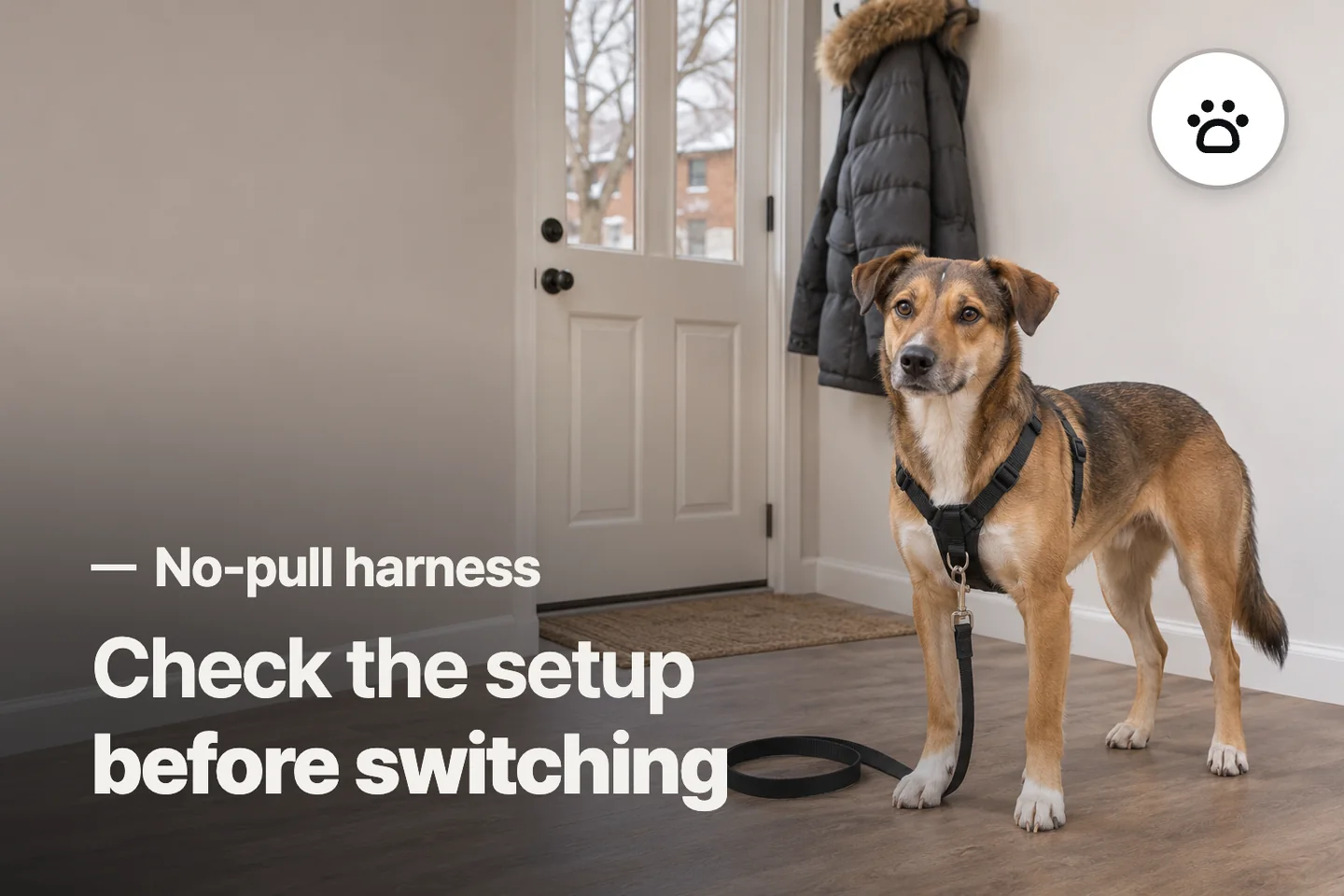
Is another no pull harness really going to help when your new rescue is already dragging you toward the apartment exit? The gear aisle makes replacement look simple. But the useful question is whether the straps shift, the leash is attached incorrectly, or the doorway is harder than the dog’s training so far.
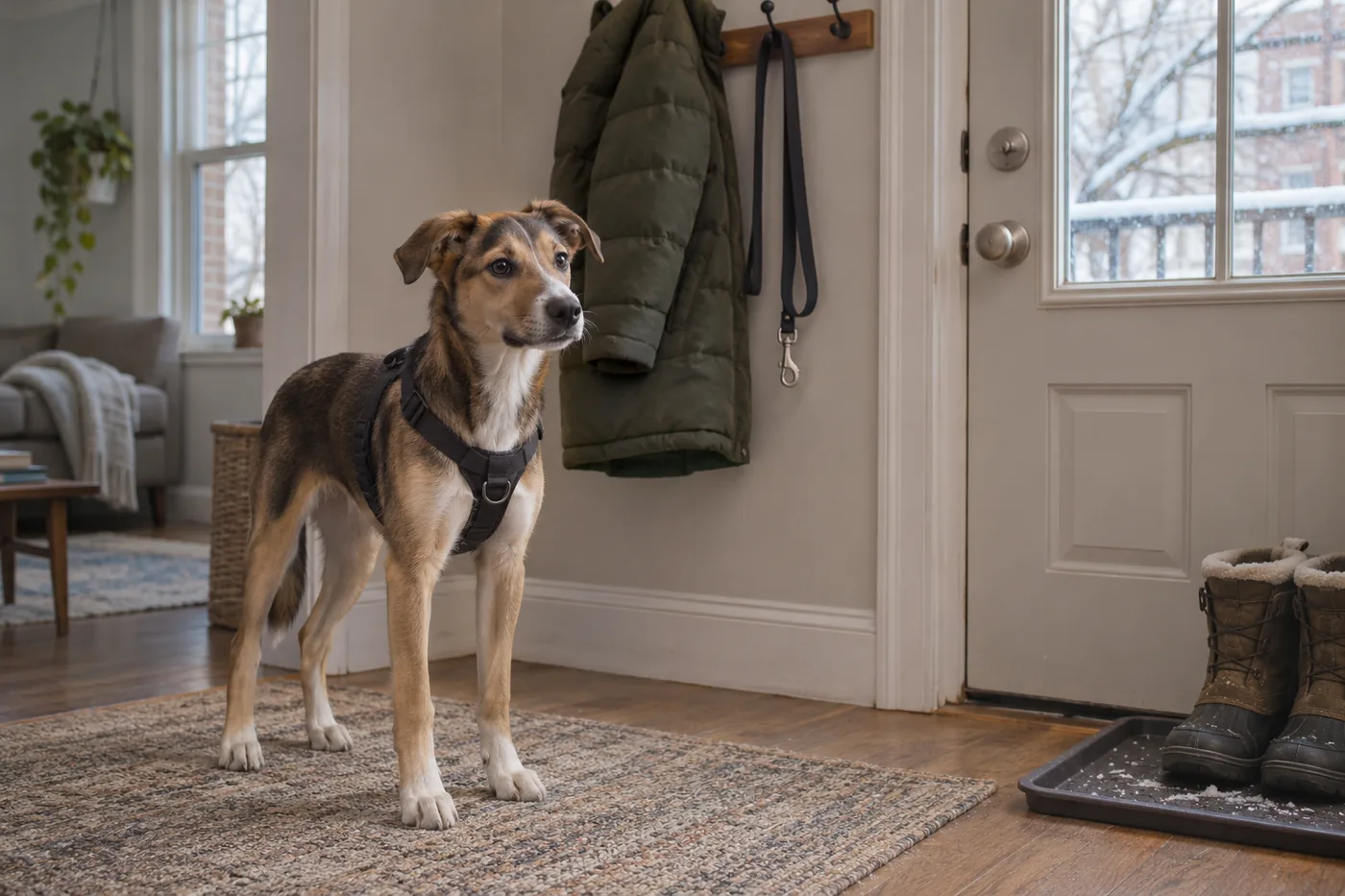 Start the setup check inside, away from the elevator and sidewalk traffic.
I would keep a harness that holds its intended fit and work on the departure routine first. The PetSafe Easy Walk Harness is my conditional replacement choice if the present harness cannot fit correctly, because PetSafe provides specific strap-position and training instructions. That makes it something you can check, rather than another promise on a package.
Use the labeled checks below as a log of your dog’s responses. Record the starting position, what you changed, and what happened along the same quiet indoor route afterward. This separates a moving strap from a dog who only surges when the door opens.
How we chose
Reviewed PetSafe’s sizing chart, fitting instructions, and leash-training sequence alongside AKC and ASPCA guidance. The three checks are strap stability, the designated leash attachment, and reward timing; the listed harness is a conditional replacement, not a claim of measured training results.
Toneandroom picks
Best no pull harness for a fit-related replacement: Top 1
A replacement only when the present harness cannot maintain its intended fit and the Easy Walk matches current measurements
PetSafe Easy Walk Harness
PetSafe maker-direct displayed item price: $22.99 for the linked Black/Tan Petite configuration, checked 2026-11-24. Other sizes, tax, shipping, and checkout total require confirmation; Amazon price n
Model-specific fitting diagrams and a defined front-attachment training sequence make setup checks possible before further purchases.
- Adjusters
- 4 points
- Clip
- Front chest
- Small chest
- 9–12 in
- Small girth
- 15–21 in
- Current measurements match the chart
- You want a defined front-clip setup
- Sizing needs chest width and girth
- Remove between walks, per PetSafe
What we considered
Fit stability
Can the harness hold the position its maker illustrates?
PetSafe publishes both chest-width and girth measurements. A replacement only earns its place here if the dog’s current measurements and the illustrated strap layout agree.
Leash connection
Is the leash attached to the intended walking point?
The Easy Walk uses the front martingale D-ring with a standard nylon leash. A convenient ring elsewhere does not provide the same instructed setup.
Reward timing
Can you reward a loose leash in the easier setting?
PetSafe pairs the harness with immediate rewards when the dog returns alongside. Equipment that fits still needs practice before the apartment exit becomes the classroom.
Part 1Check A: Does the no pull harness stay in place?
Start with the dog standing comfortably indoors, before adding the winter coat. For the Easy Walk, PetSafe places the shoulder and belly straps in a vertical line, with the chest strap horizontal and the front martingale loop centered. Together, those straps should resemble a sideways T, not a chest loop hanging toward the legs.
PetSafe specifies 1–2 fingers beneath the shoulder strap and says the harness should not slide over the fur when gently checked for rotation. This is the maker’s instruction for this model; another harness may need a different fit check. Revisit the adjustment once the dog relaxes instead of tightening every strap at once.
The Easy Walk has 4 adjustment points, but adjustment cannot make an unsuitable size fit. PetSafe’s Small chart lists chest width of 9–12 in and girth of 15–21 in, so measure both rather than shopping by your rescue’s guessed breed. Those measurements describe Small only, not every configuration.
PetSafe’s linked Black/Tan Petite page displays $22.99, checked November 24, 2026. That is a maker-direct item price for that configuration, not a Small-size quote or an Amazon price; check the correct size and checkout total separately. I would not replace a well-fitting harness just to get more adjustment points.
Part 2Check B: Which ring is doing the work?
For the Easy Walk, PetSafe identifies the D-ring on the front martingale loop as the leash attachment. So a ring elsewhere on the harness is not an alternative walking connection just because the clip fits through it. With another model, follow that maker’s attachment diagram.
PetSafe calls for a standard 4–6 ft nylon leash, excluding retractable and bungee designs. That gives you a fixed line to manage, but you still need working slack rather than a constantly tight lead. The maker says to allow some slack without letting the dog travel several feet ahead.
Swipe sideways to see the full table →
| Log entry | What changes the next step | Next action |
|---|---|---|
| Chest loop moves off center | Fit changes before the doorway | Return to the fitting instructions |
| Leash catches under a leg | The line is interfering with walking | Pause and clear it before continuing |
| Fit holds until the door opens | The transition increases difficulty | Rehearse farther from the exit |
After adjusting, repeat the same quiet route and note whether the harness still shifts. If the equipment stays in position but tension starts at the elevator, change the setting before changing the gear. That is a more useful next check than comparing another set of buckles.
A stable fit and the correct attachment let you check the walking routine separately.
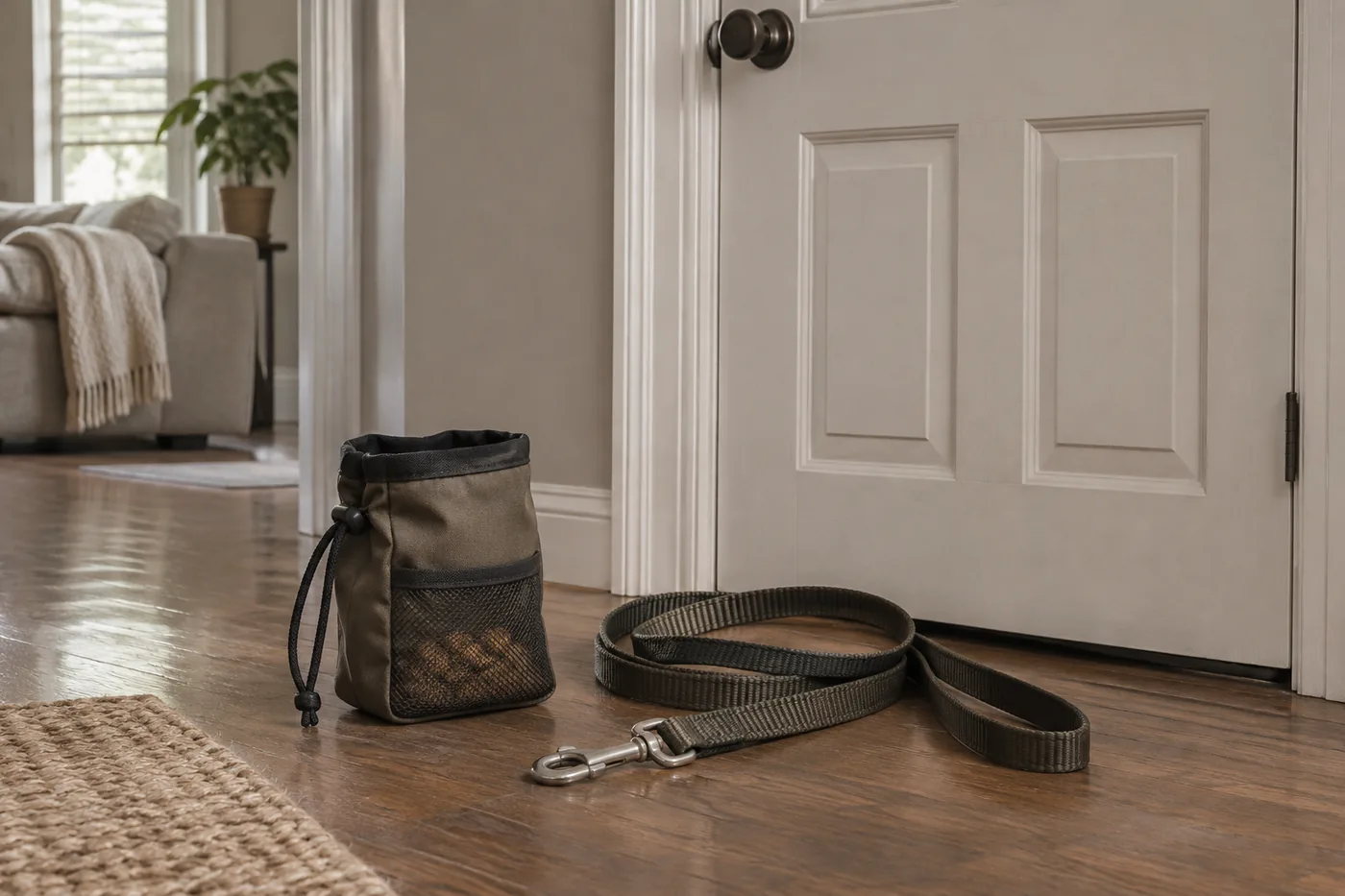 A quiet indoor route makes it easier to spot when slack disappears.
Part 3Check C: Does the reward arrive before the next surge?
The American Kennel Club’s puppy leash guide starts with a marker, such as “yes,” paired with a treat, then rewards attention and walking nearby. For a rescue whose walking history is uncertain, begin with those simple indoor exercises rather than assuming the cue is already understood. This is a starting exercise, not a prediction about how quickly your dog will learn.
Keep the treat available when you mark the behavior, because the AKC says the marker should be followed by the expected reward. Then reward the dog for remaining near you while the line is loose. Waiting until the next lunge makes it harder to connect the reward with the behavior you wanted.
When tension starts, PetSafe’s sequence is to slow or stop without a sudden tug. Once the dog comes alongside, release tension and reward promptly, then move again. So your log should capture what happened immediately before forward movement resumed, not merely whether you reached the lobby.
PetSafe limits sessions to no more than 15 minutes and says training time differs between dogs. That is a ceiling, not a session target or a deadline for improvement. End sooner if necessary, and return to an easier setting rather than stretching practice to fill the clock.
The AKC introduces outdoor distractions after indoor or yard practice is understood. Following that progression, a quiet closed doorway can come before an elevator opening onto other dogs. If pulling remains beyond what you can manage, the AKC recommends getting help from a professional trainer.
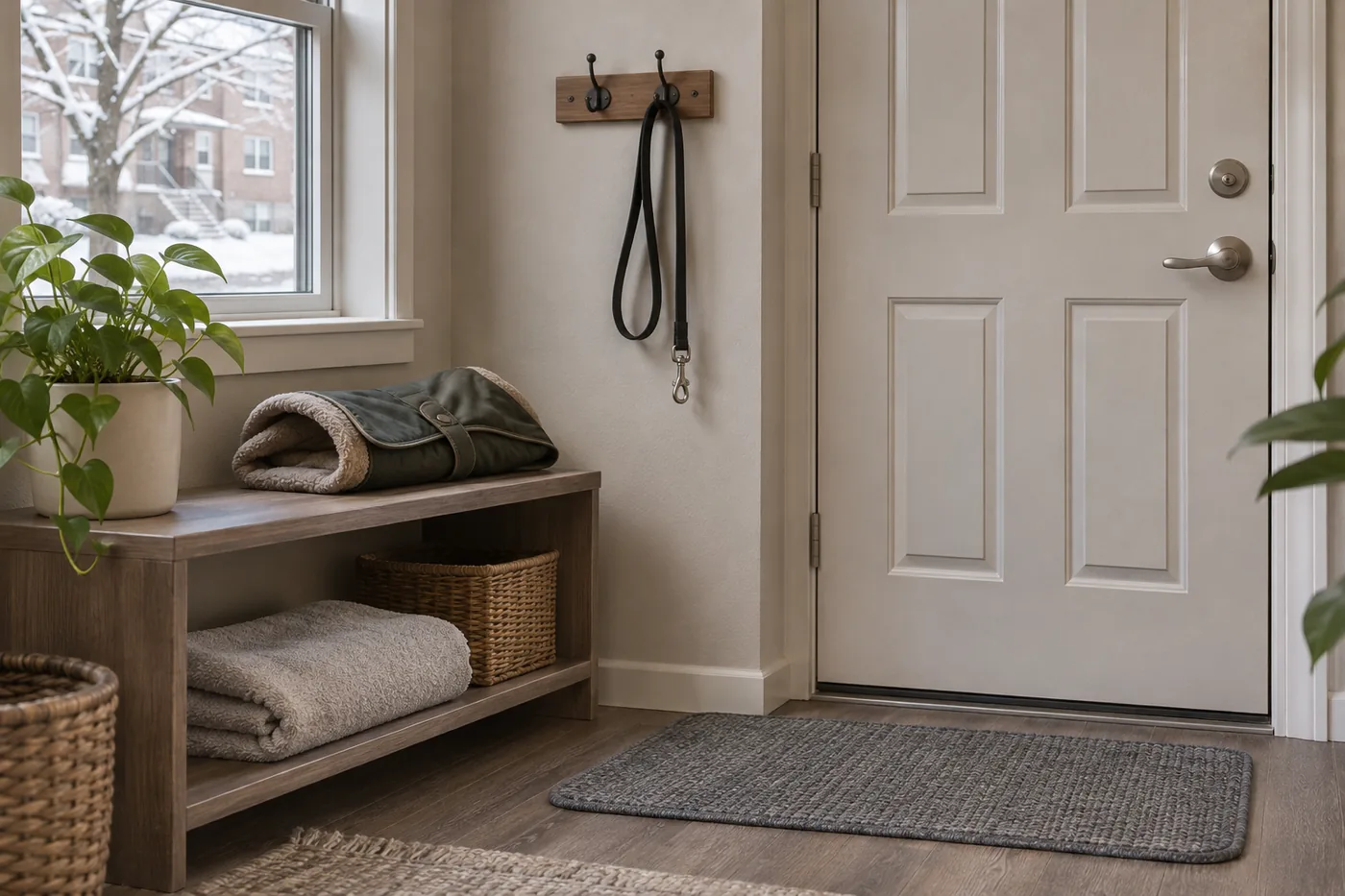 Keep winter cleanup supplies by the door so the walk can end calmly.
Part 4Check D: Is winter changing the problem?
Recheck strap position with the coat arranged as it will be during the walk. If the coat shifts the chest loop, return to the maker’s fit instructions rather than accepting a different attachment position. A front clip does not provide traction, so move training off slick pavement instead of practicing abrupt stops there.
ASPCA advises keeping dogs leashed on snow and ice, then washing and drying their feet and stomach after walks to remove ice, salt, and chemicals. It also calls for checking paw pads and between toes for irritation. If movement changes or a paw appears painful, pause the exercise and seek veterinary advice rather than treating discomfort as a training failure.
Finish the log by noting whether the harness stayed positioned, the leash remained manageable, and rewards followed slack. Those observations tell you what to repeat indoors before the next departure. PetSafe also instructs owners to take the Easy Walk off after walking.
Method: Sources were PetSafe’s product chart, fitting guide, and training instructions, plus AKC leash-training and ASPCA winter guidance. The checks prioritize fit stability, correct attachment, and reward timing; replacement is conditional on a fit problem, not price ranking. Source pages and the configuration-specific maker price were checked November 24, 2026.
In one sentence
Check fit and attachment indoors, then practice rewarding slack before taking the routine to the apartment exit.
PetSafe Easy Walk Harness
Check price on AmazonFrequently asked questions
Why does my dog still pull in a no pull harness?
A shifted harness, an incorrect attachment, or distractions beyond the dog’s current training can each require a different response. PetSafe pairs its harness with a reward routine; check the fit indoors before expecting the equipment to change behavior.
How tight should the PetSafe Easy Walk Harness be?
PetSafe specifies room for 1–2 fingers beneath the shoulder strap, a centered chest loop, and a sideways T layout. It says the harness should not slide across the fur during its rotation check; use this model’s instructions rather than applying that rule to every harness.
Which leash works with the Easy Walk Harness?
PetSafe specifies a standard 4–6 ft nylon leash connected to the front martingale D-ring. It excludes retractable and bungee leashes and calls for some slack without allowing the dog several feet of forward travel.
How long should loose-leash practice last?
PetSafe says no more than 15 minutes per session and does not give a fixed completion date. Shorter practice in a manageable indoor setting is appropriate before adding doorway and outdoor distractions.
Sources
- PetSafe Easy Walk Harness · 2026-11-24
$22.99 displayed on linked Black/Tan Petite product page; 4 adjustment points. Small chart: chest width 9–12 in and girth 15–21 in. Price is not a Small configuration or Amazon quote.
- PetSafe Easy Walk fitting instructions · 2026-11-24
1–2 fingers under shoulder strap; vertical shoulder/belly line, horizontal chest strap, centered martingale, sideways T, and no sliding over fur in rotation check. Recheck after the dog relaxes.
- PetSafe Easy Walk training sequence · 2026-11-24
4–6 ft standard nylon leash; no retractable or bungee leash; sessions no longer than 15 minutes. Front D-ring attachment, immediate release and reward alongside, no sudden tugs, and removal after walking.
- American Kennel Club leash-training guide · 2026-11-24
Lists lightweight 6 ft leashes; used here for qualitative marker-and-treat instruction, rewards for attention and nearby walking, indoor-to-outdoor progression, and professional training help. Its puppy guidance is not evidence of a rescue-specific improvement rate.
- ASPCA cold-weather safety tips · 2026-11-24
No numerical claim used. Advice covers leashing on snow and ice, washing and drying feet and stomach after walks, and checking pads and between toes for irritation.