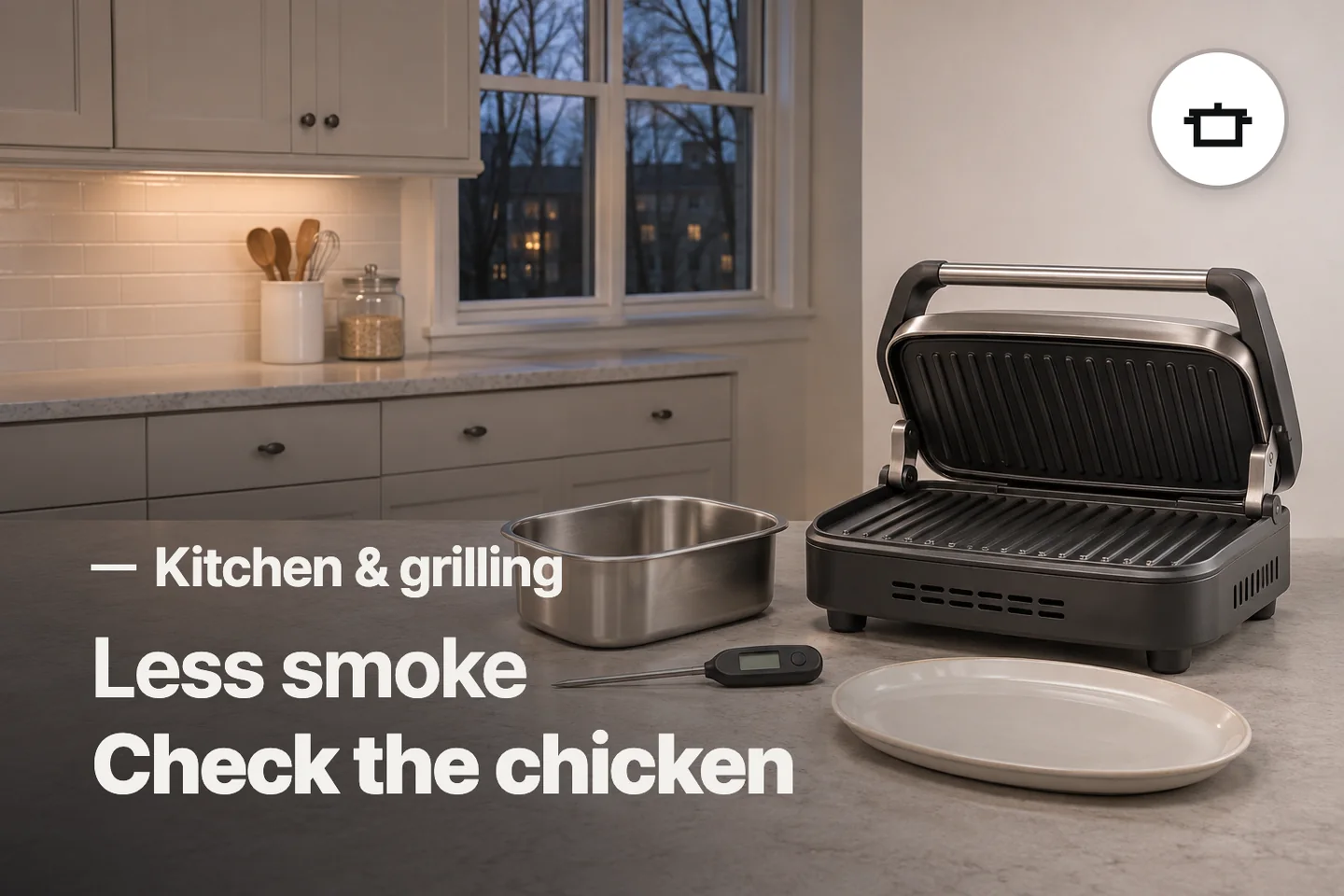
Hot grease has a sharp smell, and when it drifts from an apartment kitchen toward the coats by the door, a browned chicken breast with a pink middle feels like another thing going wrong. With the backyard grill covered and dinner for five waiting, the useful move is to separate the problems: fix the smoke at the appliance, check doneness in the food.
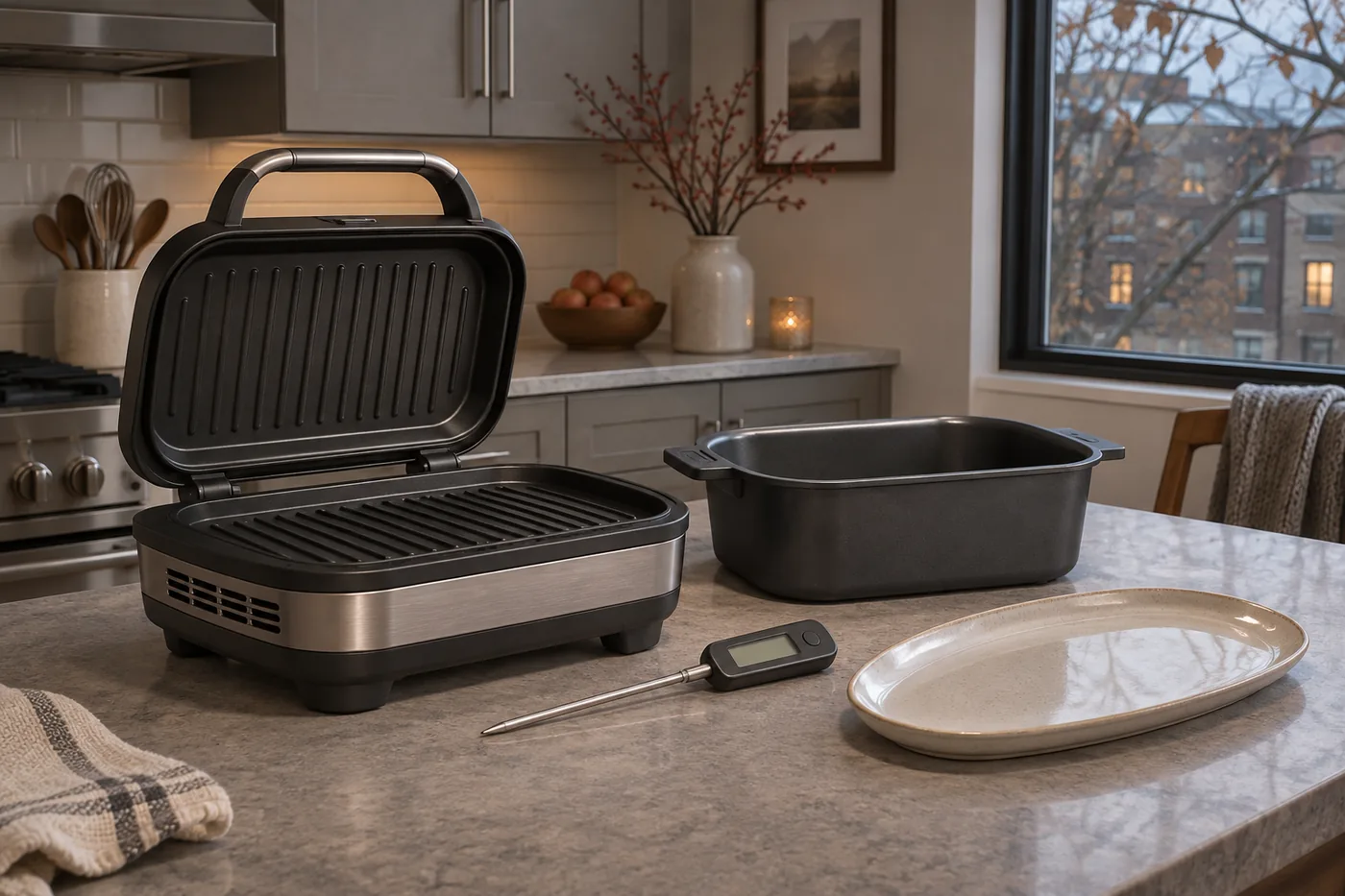 A clear counter, a separate serving platter and a food thermometer make room for different checks.
For the Ninja Foodi AG301, I would start with the removable pot, splatter shield and preheat routine rather than buy a new accessory. These instructions come from Ninja's North American AG300-series guide; a different Foodi model needs its own manual, even if the controls look familiar.
How we chose
Reviewed Ninja's model-specific instructions and MEATER's probe guidance, retaining the original FDA guidance where the page was unavailable. The three checks are correct appliance assembly, oil and grease handling, and internal food temperature; no accessory purchase is needed for its own sake.
Part 1Start with a cool grill and the right parts
Ninja specifies at least 6 inches above and on every side for air circulation, so the usable space is the clear counter around the grill, not the size of the apartment. Its guide also prohibits an extension cord and blocked air vents. That means a crowded corner beneath a low cabinet is not a setup to work around by turning down the heat.
With the grill unplugged and cool, check that the cooking pot is seated in the base and the grate sits inside it with its handles facing up. Then check the splatter shield beneath the hood: Ninja requires both the pot and shield during operation, so neither belongs in the sink while dinner cooks.
There is a point where troubleshooting ends. Black smoke or a grease fire means stop: Ninja directs owners to unplug immediately and wait until smoking stops before removing cooking accessories. That is not the moment to open the grill and investigate the drips.
Part 2Give the grate its own preheat
Select Grill and the ingredient's recommended setting, then close the hood and start the preheat cycle with the grate installed. Ninja describes approximately 8 minutes, depending on the setting, but the normal cue is the completed cycle and flashing Add Food message, not a countdown borrowed from a recipe.
A warm appliance can complicate that cue. If another function has heated the unit but the grate goes in at room temperature, Ninja says Add Food may appear immediately; in that situation, its guide calls for at least 6 minutes of grate heating before adding ingredients. So a warm cooking chamber is not necessarily a ready grill grate.
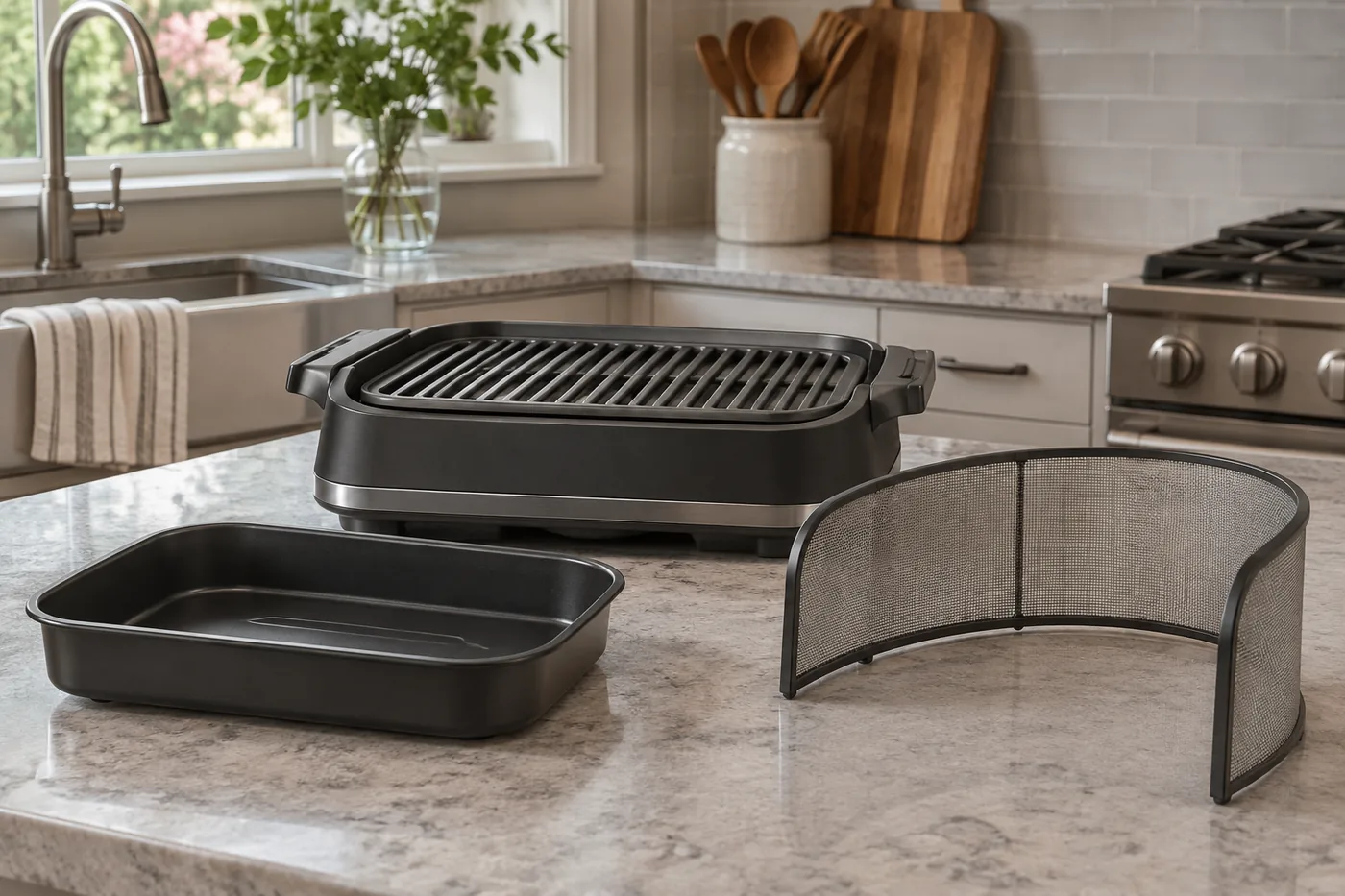 The pot below the grate collects drips; the shield belongs beneath the hood during cooking.
Preheat cannot make an unsuitable setting suitable. Ninja's troubleshooting instructions say to use the recommended Grill temperature for the ingredient and check that the shield is installed, rather than simply raising the temperature whenever chicken needs longer. That distinction matters when the surface is already browned and the middle still needs checking.
Part 3Follow the oil into the cooking pot
Ninja recommends canola, coconut, avocado, grapeseed or vegetable oil instead of olive oil to reduce smoke. So look at what coats the chicken, including its marinade, before adding another layer of oil to the grate; the oil already on the food counts. This is an ingredient check, not a promise of a completely smoke-free kitchen.
On this model, the grease collector is the removable cooking pot under the grate, not a separate slide-out tray. Ninja says to empty accumulated oil after every 2 batches and allow the grate 3–5 minutes between batches to recover for consistent grill marks. Those are separate tasks: removing collected grease addresses burning drips, while reheating prepares the grate for the next batch.
Ninja warns against moving the appliance during use and calls for protective mitts when handling hot removable parts. For disassembly and cleaning, its instructions say to unplug and let the appliance cool; the splatter shield needs cleaning after every use. So plan the batch sequence around those precautions instead of trying to tip grease out of a running grill.
For five dinners, work in batches when the food will not fit comfortably on the grate, rather than pile chicken up to finish everything together. Similar thicknesses make the sequence easier to follow, but they do not establish a shared finishing time. A clean pot cannot answer whether the thickest piece is cooked through.
Keep the jobs separate: a clean grease collector addresses smoke, while a thermometer checks the food.
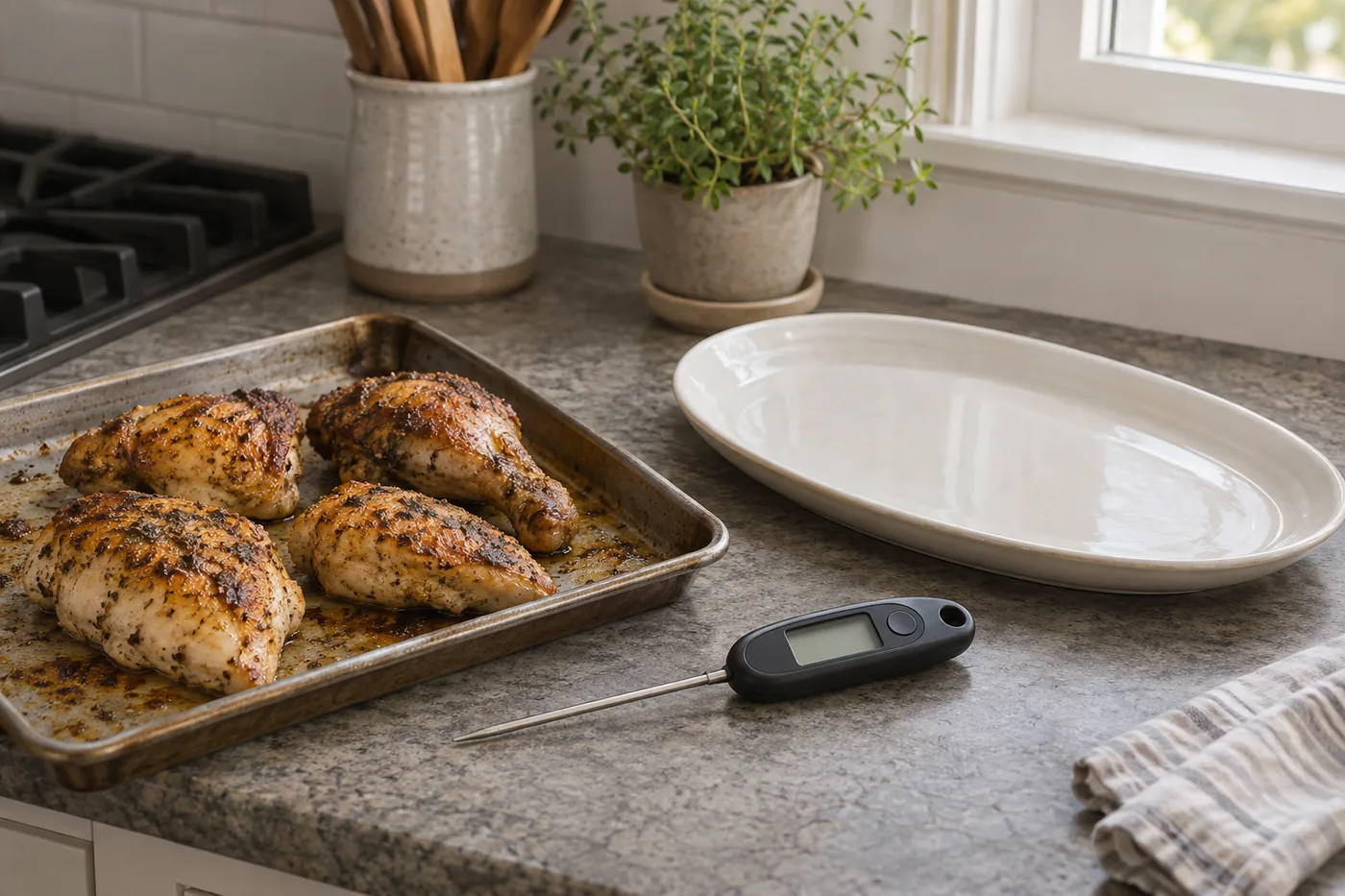 A browned outside is not a temperature reading for the center or for neighboring pieces.
Part 4Check the chicken, not its color
The FDA says color and texture do not reliably establish food safety. Its minimum internal temperature is 165°F for poultry, including chicken pieces and ground poultry; for ground beef burgers, it is 160°F. So a pink center calls for a thermometer reading, while attractive grill marks settle nothing about the middle.
Swipe sideways to see the full table →
| Food being checked | FDA minimum internal temperature | Not a substitute |
|---|---|---|
| Chicken pieces or ground poultry | 165°F | Color, texture or grill marks |
| Ground beef burgers | 160°F | A browned surface or an expired timer |
Check individual pieces in their thickest part, following the thermometer manufacturer's placement instructions. If a piece is below the applicable minimum, it needs more cooking and another measurement; a reading from its neighbor does not cover it. The FDA also says cooked food must not return to a raw-meat plate unless that plate has been washed with hot, soapy water.
Already have a suitable food thermometer? Keep it in the routine rather than treating a wireless upgrade as the repair. MEATER's insertion guidance puts its probe past the safety notch in the thickest part, away from bone, fat and gristle, with the ambient end outside the meat; that placement may not fit a thin cutlet.
MEATER identifies instant-read thermometers as useful for thinner foods, but those instruments are not intended to stay inside the grill. A leave-in probe also needs permission from both its own instructions and the appliance's accessory rules, so an impressive heat rating alone is not enough. If abnormal operation persists after correct assembly, cleaning and settings, stop using the grill and contact Ninja rather than opening its housing.
Method: Ninja's AG300-series instructions and MEATER's insertion guidance were checked on November 24, 2026. The FDA page could not be retrieved on that date, so its temperature and handling guidance retain the original November 15, 2026 check. The focus is assembly, grease handling and measured doneness.
In one sentence
Treat indoor-grill smoke and chicken doneness as separate checks before serving dinner.
Frequently asked questions
Why is my Ninja grill smoking even after preheating?
Ninja's AG300-series instructions call for the recommended ingredient setting and an installed splatter shield. They also recommend specified oils instead of olive oil and emptying accumulated oil after every 2 batches. Black smoke is a stop signal: follow Ninja's unplugging instruction rather than continuing to troubleshoot during cooking.
Where is the drip tray on a Ninja AG301?
In the AG301 layout, the removable cooking pot beneath the grate collects grease. Do not substitute an improvised tray; follow the model's instructions for handling hot parts and cooling before cleaning.
Does pink chicken mean it needs more time on the grill?
The FDA says color and texture are unreliable safety indicators. Check each piece with a suitable thermometer against the FDA poultry minimum of 165°F; continue cooking and recheck any piece below that temperature.
Do I need a wireless meat thermometer to fix uneven chicken?
No wireless purchase is necessary if you already have a suitable food thermometer. MEATER's instructions require correct insertion past the safety notch, which may not suit thin cuts; an appropriate instant-read thermometer can be more suitable, but should not remain inside the grill.
Sources
- Ninja AG300-series owner's guide: safeguards · 2026-11-24
Ninja's reproduced guide specifies at least 6 inches above and on all sides, requires the pot and splatter shield, prohibits extension cords and gives the black-smoke unplugging instruction. Only the reproduced manufacturer's text is used, not viewer comments or automated answers.
- Ninja AG300-series owner's guide: preheat and batches · 2026-11-24
Approximately 8 minutes of preheating depending on setting; at least 6 minutes for a room-temperature grate in an already-warm unit; empty collected oil after every 2 batches; 3–5 minutes of grate recovery. Also lists oils and shield-cleaning instructions.
- Ninja AG300-series owner's guide: troubleshooting · 2026-11-24
No additional numerical claim used. Ninja's smoke troubleshooting specifies the recommended Grill setting and an installed splatter shield.
- FDA: Safe Food Handling · 2026-11-15
Original article's verified guidance retained: poultry 165°F and ground meat 160°F; color and texture are unreliable safety indicators; wash raw-meat plates before reusing for cooked food. Retrieval on 2026-11-24 returned Not found, so the original verification date is unchanged.
- MEATER: how to use a meat thermometer · 2026-11-24
No numerical specification used. Probe insertion must pass the safety notch in the thickest part, avoiding bone, fat and gristle, with the ambient end exposed. The page identifies instant-read thermometers as useful for thinner foods and not designed to remain in the grill.