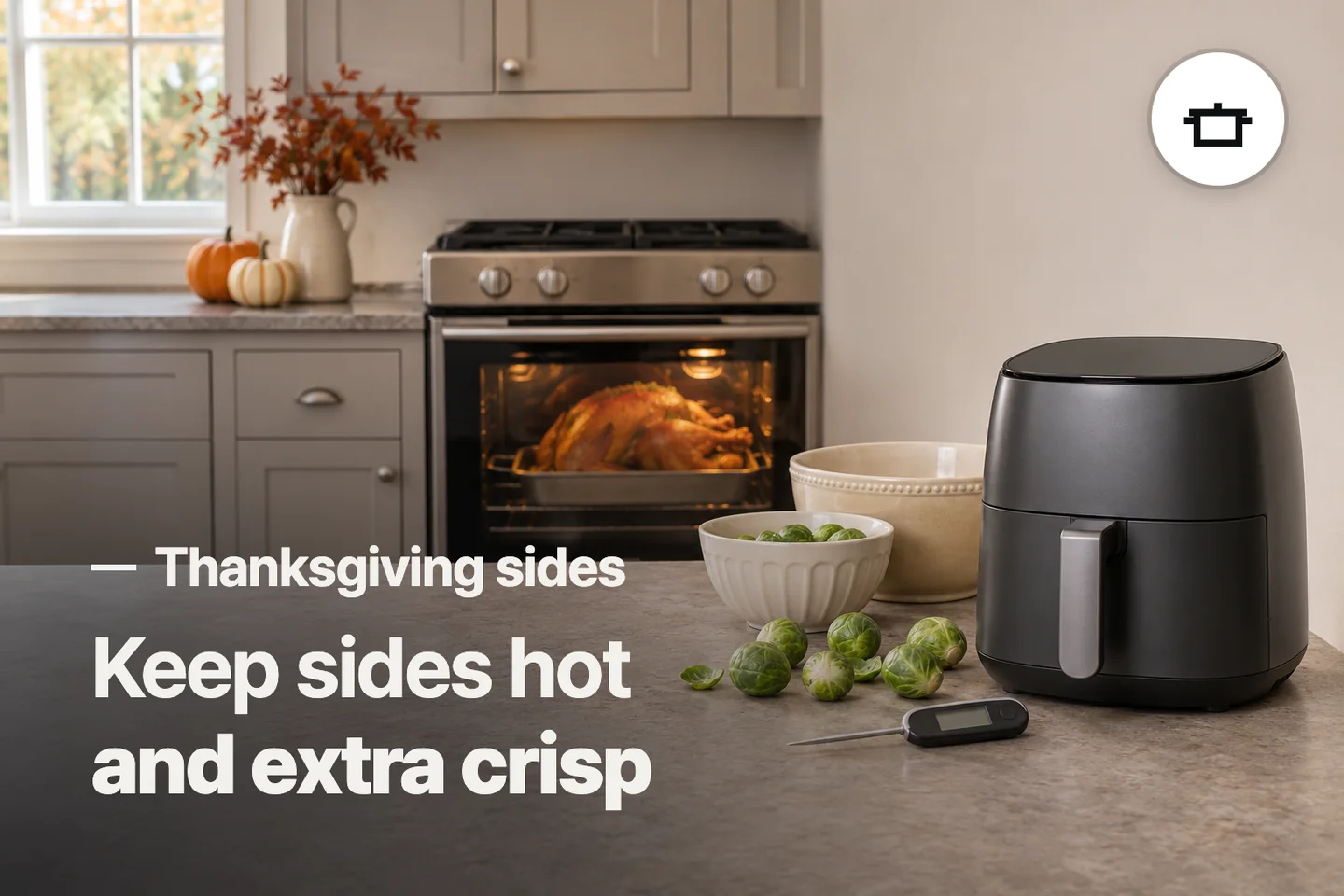
The toasted smell of Brussels sprout leaves promises dinner, until the basket opens and the vegetables underneath look wet and pale. With the turkey occupying an American kitchen’s only oven, a large air fryer becomes the obvious place for Thanksgiving sides, but a crowded basket needs a smaller load before it needs more heat.
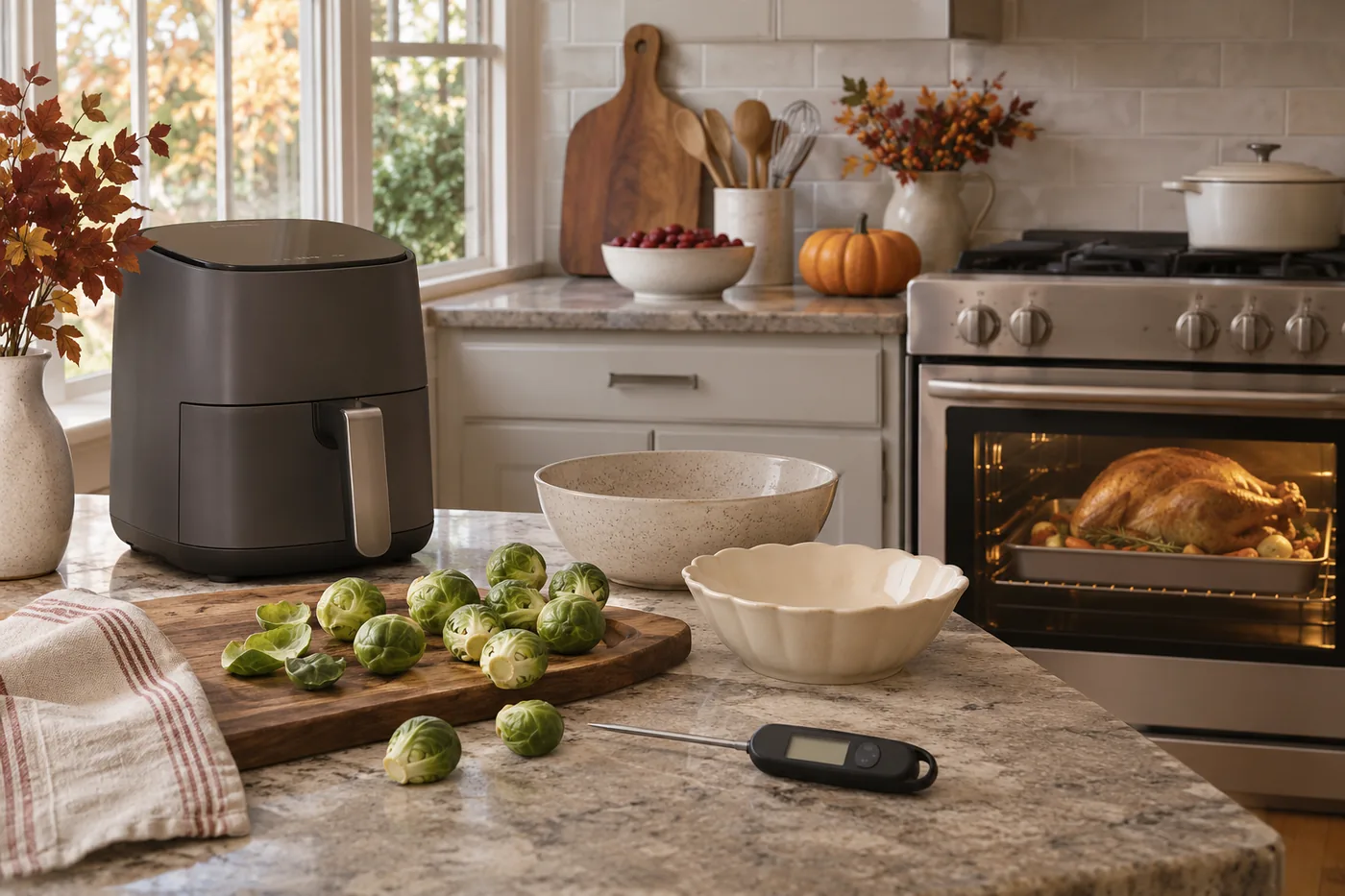 Leave room for the vegetables, not just the serving dishes.
I would start with smaller batches and a finishing order, rather than another cooker. If there is no food thermometer in the drawer, the ThermoWorks ThermoPop 2, 4.5-inch probe is the useful purchase here, because the center of a reheated casserole needs a temperature check that its browned topping cannot provide.
How we chose
Reviewed the reopened Well Plated recipe alongside the earlier FDA, FoodSafety.gov, and ThermoWorks source record. The three checks were basket loading, a workable hot-holding arrangement, and a probe suitable for center-temperature checks; inaccessible official sources retain their earlier verification dates.
Toneandroom picks
Best large air fryer helper for Thanksgiving sides: Top 1
A kitchen without a handheld food thermometer for reheated sides and hot-holding checks
ThermoWorks ThermoPop 2, 4.5-inch probe
Earlier manufacturer direct-store display: $27.30 USD, comparison $39.00, before tax and delivery; checked 2026-11-19. Listing inaccessible on 2026-11-24; current price unconfirmed. Price varies; chec
A handheld thermometer checks casserole centers and held sides without adding a wireless system; the probe must reach the center of the dish.
- Probe
- 4.5 in
- Response
- 2–3 seconds
- Accuracy
- ±1°F
- Accuracy band
- 14°F–208°F
- You need center-temperature spot checks
- You prefer a handheld tool to wireless gear
- Not a leave-in air-fryer probe
- Check probe reach and current price
What we considered
Basket loading
Can the vegetables spread loosely instead of piling up?
The cited recipe uses shaking and similarly sized pieces to support even cooking. Capacity alone cannot establish a batch size, so the first correction is dividing a crowded load.
Holding space
Where will finished soft sides stay hot?
FDA specifies an internal holding temperature of 140°F or warmer. The queue only works with a holding appliance that actually maintains that temperature; otherwise, reduce the menu.
Center checks
Can a probe reach the middle of the reheated dish?
FoodSafety.gov lists 165°F for leftovers and casseroles. The selected handheld probe supports spot checks, but its reach must suit the cookware and it is not a leave-in fryer probe.
Part 1Give the large air fryer room to work
Look beneath the browned leaves before changing the dial: are the vegetables piled together, or can they spread loosely across the cooking surface? If the upper pieces have color while the buried ones remain damp, divide the load, so the next batch is not fighting the same crowding.
Well Plated’s Brussels sprout recipe calls for similarly sized pieces and repeated shaking, which gives the vegetables a more even chance to cook. That means trimming oversized pieces to match the rest and drying washed sprouts before seasoning, rather than expecting extra cooking time to correct uneven preparation.
The basket’s advertised capacity is not a serving guarantee. A large air fryer still has a finite cooking surface, so a dish that almost fills it is a poor companion for vegetables that need room around them; use cookware and loading arrangements allowed by your appliance’s instructions.
Part 2Put soft sides ahead of the crisp finish
Start the queue with dishes whose texture can tolerate proper hot holding, and leave delicate, browned vegetables closest to serving. But that only works if another appliance can hold the soft sides at the right temperature; a covered bowl on the counter is not a substitute.
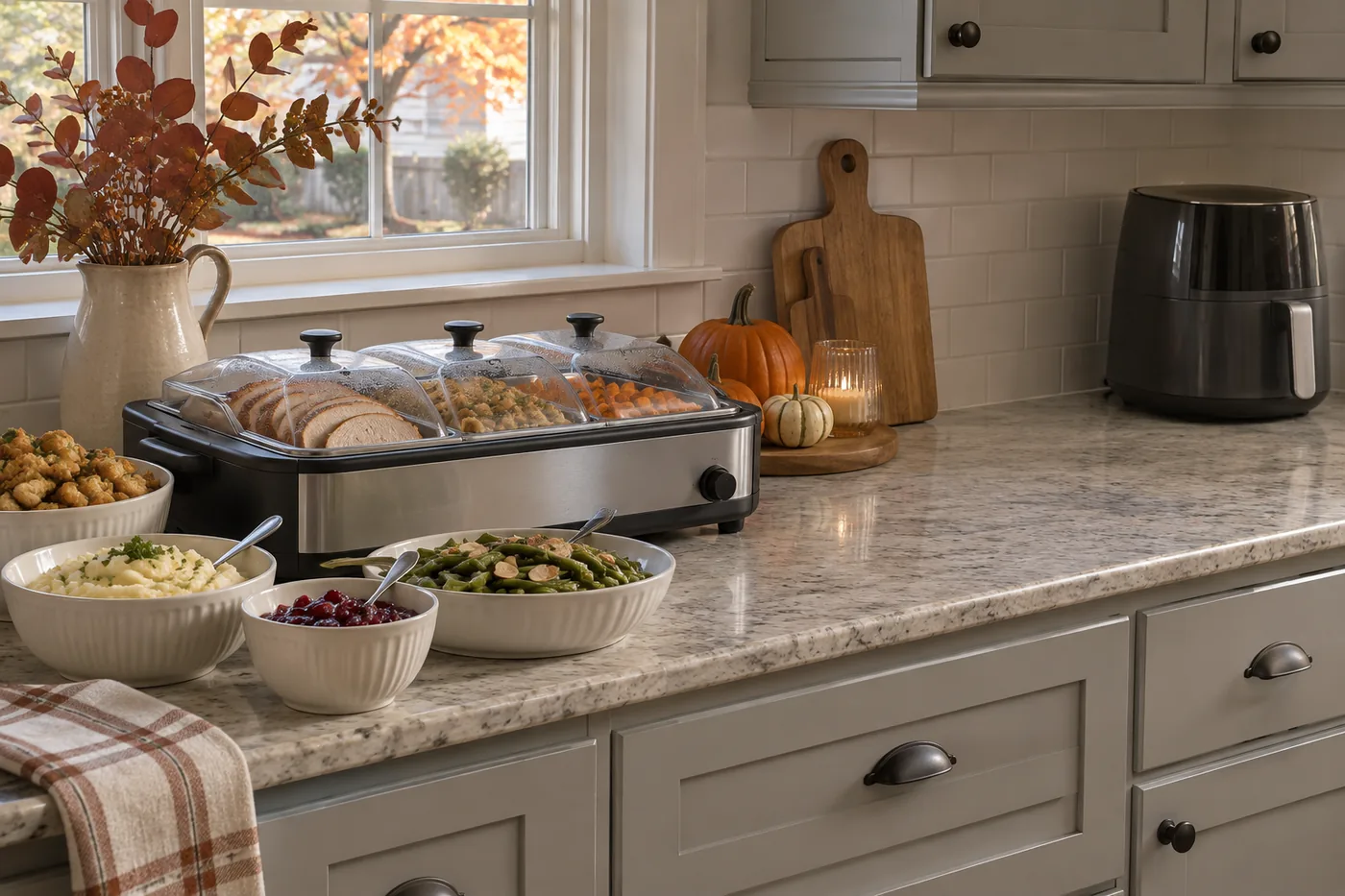 A separate holding station keeps the fryer available for the final vegetable batches.
FDA’s buffet guidance sets hot holding at an internal temperature of 140°F or warmer and names slow cookers, warming trays, and chafing dishes as options. Because FDA also warns that some warmers cannot maintain that temperature, check the food itself rather than trusting the appliance’s label.
Swipe sideways to see the full table →
| Place in the queue | What belongs here | Before moving on |
|---|---|---|
| Earlier cooking | Soft sides made with their own recipes | Move to holding that maintains FDA’s 140°F minimum |
| Before the crisp finish | A prepared casserole reheated by a suitable method | Check the center reaches FoodSafety.gov’s 165°F target, then hold hot |
| Closest to serving | Loosely loaded vegetables | Check tenderness and browning, add finishing ingredients, and serve |
Does the menu have somewhere suitable for the food to wait? If not, simplify the menu, because putting finished food back into the fryer leaves nowhere to cook the remaining vegetables.
Allow for shaking, checking, transferring, and bringing dishes to the table, not just the cooking time on the display. So when vegetables need successive batches, use smaller serving dishes and replenish them with freshly finished food; FDA recommends replacing depleted buffet dishes rather than topping up a dish already in use.
Cook earlier only when the next stop is verified hot holding; otherwise, shorten the queue.
Part 3Borrow a recipe, not a promise about every basket
For Brussels sprouts, Well Plated provides a concrete starting point: 375°F, a shake after 5 minutes, another after 5 more, then a further 2–4 minutes with checking and shaking. That is a recipe schedule, not a universal setting for every vegetable or a chilled casserole.
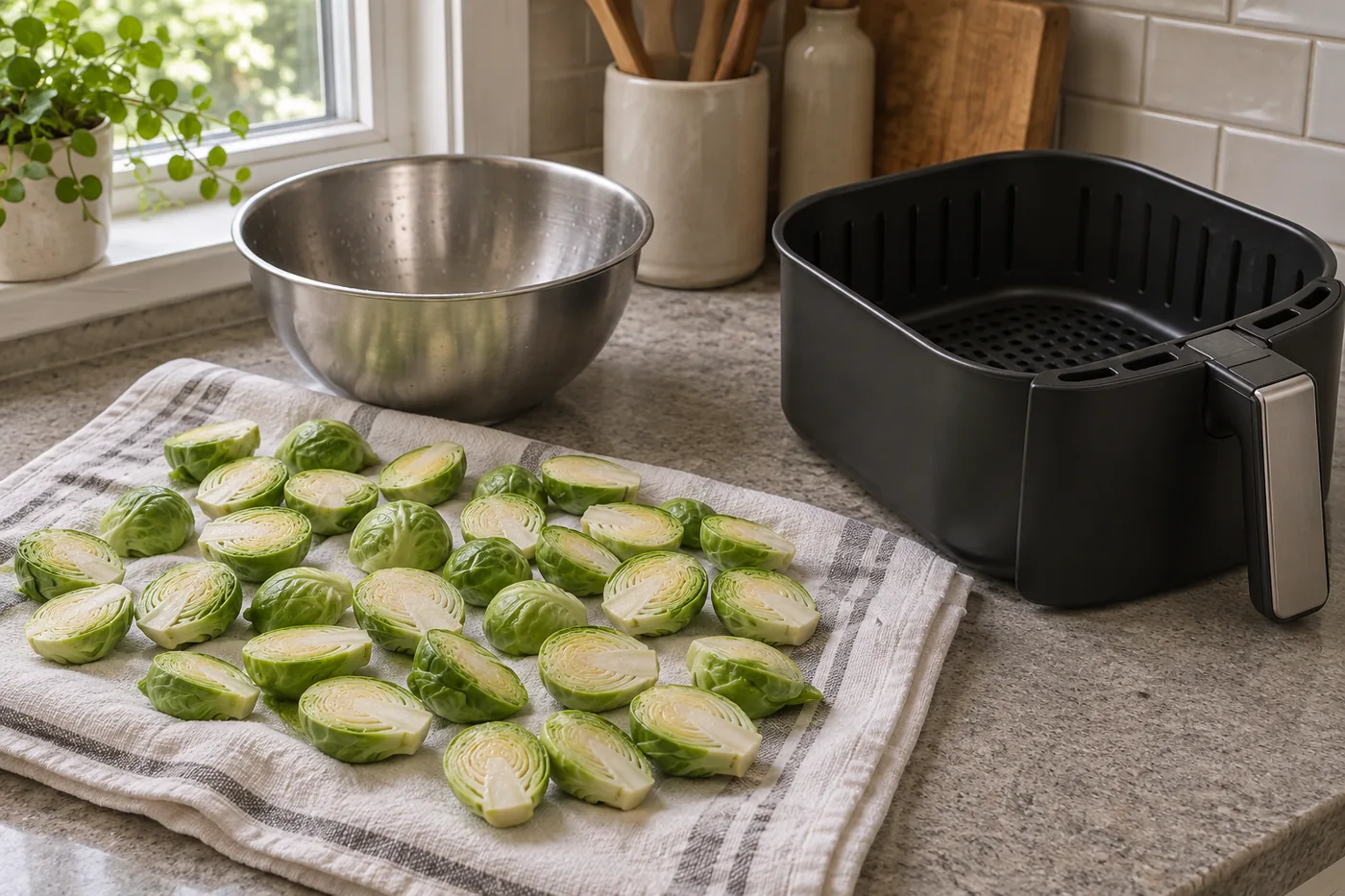 Even pieces and a dry surface give the next batch a better start.
The recipe uses 1 pound of sprouts and lists 4 servings, but those servings do not establish how much your particular basket can cook at once. So split the ingredients whenever they cannot spread loosely, and follow your appliance maker’s preheating instructions rather than copying another machine’s warm-up time.
A browned outer leaf does not tell you whether the dense center is tender. If the outside darkens while the middle stays firm, make the remaining pieces more uniform instead of repeatedly raising the heat; Well Plated also describes an optional soak for softer centers, followed by draining and drying before cooking.
Pale, damp vegetables call for a different correction: less crowding and better drying. That is why color and tenderness belong together when checking a batch, rather than treating a dark edge as the only sign that dinner is ready.
Part 4Check the casserole where the topping cannot tell you
FoodSafety.gov lists 165°F for leftovers and casseroles, including meatless casseroles. That is the temperature inside the food, not the air-fryer setting, so a reheated side needs a probe check at its center even when the topping has already browned.
For that job, I would choose the ThermoWorks ThermoPop 2, 4.5-inch probe over an unnecessary wireless setup. ThermoWorks’ previously checked specifications list a 2–3-second response and ±1°F accuracy from 14°F to 208°F, which suit spot checks of reheated dishes and held sides; confirm that the probe can reach the center of your cookware.
The manufacturer’s November 19, 2026 listing showed $27.30, against a $39.00 comparison price, before tax and delivery. That is an earlier direct-store reference, not a current offer: the official listing could not be reopened for this update, so confirm the checkout price before ordering. Price varies; check Amazon.
Use this handheld tool for spot checks, not as a probe left inside the running fryer. FDA’s holiday guidance also calls for separating raw foods from ready-to-eat foods, so keep a probe that has touched undercooked turkey away from finished sides until it has been cleaned.
FDA’s buffet guidance says to discard perishables left at room temperature for more than 2 hours, unless properly kept hot or cold. So a final crisping pass is not a way to rescue a dish that has waited too long; the serving plan needs to protect both the food’s texture and its temperature.
Sources and selection: Well Plated’s recipe was reopened November 24, 2026. FDA, FoodSafety.gov, and ThermoWorks details are retained from the November 19, 2026 source record because those pages could not be reopened for this update. Selection considered loading, holding arrangements, and center-temperature checks; the cooking queue is editorial guidance rather than a timed trial. The earlier manufacturer price excludes tax and delivery.
In one sentence
Split crowded vegetable loads, hold soft sides at a checked temperature, and save the crisp finish for serving time.
ThermoWorks ThermoPop 2, 4.5-inch probe
Check price on AmazonFrequently asked questions
Can a large air fryer cook all the Thanksgiving sides together?
Not simply because its capacity label looks generous. Vegetables need loose loading, and finished soft sides need a separately verified hot-holding arrangement; split the loads or reduce the menu when either space is missing.
What temperature does the Brussels sprout recipe use?
Well Plated specifies 375°F, shaking after 5 minutes and after 5 more, then cooking another 2–4 minutes while checking and shaking. It uses 1 pound of sprouts, but that does not establish the right load for every basket.
What is the difference between reheating and hot-holding temperatures?
FoodSafety.gov lists 165°F inside leftovers and casseroles. FDA lists 140°F or warmer for hot holding after proper cooking or reheating; neither figure is an air-fryer dial setting.
Do Thanksgiving sides need a wireless meat thermometer?
A handheld instant-read thermometer is sufficient for spot checks of reheated sides and hot-held food. Use the ThermoPop 2 as a handheld tool, confirm its reach suits the dish, and do not leave it inside the running fryer.
Sources
- FDA holiday food safety · 2026-11-19
Earlier source record: 165°F for turkey and stuffing; separates raw and ready-to-eat foods. Reopening failed on 2026-11-24; original verification date retained.
- FDA safe buffet guidance · 2026-11-19
Earlier source record: hot holding at 140°F or warmer; discard room-temperature perishables after more than 2 hours unless properly held hot or cold; replace depleted dishes. Reopening failed on 2026-11-24.
- FoodSafety.gov internal temperature chart · 2026-11-19
Earlier source record: 165°F for leftovers and meat or meatless casseroles, measured inside the food. Reopening failed on 2026-11-24; original verification date retained.
- ThermoWorks ThermoPop 2, 4.5-inch probe · 2026-11-19
Earlier source record: selected red 4.5-inch model displayed $27.30 USD against $39.00 before tax and delivery; 2–3-second response; ±1°F accuracy from 14°F to 208°F. Reopening failed on 2026-11-24; price and specifications not newly verified.
- Well Plated Brussels sprouts recipe · 2026-11-24
Reopened recipe: 375°F; shake after 5 minutes and after another 5, then 2–4 more minutes; 1 pound sprouts. Similar-sized pieces, optional soaking, and drying before cooking; recipe timing is attributed, not independently measured.