Hardwood smoke curls past a frost-white patio chair, but the number on the smoker keeps dropping while dinner waits inside. For a family trying to get a roast onto the table in cold weather, the useful distinction is a temperature that recovers versus a fire that keeps fading, not whether the display ever moves.
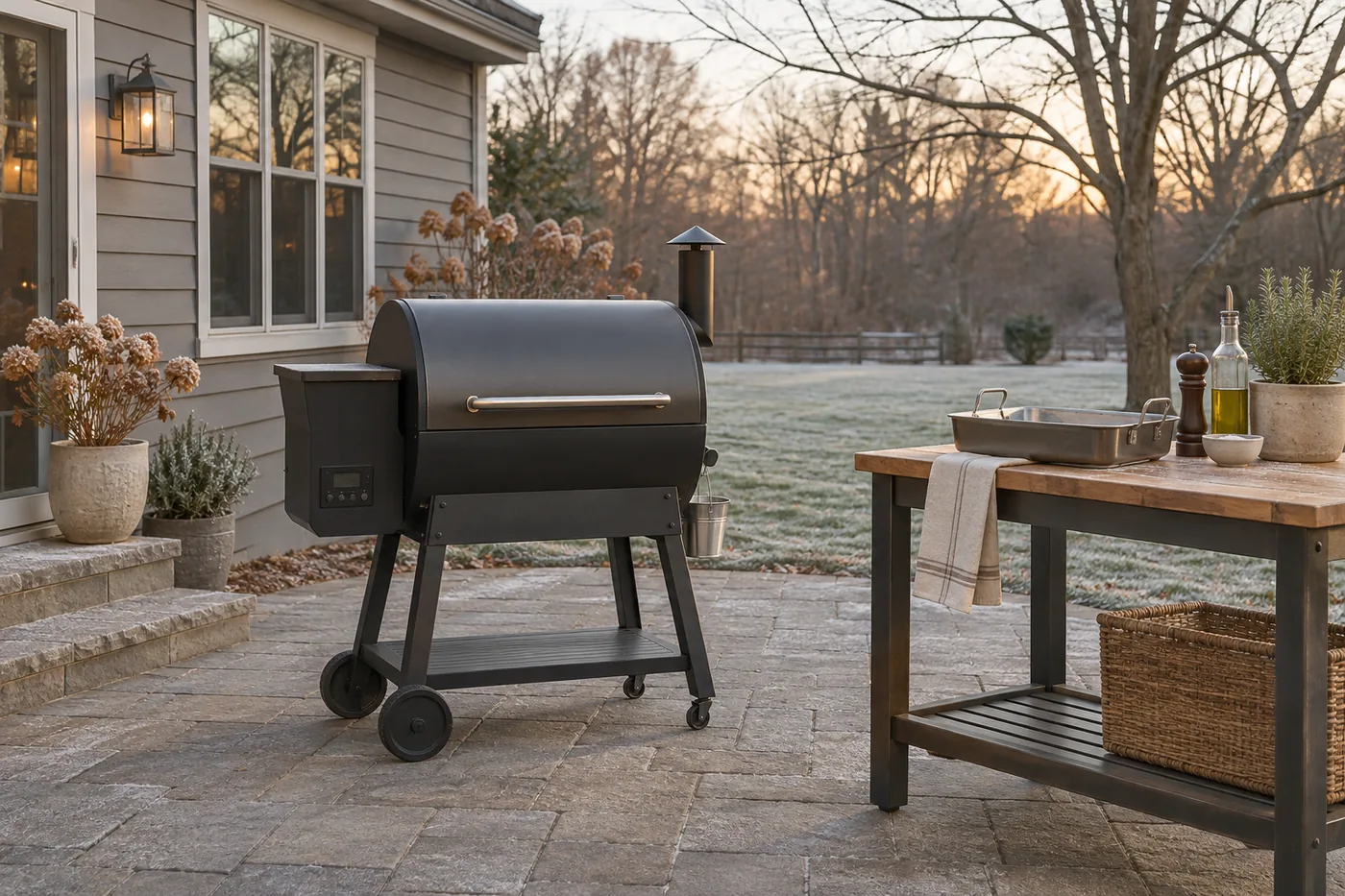 Cold-weather cooking starts with an open outdoor position and room around the cooker.
For a Pit Boss pellet smoker, I'd work through the existing fuel, cold firepot, and airflow before spending anything on insulation. That sequence gives you something concrete to check, while a blanket bought for an unidentified model may solve nothing. Keep an oven-finishing recipe available before the outdoor cook begins.
How we chose
Pit Boss's FAQ, maintenance instructions, winter advice, and controller explanation were reviewed to distinguish heating cycles from combustion trouble. The checks follow three priorities: usable fuel, unobstructed combustion airflow, and outdoor heat loss. No accessory is selected without the smoker's exact model.
Part 1Separate a heating cycle from a failing fire
Pit Boss's FAQ describes swings of approximately ±25°F when the auger delivers pellets at timed intervals. But that explanation belongs to that feeding system: the company's controller guide describes PID control as adjusting pellet delivery in response to the chamber temperature. So find your model's controller type before treating a general figure as its accuracy promise.
Watch whether the reading returns toward its setting with the lid closed, rather than changing the setting at every dip. Pit Boss cautions against using the lid to regulate heat outside the Smoke setting because incoming cold air can prompt further controller reactions. Leave the setting alone while checking the trend; a continuing decline, a flameout, or an error needs the model's troubleshooting instructions instead.
Which temperature are you watching? Pit Boss says the lid thermometer and digital controller reading can differ by up to 100°F, so those readings are not interchangeable. That difference alone does not establish a failed fire, and a food probe answers a different question again.
Part 2Start with the pellets, not another setting change
A full hopper can still contain poor fuel. According to Pit Boss, usable pellets look slightly shiny and break with a crisp snap; pellets that crumble deserve attention before the next startup. Check pellet condition before adding more, because topping up a hopper does not remove what is already damp inside it.
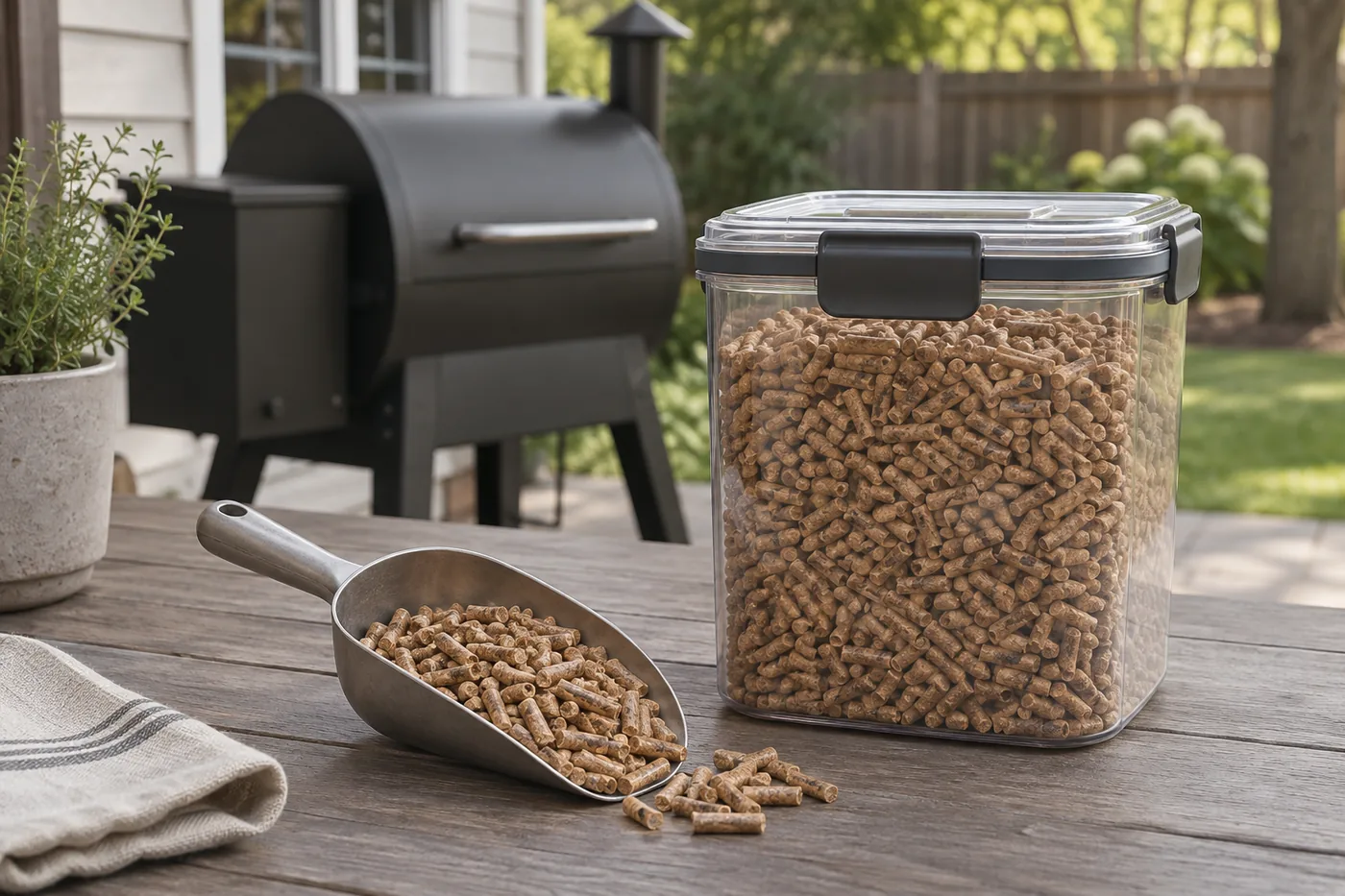 Inspect the fuel before blaming the controller, and keep replacement pellets sealed against moisture.
Pit Boss explains that wet pellets can swell, disintegrate, and later harden into an auger jam. So replace moisture-damaged fuel and keep the replacement in an airtight container, rather than expecting the fire to dry out a questionable supply. If the feed area contains a hardened mass, follow the exact model's jam-clearing directions or contact Pit Boss support instead of forcing another ignition.
The manufacturer's winter guidance also puts dry pellets and an ash-free firepot ahead of lighting. That makes fuel inspection a preparation task, not a reason to dismantle a cooker while the roast is inside. Do the invasive checks only when the smoker is cold.
Part 3Let shutdown finish, then clear the firepot
For routine cleaning, follow the model's shutdown procedure before disconnecting power. Pit Boss's FAQ describes a fan cooldown of approximately 15 minutes, so a fan still running after switch-off is not itself a fault. That timed cycle is not proof that everything is cool: wait until the cooker is completely cold, then unplug it before taking components out.
With the parts removed as your manual directs, inspect the firepot and its air holes for excess ash. Pit Boss identifies blocked air holes as a reason a fire can fade, so clear the air path, not just the visible cooking surface. Its cleaning guide allows suitable shop-vac or ash-vac equipment and specifically rules out a household vacuum; use equipment appropriate for completely cold ash.
The cleaning guide calls for a deeper clean after 15–20 cooking hours, while the FAQ gives a reminder after 40–60 lb of pellets or whenever excess ash appears. Those reminders measure different things, so neither is a reason to leave an obstructed firepot until a calendar date. Reassemble the cooker correctly before restarting; for a barrel grill, check the flame-broiler plate and slider against its manual rather than borrowing instructions from a vertical cabinet.
A visible ash obstruction matters more than whether the next scheduled cleaning feels due.
Part 4Give wind less access without trapping exhaust
Cold air and wind can keep a grill from reaching temperature, according to Pit Boss, but shelter does not mean enclosure. Its FAQ specifies at least 36 inches from combustible construction and says the grill must remain outside. Choose a less exposed outdoor position while the cooker is cold, preserving that clearance and any greater distance in your model's manual.
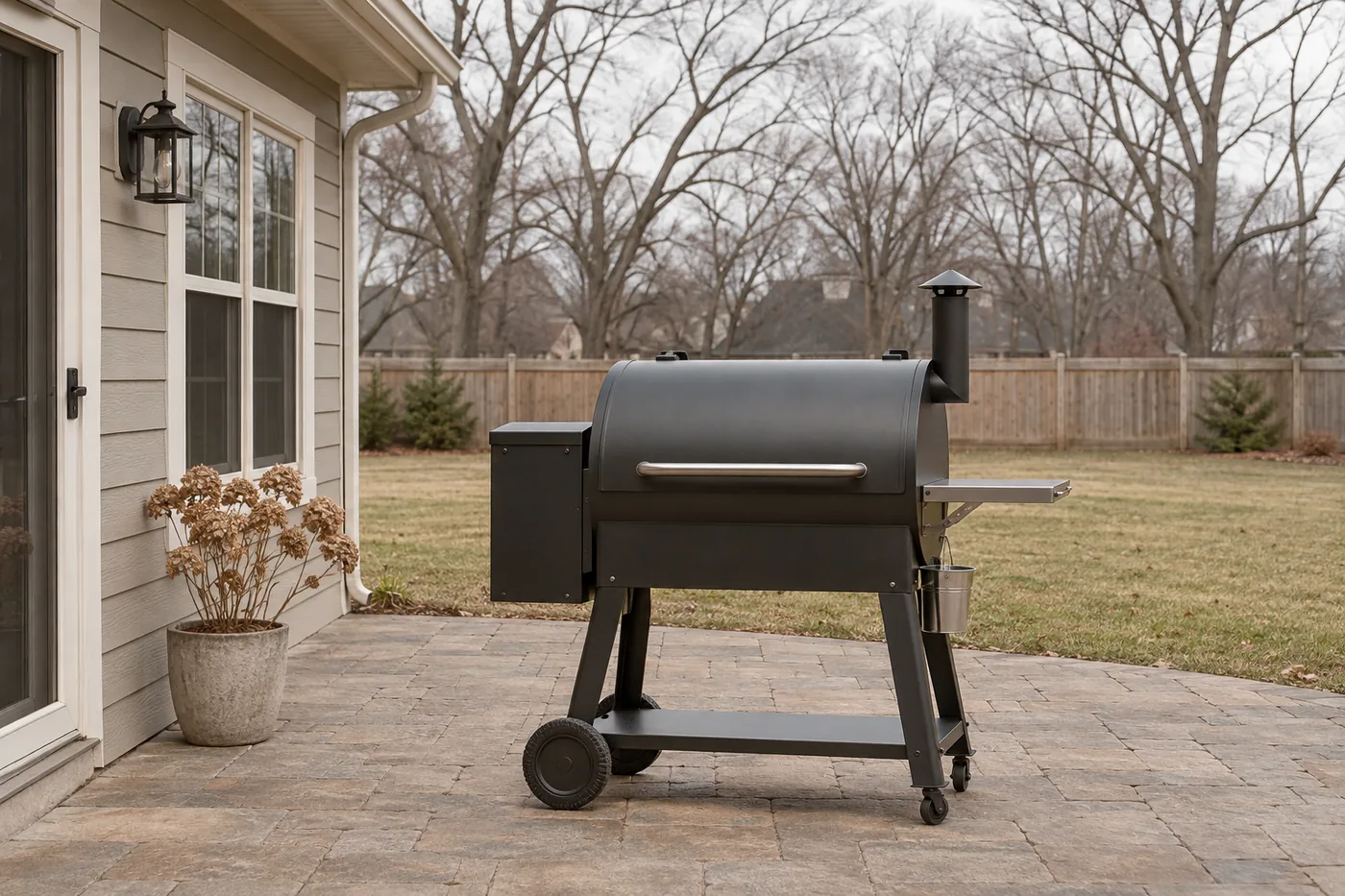 Choose the outdoor position before lighting, without crowding walls or enclosing the smoker.
Pit Boss also warns that restricting exhaust can cause temperature trouble and even let the fire die. So keep ventilation openings clear and use the chimney instructions for your specific model, rather than lowering a cap simply to hold smoke inside. Shelter from wind must not cost the fire its airflow.
A move beside combustible siding, into a garage, or onto an enclosed porch is not the answer to a cold-weather cook. That leaves a practical combination: a suitable outdoor spot, unobstructed ventilation, and fewer unnecessary lid openings. A wind problem is not fixed by creating an airflow problem.
Part 5Decide whether insulation actually fits the problem
Pit Boss suggests checking for a compatible insulated blanket in extremely cold conditions. But exact-model compatibility comes before ordering: a broad series name does not establish the right fit around a particular body, controller, and exhaust. Ask Pit Boss to confirm both fit and operating restrictions, and never substitute an ordinary storage cover or household bedding for an approved operating accessory.
No blanket is selected here because the smoker's exact model is unknown. That is money I'd keep in my pocket until dry pellets, a clean firepot, correct assembly, and clear airflow have been checked. Insulation can be considered for remaining weather-related heat loss; it is not a repair for a fire that will not stay lit.
An existing meat thermometer can help you follow dinner without opening the lid as often, but it cannot restore combustion or replace attending the cooker. If the temperature keeps falling, an error appears, or the fire goes out, use the model's shutdown and restart directions rather than repeatedly feeding a failed fire. Protect the meal plan separately from fixing the smoker: use an appropriate immediate oven-finishing recipe if outdoor cooking cannot continue, without promising a finish time the cooker cannot sustain.
Method: This sequence draws on Pit Boss's FAQ, cleaning instructions, winter guidance, and controller explanation. It prioritizes fuel condition, combustion airflow, and outdoor heat loss; no blanket is selected without model-specific fit confirmation. Sources checked November 24, 2026.
In one sentence
Check pellets, the fully cold firepot, and outdoor airflow before blaming winter or buying insulation.
Frequently asked questions
Are Pit Boss smoker temperature swings always a fault?
No. Pit Boss's FAQ describes approximately ±25°F swings for interval-fed auger operation. Identify the controller type and watch whether temperature recovers; a continuing decline, flameout, or error needs the model's troubleshooting procedure.
Why does a pellet smoker lose heat in cold weather?
Pit Boss identifies cold air and wind as possible causes, but damp pellets and ash-blocked firepot air holes can also prevent a strong fire. Check fuel and the fully cold firepot before assuming that insulation is the missing piece.
Should I unplug a Pit Boss smoker as soon as I switch it off?
Follow the model's shutdown instructions and allow its cooldown to finish. Pit Boss describes a fan cycle of approximately 15 minutes; let the smoker become completely cold and unplug it before disassembly for cleaning.
How often should I clean ash from the firepot?
Pit Boss's cleaning guide gives a deeper-cleaning interval of 15–20 cooking hours. Its FAQ also gives 40–60 lb of pellets or visible excess ash as reminders; an obstructed air hole needs attention during cold cleaning rather than waiting for an interval.
Will an insulated blanket fix a Pit Boss flameout?
A blanket does not fix damp fuel or blocked combustion airflow. Pit Boss suggests compatible insulation for extreme cold, but confirm the exact model and operating restrictions with the manufacturer before buying or using one.
Sources
- Pit Boss FAQ · 2026-11-24
Interval-fed swings approximately ±25°F; lid and digital readings can differ by up to 100°F; outdoor clearance at least 36 inches from combustible construction; fan cooldown approximately 15 minutes; cleaning reminder after 40–60 lb of pellets or visible excess ash. Also used pellet-condition, moisture, airflow, and compatible-blanket guidance.
- Pit Boss cleaning and maintenance guidance · 2026-11-24
Deep cleaning after 15–20 cooking hours. Allows suitable shop-vac or ash-vac equipment and excludes household vacuums; no vacuum product or price selected.
- Pit Boss winter grilling guidance · 2026-11-24
Used nonnumeric instructions to check pellet moisture, empty firepot ash before lighting, and reduce lid opening. No numerical warmup or fuel-saving claim taken from this page.
- Pit Boss controller and flame-broiler explanation · 2026-11-24
Uses Navigator 850 Connected Grill (PB850M) to explain responsive PID pellet delivery versus timed feeding. No model-specific temperature range or accuracy figure generalized to the unspecified smoker.