Butter sputters in the roasting pan, the kitchen smells like Thanksgiving, and the turkey breast is already deeply golden while the thigh still needs checking. For a host juggling an American home oven and a backyard pellet grill, the useful fix is separate breast and thigh readings, not another stretch of cooking based on color.
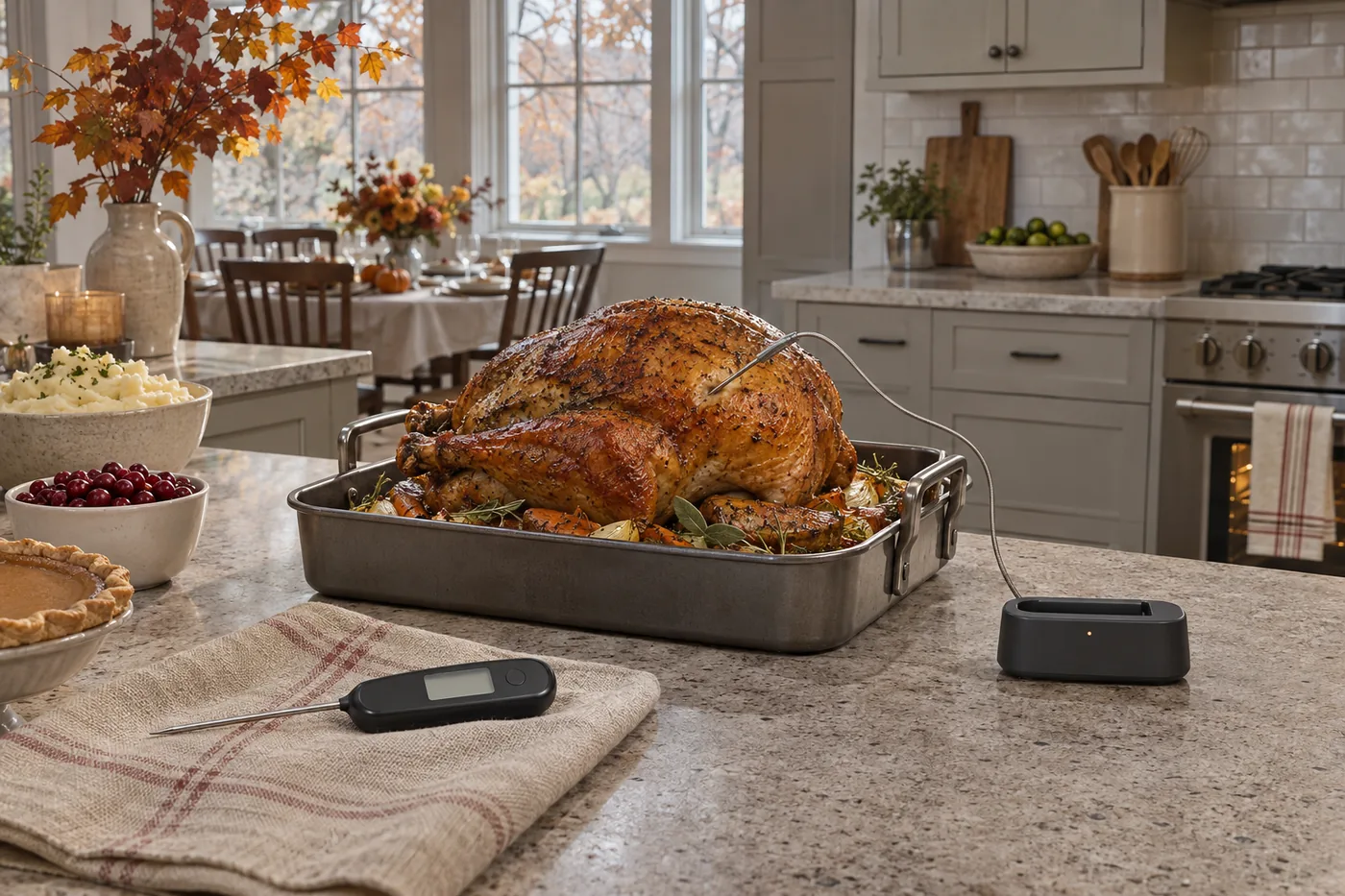 A browned surface cannot tell you the temperature deep inside the thigh.
I'd keep a suitable instant-read thermometer within reach before buying anything connected, because a leave-in probe cannot check every part of a whole bird. If you already own a MEATER Plus, it can follow the breast between checks, but placement comes before the app. That is where a dry-turkey problem often needs attention first.
How we chose
Reviewed official turkey guidance from the Partnership for Food Safety Education and manufacturer instructions from ThermoWorks and MEATER. The three checks were sensing-area placement, safety versus texture temperatures, and connection reliability with the cooker closed; no new thermometer purchase is required.
Part 1Put the sensing area in the breast, not the cavity
ThermoWorks describes placing a conventional leave-in breast probe roughly parallel to the roasting pan, aiming toward the center of the thickest meat. This approach helps the sensing area reach the slower-heating interior rather than sliding toward the cavity, where a reading would not describe the breast you plan to carve. Keep it clear of bone and the pan, following the thermometer's own insertion instructions.
For MEATER, those instructions include insertion past the safety notch, with the internal sensing section buried in meat and the ambient end outside. So a shallow angle is useful only if it also meets that depth requirement; an attractive photograph is not a placement guide. MEATER also says to avoid fat, bone, and gristle.
A leave-in reading tells you about its location, not the entire turkey, which is why ThermoWorks pairs continuous monitoring with instant-read verification. Move the instant-read through different positions in the thickest breast, allowing readings to settle as directed by its maker, and check both sides rather than stopping at the easiest spot to reach. Then check the innermost thighs and wings separately; keep an instant-read out of the oven between checks unless its maker specifically allows leave-in use.
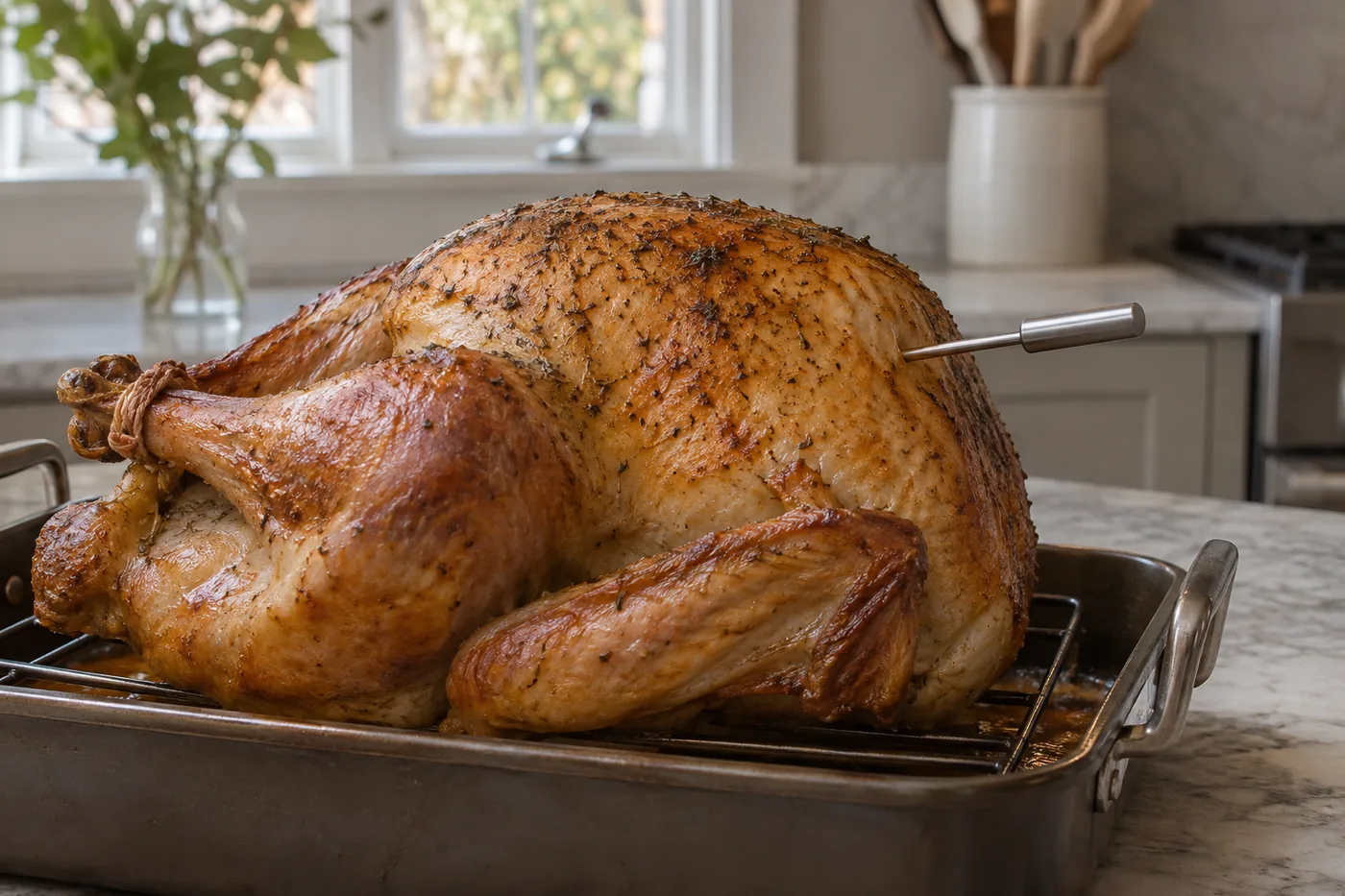 The sensing section belongs in breast meat, away from the cavity and bone.
Part 2Read the safety minimum separately from thigh texture
The Partnership for Food Safety Education specifies at least 165°F throughout the turkey, checked in the thickest breast and innermost thigh and wing. So a finished breast is not permission to skip a cooler thigh, and a warm thigh reading does not establish that the breast is ready. Its guidance also requires stuffing to reach 165°F and recommends cooking it separately for optimum safety and more even cooking.
ThermoWorks recommends 175°F for thigh texture, which is a different question from the minimum safety temperature. Its guide also discusses a lower breast-temperature approach involving time and temperature, but that is not the workflow here. For this straightforward approach, verify the required locations at 165°F or above before taking the whole bird off the heat.
Swipe sideways to see the full table →
| Where you check | Temperature to distinguish | What it changes |
|---|---|---|
| Thickest breast | At least 165°F in this workflow | Verify more than a convenient warm spot |
| Innermost thigh and wing | At least 165°F | A lower reading means cooking must continue |
| Thigh texture | ThermoWorks recommends 175°F | This is a texture preference, not a separate safety minimum |
| Center of stuffing | At least 165°F | The turkey's reading cannot stand in for stuffing |
If the breast gets there first, recheck the lagging thigh away from bone before adding more cooking time. But if that required location is still below 165°F, continue cooking and verify again; keeping the breast moist cannot override that check. When every required location has reached the minimum, I would stop chasing a matching number in the breast and thigh.
Equal temperatures are not the goal; verified temperatures in the required places are.
Part 3Fix the Bluetooth link without opening the cooker
MEATER lists the Plus for oven and pellet-grill cooking, with a maximum internal temperature of 212°F and maximum ambient temperature of 527°F. But these are model-specific limits, not permission to expose the probe to any grill setup: MEATER does not recommend its Alpha Collection probes over open flame. Check the model you own before treating these limits as yours.
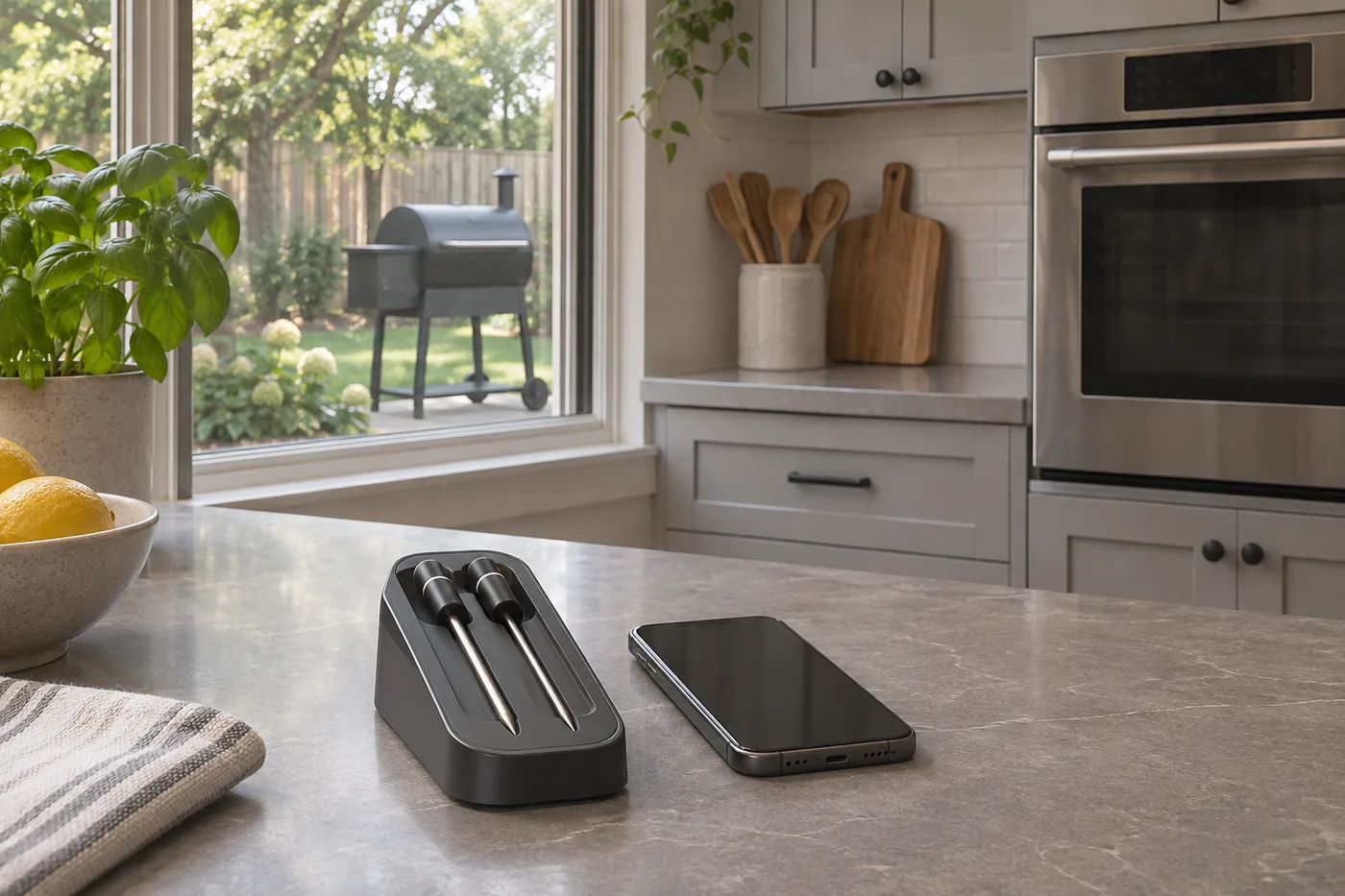 A nearby charger and phone are more useful than a distant screen with a frozen reading.
The maker advertises up to 165 ft for MEATER Plus, but says cooker thickness, obstacles, and the phone or tablet affect that range. So an open-counter connection proves little about reception once a metal oven door or grill lid closes. Pair before the cook, then confirm that live readings still arrive with the cooking chamber shut.
Keep the charger outside the cooker in a dry position protected from heat, and follow MEATER's advice to keep the phone reasonably close and within sight of the charger. If updates stop, bring the phone closer and reposition the charger away from obstructions and hot surfaces. Then look for fresh updates, rather than treating the last displayed number as a current measurement.
Still disconnected? Switch back to local instant-read checks at the required locations instead of waiting for an alert, keeping the chamber closed between necessary checks. A Bluetooth fix should not involve leaving the oven door or grill lid ajar, and a restored connection still cannot correct a misplaced probe.
Part 4Rest a verified turkey, then carve
The Partnership for Food Safety Education recommends a 20-minute rest before carving. That gives you room to finish gravy and bring the side dishes together, but in this workflow it follows the final temperature checks; it does not replace them. A thigh that has not been verified at the minimum is not ready simply because the breast needs a rest.
The same organization says turkey and other leftovers should not sit out for more than two hours, so resting, serving, and putting food away need to fit within that window. This is a useful moment to set out shallow storage containers as well as the carving board. Dinner is easier to manage when the cleanup plan is already beside it.
For the next holiday, note where the breast probe sat and which area finished last, rather than saving only an app's predicted finish time. If the breast repeatedly finishes well ahead of the dark meat, ThermoWorks describes cooking the white and dark meat separately as an alternative worth planning before the next roast. That changes how the parts cook instead of asking the breast to wait indefinitely.
Method: Reviewed the Partnership for Food Safety Education's turkey guidance and ThermoWorks and MEATER instructions, focusing on probe location, final temperature verification, and closed-cooker connection limits. No cooking trials or wireless-range measurements were performed for this article. No purchase links are included. Sources checked November 24, 2026.
In one sentence
Check breast and dark meat separately, and let verified temperatures—not color or a frozen app reading—decide when the turkey is ready.
Frequently asked questions
Where should a meat thermometer go in a whole turkey?
For breast monitoring, aim the sensing area into the thickest breast meat, avoiding bone and the cavity. ThermoWorks describes a roughly pan-parallel entry for a conventional leave-in probe. Follow the specific probe's insertion-depth instructions and separately verify the innermost thighs and wings.
Does a turkey thigh have to reach 175°F to be safe?
The Partnership for Food Safety Education specifies a minimum of 165°F throughout turkey, checked in the thickest breast and innermost thigh and wing. ThermoWorks' 175°F thigh recommendation concerns texture. In this workflow, any required location below 165°F needs further cooking, regardless of the other readings.
Why does a Bluetooth meat thermometer disconnect when the lid closes?
MEATER says cooker thickness, obstacles, and the phone or tablet affect its Plus connection range. Keep the charger outside the cooker and protected from heat, move the phone closer, and confirm fresh updates with the lid closed. If the connection remains unreliable, use an instant-read to verify the required locations.
How deep should a MEATER probe go into turkey breast?
MEATER requires insertion past the safety notch so the internal sensing section is inside the meat, with the ambient end outside. Avoid bone, fat, and gristle, and follow the instructions for the specific model rather than copying a shallow placement.
Can the resting period finish an under-temperature turkey thigh?
Do not rely on resting to replace verification in this workflow. Check the required breast, thigh, and wing locations at 165°F or above before removal, then follow the Partnership for Food Safety Education's 20-minute rest before carving.
Sources
- Partnership for Food Safety Education: turkey cooking guide · 2026-11-24
165°F minimum throughout turkey and in stuffing; check thickest breast and innermost thigh and wing. Rest 20 minutes before carving; turkey and other leftovers should not remain out for more than two hours.
- ThermoWorks: turkey temperatures and probe placement · 2026-11-24
175°F thigh-texture target; pan-parallel breast-probe insertion and instant-read verification. The page's alternative 157°F breast method is not adopted here; it also discusses cooking white and dark meat separately.
- MEATER Plus · 2026-11-24
Plus limits: internal 212°F, ambient 527°F, Bluetooth range up to 165 ft subject to cooker thickness, obstructions, and phone or tablet. Oven and pellet-grill use listed; Alpha Collection not recommended over open flame.
- MEATER: meat thermometer insertion guide · 2026-11-24
No numeric insertion depth specified for the guidance used here: insert past the safety notch, keep the internal sensing section inside meat and ambient end outside, and avoid fat, bone, and gristle.