The smell turns before the timer finishes: bacon fat, suddenly sharp and bitter, drifting toward the holiday serving plates while the oven is already occupied. In a closed-up winter kitchen, stop the cooking before investigating; a greasy basket and an indoor grill need different checks, not the same hurried temperature adjustment.
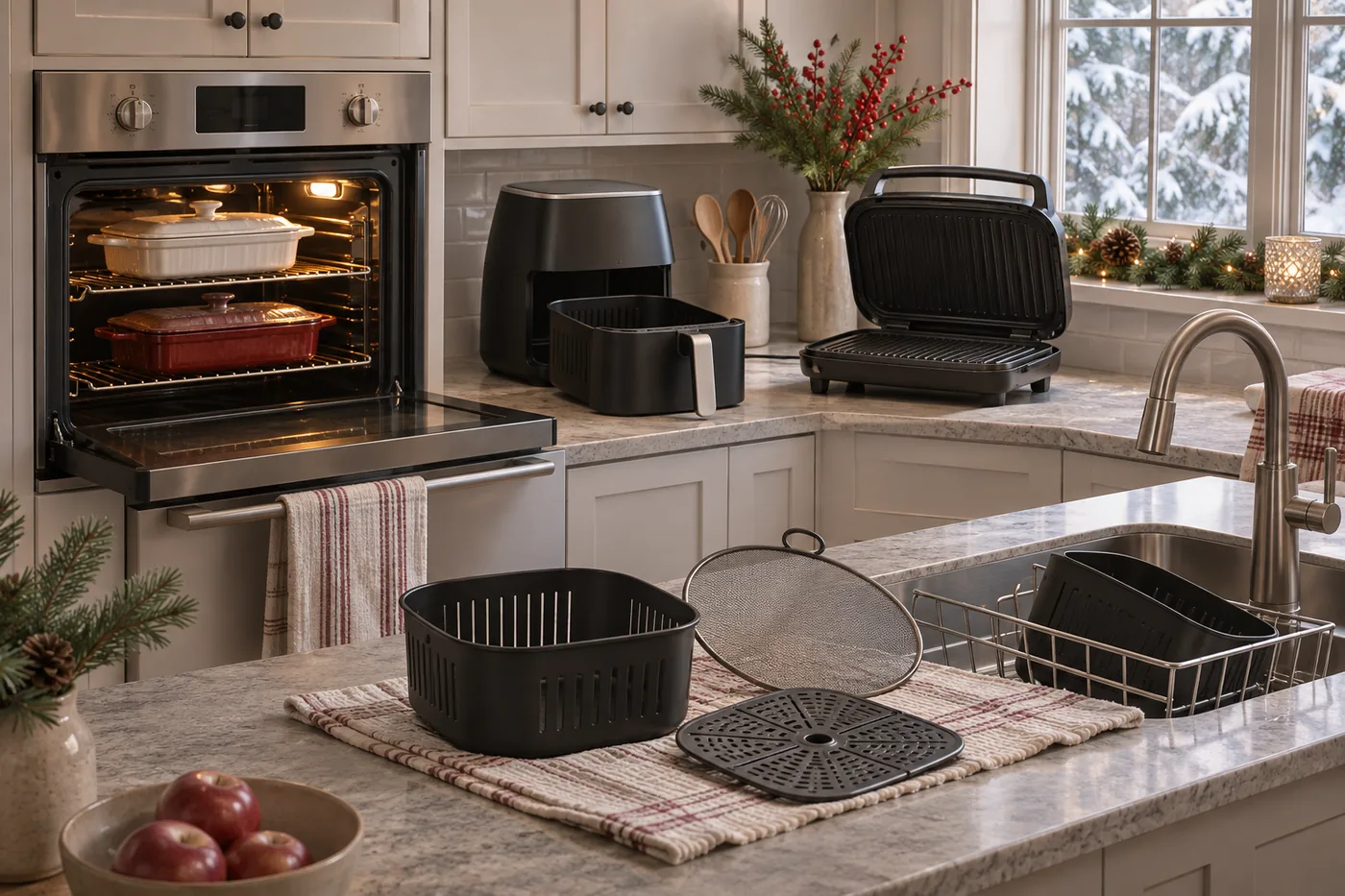 Set the next platter aside while the cooker gets attention.
For a Ninja AF101, the useful inspection starts beneath the removable crisper plate; for an AG301-style indoor grill, it includes the shield beneath the hood. That distinction matters more than buying a cleaning gadget, so this guide adds no shopping list.
How we chose
Ninja's AF100 and AG300/AG400 FAQs, CPSC fire-safety guidance, and EPA ventilation advice informed this guide. The checks follow three priorities: identify the exact appliance, clean only the parts its instructions permit, and recognize when further cooking is inappropriate.
Part 1Stop safely, then read the model label
Pulling the drawer feels like stopping the machine, doesn't it? But Ninja's AF100-series FAQ says the AF101's timer and fan continue when its basket comes out, so use START/PAUSE rather than relying on drawer removal. Ninja describes a different arrangement for the indoor grill: opening the hood pauses cooking, while START/STOP cancels the function.
Follow the controls for your model, then let it cool completely before inspecting grease. Ninja instructs owners to unplug before cleaning, so cold and unplugged comes before washing, not halfway through it.
This cleanup sequence is not an emergency response. If there are flames, spreading smoke, melting, or cord damage, stop troubleshooting; CPSC's fire-safety guidance emphasizes leaving danger using a household escape plan and keeping smoke alarms working. Contact emergency services from a safe place when there is a fire or immediate danger.
A little visible vapor cannot, by itself, identify the problem. So use the model label and a cooled inspection rather than deciding that every white plume is harmless or that every smoking appliance only needs a scrub.
Part 2Look below the food, not just at the browned surface
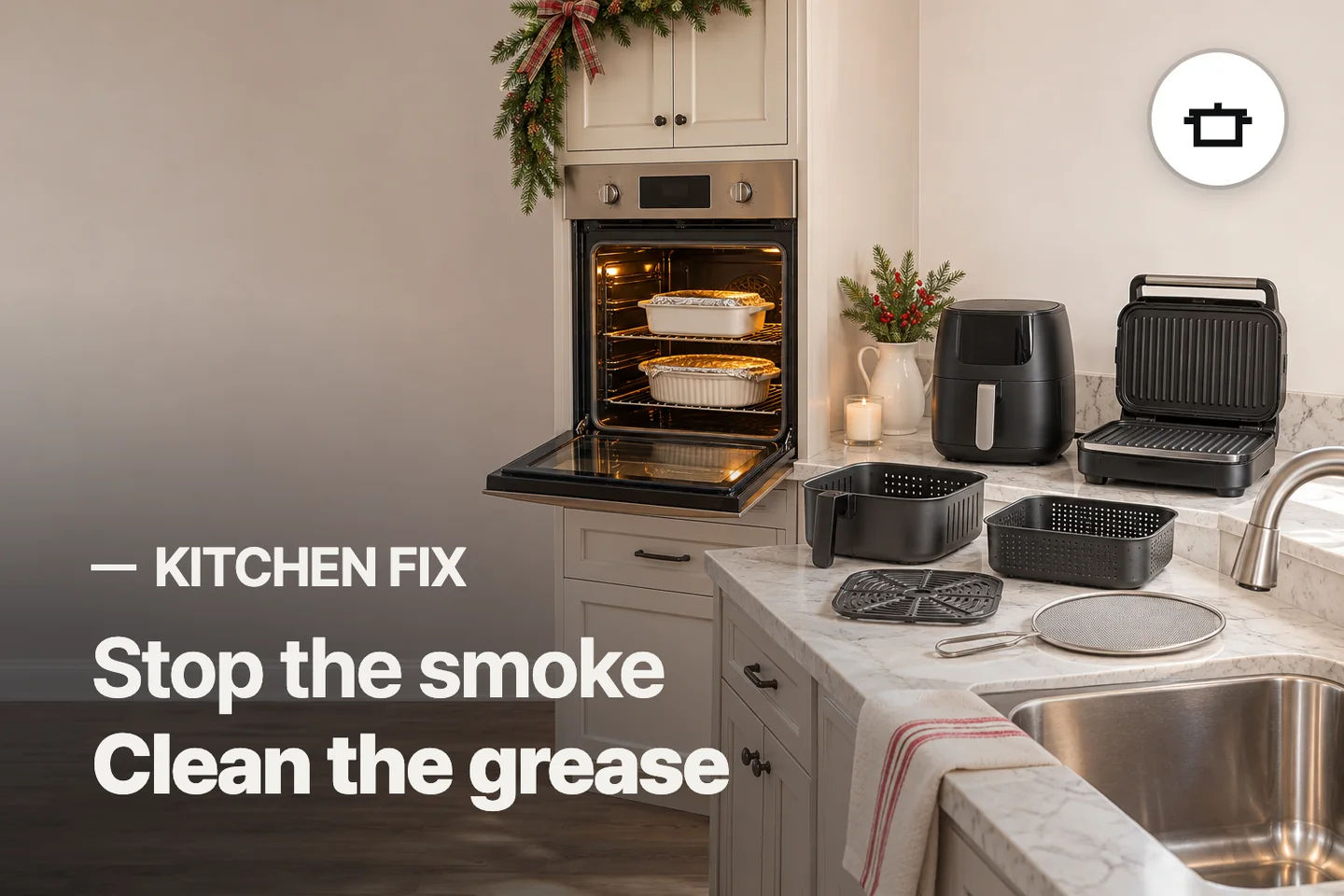
A clean-looking crisper plate can hide the part that needs attention. With the AF101 cold and unplugged, lift out that plate and inspect the basket floor and corners, because the surface touching the food is not the whole cleanup. On the indoor grill, follow the grease into the cooking pot and inspect the removable hood shield as well.
Ninja says the grill's splatter shield helps keep the heating element clean and prevent smoking. That makes residue on the shield worth checking, but it does not prove that grease is the cause of every burning smell.
Swipe sideways to see the full table →
| Where the residue sits | Which appliance this check belongs to |
|---|---|
| Under the removable crisper plate | AF101 basket air fryer |
| In the cooking pot and on the hood splatter shield | AG301-style indoor grill |
Look at the exhaust space, too. Ninja's AF100 FAQ specifies at least 5 inches from other surfaces because of the hot rear exhaust, so a countertop squeezed between serving trays and a wall needs rearranging before another batch. That clearance belongs to the AF100 instructions; other models need their own manual.
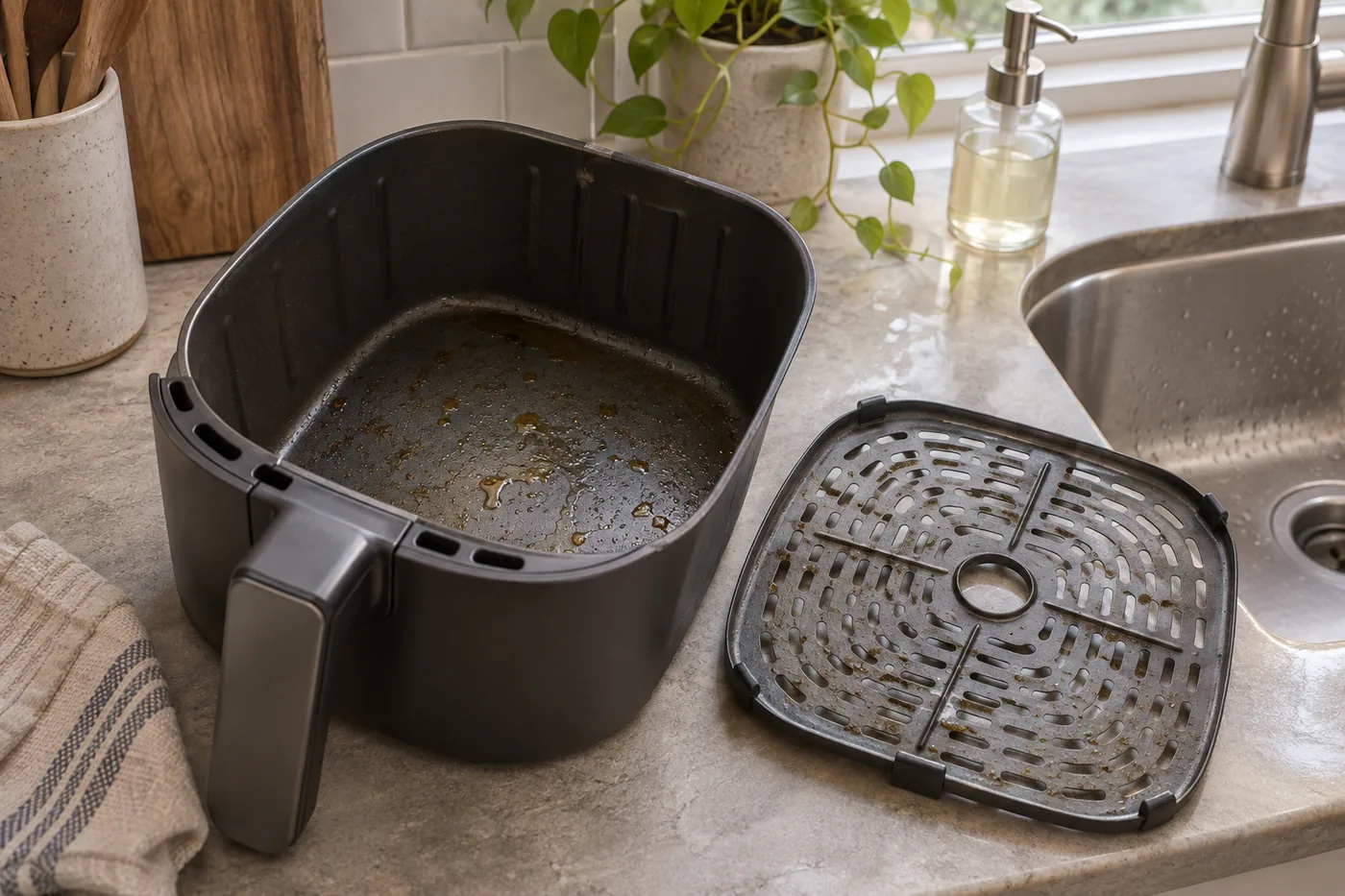 Lift out the plate so the basket floor is visible before washing.
Part 3Wash the basket without attacking its coating
Ninja recommends cleaning the AF101 after each use and allows its basket and crisper plate in the dishwasher. For stuck food, its FAQ recommends warm, soapy water and non-abrasive cleaning materials, so soaking is the sensible next step when residue resists a soft sponge. Pay attention to the plate's underside as well as the basket corners.
The same FAQ warns that conventional oven or grill cleaners can ruin the nonstick coating. So a stubborn patch is not a reason to reach for the strongest spray under the sink, and the electrical body is not another dishwasher-safe piece.
Ninja calls for wiping the main unit and control panel with a damp cloth, without immersing the appliance. After washing the removable parts, air-dry or towel-dry them before putting them back, following the manufacturer's directions.
For food on the heating element, Ninja's AF100 FAQ specifies a cleaning brush within its unplug-before-cleaning guidance. That does not authorize opening the housing or washing inaccessible electrical parts; stay within the access your manual permits, and ask Ninja about residue you cannot reach that way.
Clean the removable grease-catching parts; the electrical housing is not part of the wash-up.
Part 4Give the indoor grill its own shield check
The Foodi name alone does not tell you which cleaning instructions apply. For the AG300/AG400 indoor-grill family, Ninja describes releasing the cooled shield's front clip and lifting it from the rear ridge; that procedure belongs to this grill, not every appliance carrying the Foodi name.
Ninja lists the cooking pot, grill grate, crisper basket, and splatter shield as dishwasher-safe. So clean the shield along with the cookware, then reinstall it with the rear tab in its slot and the front clipped securely, as the manufacturer directs. If it will not attach correctly, stop and contact Ninja rather than cooking without it.
For bacon and sausages on this grill's Grill function, Ninja lists Low at 400°F. But that setting is neither an AF101 instruction nor a complete recipe for bacon-wrapped food with a filling, so keep the recipe's cooking requirements separate from the grill's heat-setting advice.
Ninja also recommends canola, avocado, or vegetable oil for grilling and says olive oil produces more smoke in this appliance. That is model-specific guidance, not a reason to change oils instead of removing old grease.
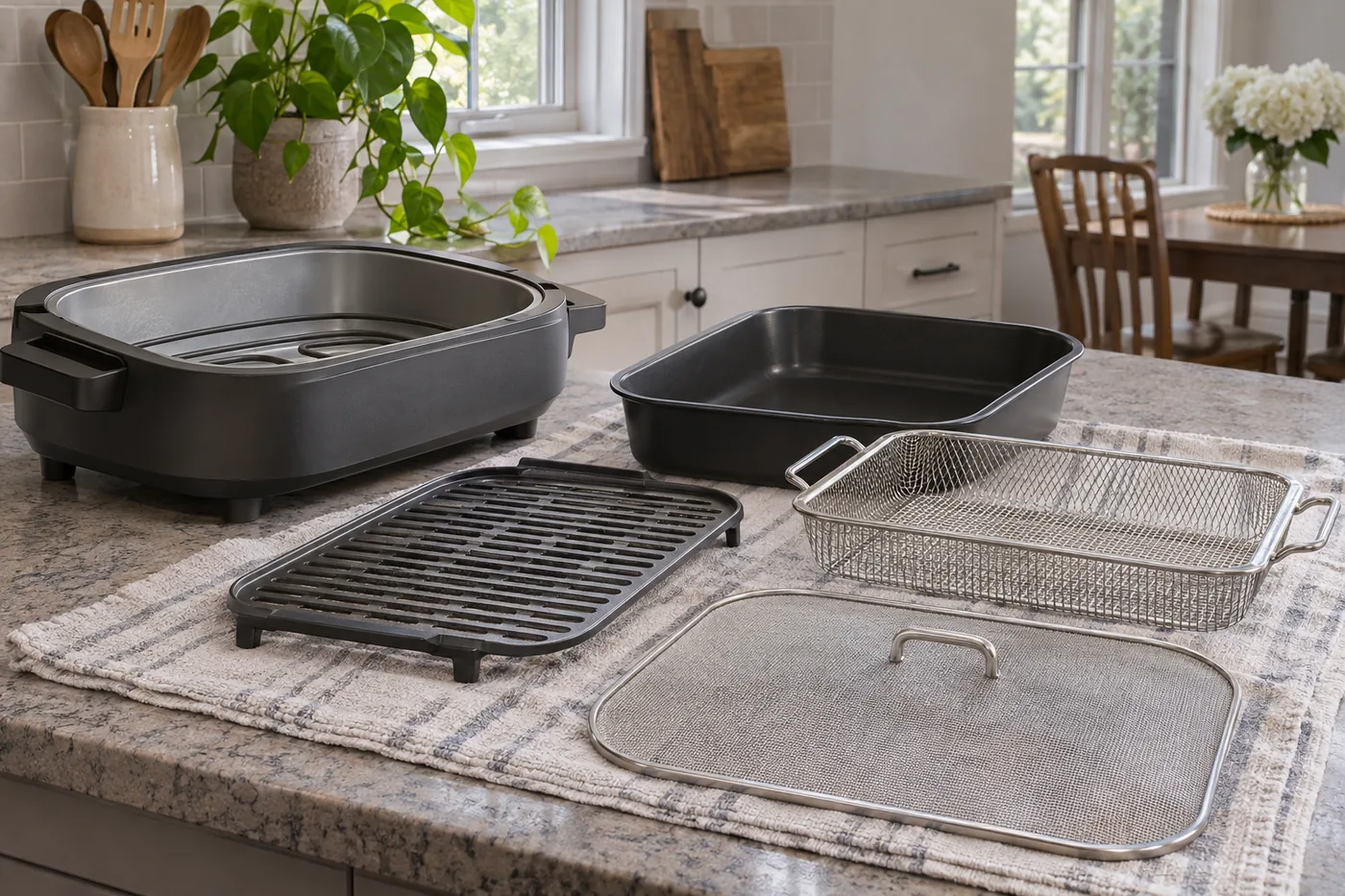 The hood shield belongs in the cleaning routine, not just the grate below it.
Part 5Ventilate, then decide whether to resume
Before restarting, check that the dried parts are seated correctly and the model's required clearances are open. EPA identifies controlling the pollution source as generally the most effective indoor-air approach, so ventilation supports grease removal rather than replacing it.
EPA says kitchen fans that exhaust outdoors remove contaminants directly from the room. Use available outdoor-exhaust ventilation during cooking; opening a window can help when weather and outdoor air conditions permit, but it does not make a dirty or damaged cooker ready.
CPSC advises staying in the kitchen while cooking and maintaining working smoke alarms. So keep the next batch attended and stop using the appliance if smoke or an abnormal burning odor returns after proper cleaning; Ninja support is the next step, not a hotter cycle to finish dinner.
Source notes: This guide uses Ninja's model-specific FAQs for controls, grease-catching parts, and cleaning; CPSC for fire safety; and EPA for ventilation. Ninja and CPSC details retain the November 14, 2026 source check because their article text could not be reverified on November 24, 2026; EPA guidance was rechecked on November 24, 2026.
In one sentence
Stop cooking, let the Ninja cool, unplug it, and inspect the grease-catching parts listed for its exact model.
Frequently asked questions
Does removing the AF101 basket pause cooking?
Ninja's AF100-series FAQ says the timer and fan keep running when the basket is removed. Use START/PAUSE instead of treating drawer removal as a pause control.
Can I use oven cleaner on Ninja air fryer grease?
Ninja warns that conventional oven and grill cleaners can damage the AF101's nonstick coating. Its FAQ recommends warm, soapy water for stuck residue and non-abrasive cleaning materials.
Does every Ninja Foodi have a removable splatter shield?
Do not infer the parts from the Foodi name. The AG300/AG400 indoor-grill FAQ describes a removable hood shield; check the model label and that appliance's manual before applying those directions.
What Ninja grill setting is listed for bacon and sausages?
Ninja lists Low, 400°F, for the AG300/AG400 Grill function. This is not an AF101 setting or a complete cooking instruction for every bacon-wrapped appetizer.
What if my Ninja still smokes after cleaning?
Stop using it if smoke or an abnormal burning odor returns after the model's prescribed cleanup, and contact Ninja. Flames, spreading smoke, melting, or cord damage are reasons to abandon troubleshooting and respond to the danger instead.
Sources
- Ninja AF100-series US FAQ · 2026-11-14
Retained from the original source check: at least 5 inches of clearance from other surfaces; AF101 pause behavior, basket and crisper-plate cleaning, coating precautions, and heater brushing. Reopened November 24, 2026, but the page delivered a site shell without verifiable article text.
- Ninja AG300/AG400-series US indoor-grill FAQ · 2026-11-14
Retained from the original source check: Low Grill at 400°F for bacon and sausages; shield handling, dishwasher-safe parts, controls, and oil advice. Reopened November 24, 2026, but the page delivered a site shell without verifiable article text.
- CPSC Fire Safety · 2026-11-14
No numerical claim. Original source guidance on attended cooking, working smoke alarms, and household fire escape planning retained; the November 24, 2026 recheck returned Access Denied.
- EPA Improving Indoor Air Quality · 2026-11-24
No numerical claim. Confirms source control is usually the most effective indoor-air approach and that outdoor-exhaust kitchen fans remove contaminants directly from a room; ventilation depends on weather and outdoor conditions.