Conclusion
The lower-priced TABYIK suits modest collection in a small, mildly damp space. A persistently damp basement calls for the higher-capacity Waykar and a practical drainage plan.
3 selected products
- No photoIf you want modest collection in a small home office
TABYIK DH-CS01
about $39.99 on Amazon.com (Oct 12, 2026) - No photoIf you prioritize a larger tank and bedroom light control
BEDRED CT11
about $59.99 on Amazon.com (Oct 12, 2026) - No photoIf you need ongoing control in a damp basement
Waykar JD025CE-80
Price varies; check Amazon
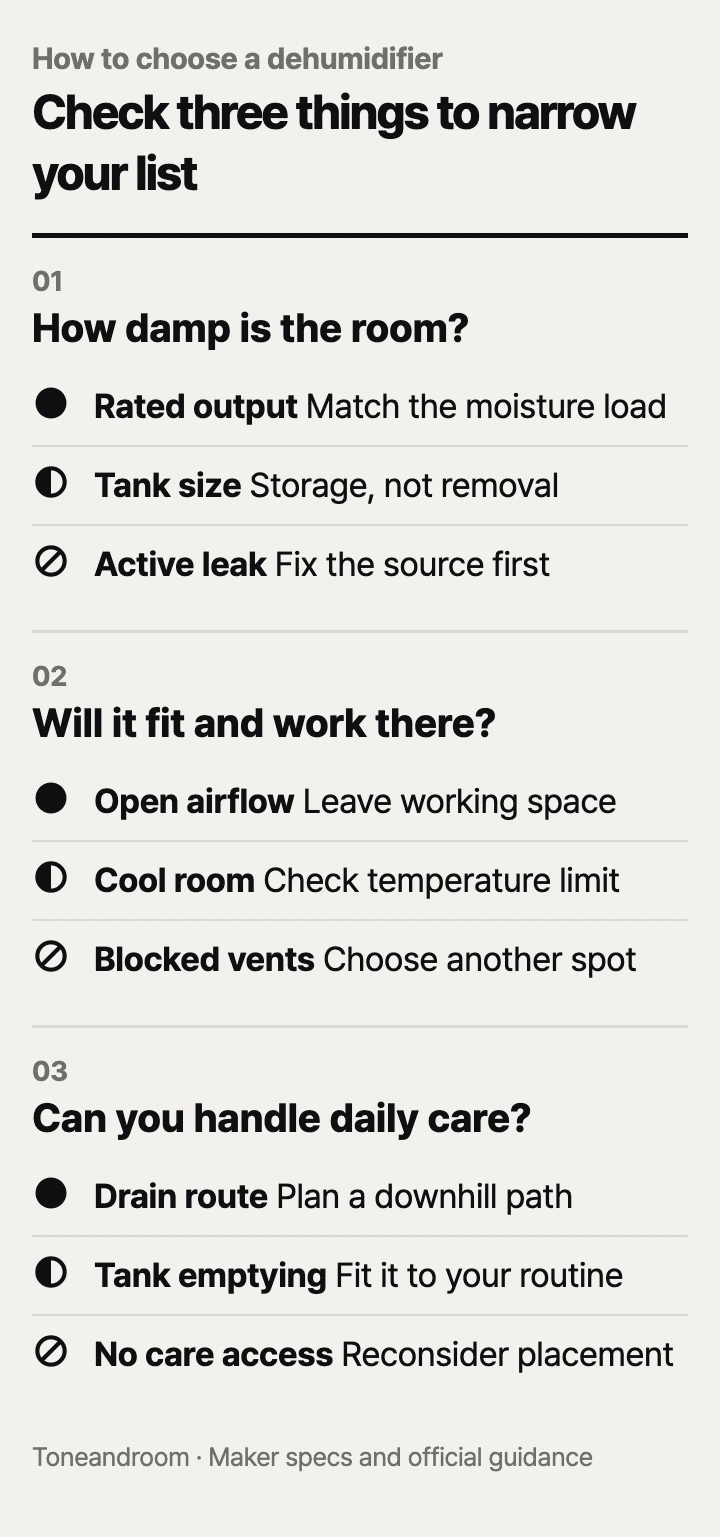
The common mistake is buying by tank size or advertised square footage while overlooking how much moisture the machine can actually remove. Before choosing one for your home, check these three things, in order
How much moisture does your space need removed?
Match daily moisture removal to the room's dampness before comparing tank sizes. ENERGY STAR's buying guidance bases capacity on room size and moisture conditions, rather than floor area alone. A tank holds collected water; its size does not tell you how quickly the machine collects it.
Start with the room you actually want to manage. A closed home office with occasional dampness is a different job from a basement that stays clammy. Write down the room's dimensions, whether doors usually stay open, and when dampness appears. An independent humidity meter gives you something more useful to compare than how the room feels on a rainy afternoon.
Swipe sideways to see the full table →
| If your home ... | Our take | What to check |
|---|---|---|
| Has a small, mildly damp enclosed room | It depends | Daily collection rating and room temperature |
| Has a basement that stays damp | Only some models | Higher removal capacity and a practical drain route |
| Has high humidity and you can maintain the unit | Worth it | Humidity readings before and during operation |
| Has an unresolved leak or seepage | Skip it | Repair the moisture source before relying on an appliance |
The EPA recommends indoor relative humidity below 60%, ideally 30%–50%, and addressing the source of moisture. EPA guidance also calls for prompt drying after leaks or spills. A dehumidifier belongs in that broader moisture plan; it cannot repair a roof, plumbing connection, or foundation.
For a compact option, TABYIK lists its DH-CS01 at up to 16 fl oz per day under 86°F and 80% relative humidity. Waykar rates the JD025CE-80 at up to 80 pints per day under 95°F and 90% relative humidity. These are different measurement conditions, so the headline numbers are not an equal-condition comparison or a promise for your room.
Treat oversized coverage claims cautiously. Decide whether you need modest collection in an enclosed space or ongoing room humidity control, then compare removal ratings with their conditions attached. If a daily rating is missing, a larger tank does not fill that information gap.
Will it fit where you actually need it?
Choose a location that accommodates the appliance, airflow, and access to its tank. TABYIK's placement guidance says to keep its top inlet and rear outlet unobstructed. Measure the proposed spot with the unit's working space in mind, rather than measuring only the rectangle it occupies.
For the TABYIK, the maker lists 5.9 × 5.9 × 10.1 inches. Think about pulling the tank out as well as setting the appliance down. A space beside a desk can be more convenient than a crowded shelf where you have to move books every time you empty it. Consider where the cord would go and whether the display would face you.
ENERGY STAR advises checking low-temperature suitability when a room falls below 65°F. That matters when the intended location is an unheated basement or garage. Record the temperature in the intended room; a warm-room capacity claim does not establish cool-room performance.
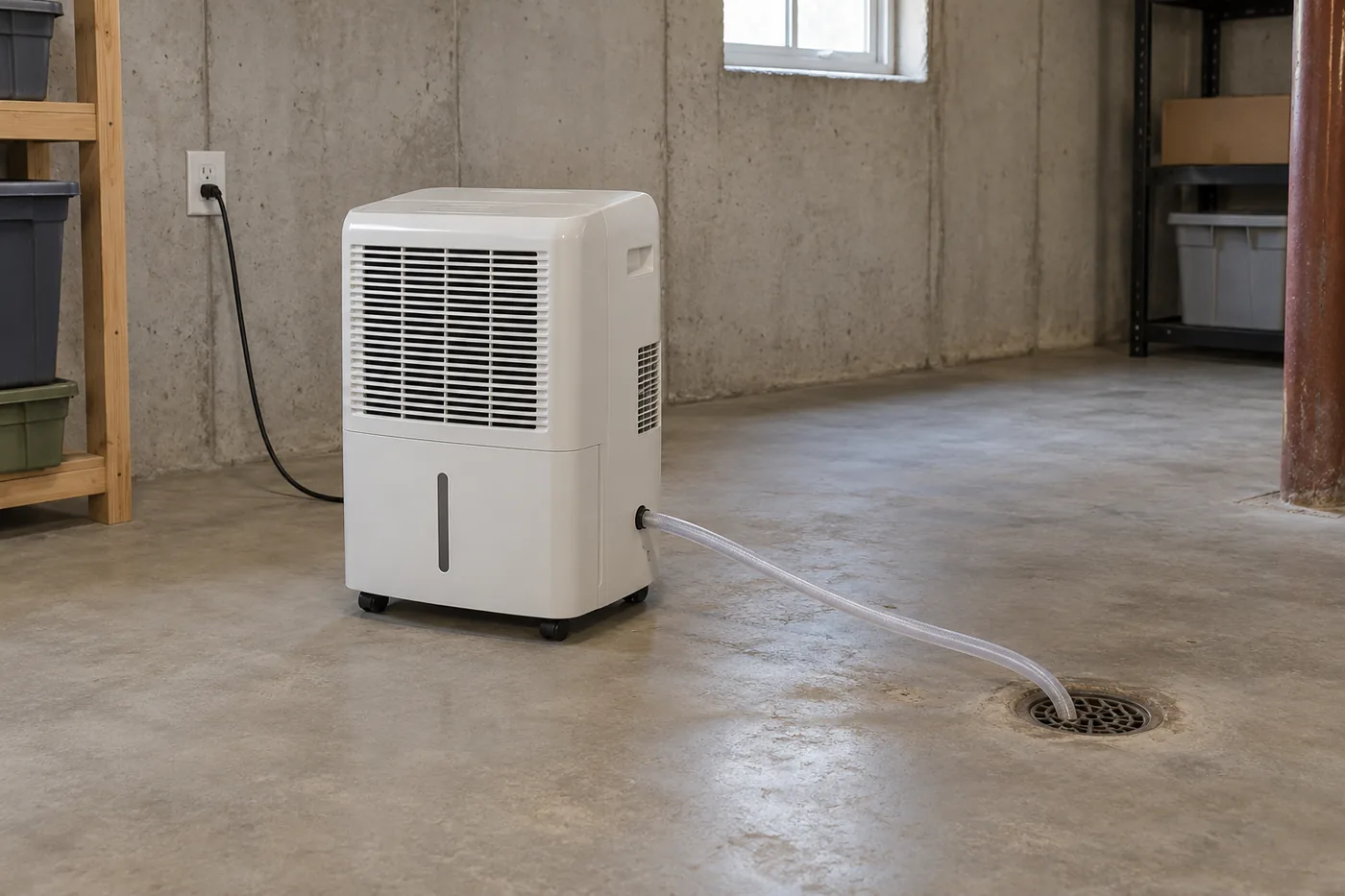 AI-generated illustration for explanation. Not a specific product.
For a bedroom, light control may matter as much as the appliance's footprint. BEDRED's CT11 listing describes a sleep mode that turns off the ambient lighting. Its numerical noise level is Not listed by the maker.
- Measure the intended spot and the tank's removal path.
- Decide whether lights belong in that room at night.
- Check the room's coolest usual temperature.
- Consider whether you will want to relocate the machine seasonally.
Can you keep up with emptying and care?
Choose the drainage arrangement around your routine before paying for extra capacity. Waykar specifies a removable tank and continuous gravity drainage for the JD025CE-80. The important household question is whether you have a suitable drain nearby or will carry collected water to a sink.
Walk that route before ordering. Is the sink on the same floor? Can you reach the tank without moving furniture? Will someone remember to check it during a busy workweek? A product can fit the room perfectly and still be inconvenient if its daily chores do not fit your schedule.
With gravity drainage, plan for water to travel downhill to the destination; an uphill route calls for a different arrangement. Waykar identifies this model's connection as a gravity drain, so do not assume it includes a pump. Confirm the included hose and connector with the seller, particularly if you intend to route it around shelving or through a utility area.
Waykar's care guidance says to tighten the hose valve securely when using tank drainage to prevent leaks. For electrical and water separation, ENERGY STAR's safety guidance says to keep drainage away from electrical devices and hoses away from cords and connections. Follow the exact model's instructions when arranging either drainage method.
TABYIK's maker describes a removable transparent tank and automatic shutoff before the tank reaches its nominal capacity. That means the advertised tank volume is not necessarily the amount you can collect between stops. Put tank checking into an existing habit, such as your morning room check, rather than assuming a collection schedule from the tank label.
- Choose manual emptying or continuous drainage before checkout.
- Leave access for tank removal and the care steps in the manual.
- Check what filter care the exact model requires.
- Keep the manual available for seasonal storage and restart.
How do the popular picks compare side by side?
TABYIK suits modest collection on a smaller budget, BEDRED adds tank space and light control, and Waykar is the more suitable option for a persistently damp room. TABYIK, BEDRED, and Waykar publish different specifications, so missing entries and rating conditions belong beside the numbers.
Swipe sideways to see the full table →
| Model | Published daily removal | Nominal tank | Control or drainage | Price (Amazon.com, Oct 12, 2026) |
|---|---|---|---|---|
| TABYIK DH-CS01 | Up to 16 fl oz at 86°F, 80% RH | 35 fl oz | Manual emptying; automatic shutoff | about $39.99 on Amazon.com (Oct 12, 2026) |
| BEDRED CT11 | Not listed by the maker | 95 fl oz | Sleep mode; automatic shutoff | about $59.99 on Amazon.com (Oct 12, 2026) |
| Waykar JD025CE-80 | Up to 80 pints at 95°F, 90% RH | 1.14 gal, per Waykar | Gravity drain or tank | Price varies; check Amazon |
Prices are what Amazon.com showed on Oct 12, 2026 and change often.
Amazon's Oct 12, 2026 popularity labels were 20K+ bought in past month for BEDRED, 9K+ for TABYIK, and 3K+ for Waykar. Those labels show buying activity, not whether a model can handle your moisture load.
BEDRED's Amazon specification lists 220 volts; confirm the exact unit's power requirements with the seller before ordering for your home. Its larger tank does not establish greater daily removal. Waykar's Amazon page and maker page also differ on some physical specifications and included hose details; verify those for the unit shipped rather than planning installation from conflicting entries.
Choose TABYIK for a small, mildly damp space where modest collection is acceptable. Choose Waykar when ongoing humidity control and a workable drain route matter more than a compact tabletop form.
A closer look at each product
If you want modest collection in a small home office · TABYIK DH-CS01
The Peltier design has a compact footprint and a removable tank. Its published daily collection is modest, making it a conditional fit for mild dampness.
- 5.9 × 5.9 × 10.1-inch body
- 35 fl oz transparent tank
- Automatic shutoff
- Daily removal rated under warm, humid conditions
- Requires manual tank emptying
If you prioritize a larger tank and bedroom light control · BEDRED CT11
The tank and lights-off sleep mode offer convenience; daily removal is Not listed by the maker.
- 95 fl oz tank
- Lights-off sleep mode
- Unverified daily removal
- Confirm power requirements with BEDRED before ordering
If you need ongoing control in a damp basement · Waykar JD025CE-80
A published higher removal rating and adjustable humidity control make it the stronger fit for persistent dampness. Gravity drainage can reduce tank-emptying chores when your layout allows it.
- Up to 80 pints/day at 95°F, 90% RH
- Continuous gravity drainage
- Adjustable humidity control
- Maximum rating uses hot, humid conditions
- Confirm physical specifications and hose details before installation
In one sentence
Choose by moisture load, placement, and daily upkeep before comparing tank sizes.
TABYIK DH-CS01
View on AmazonBEDRED CT11
View on AmazonWaykar JD025CE-80
View on AmazonWhat to check
- Moisture loadMeasure humidity in the intended room and compare daily removal ratings with their conditions.
- PlacementMeasure the working space and check the room temperature against the exact model instructions.
- Daily upkeepWalk the tank-emptying route or identify a suitable drain before ordering.
- Moisture load and rated daily removal
- Placement and operating temperature
- Daily emptying and care
Frequently asked questions
What humidity should I set my basement dehumidifier to?
EPA guidance recommends keeping indoor relative humidity below 60%, ideally 30%–50%. Use a separate humidity meter to check the room rather than relying on how damp it feels.
Are small dehumidifiers enough for a basement?
Room size alone cannot answer that question; ENERGY STAR also considers dampness when choosing capacity. A small collection unit is a conditional option for mild dampness, rather than an automatic fit for a persistently damp basement.
Does a larger water tank mean better dehumidification?
Tank volume describes storage, while daily removal describes collection. TABYIK publishes both figures, but the larger BEDRED tank does not establish a higher daily removal rate.
Can I drain a dehumidifier without emptying the bucket?
Waykar lists continuous gravity drainage for the JD025CE-80. Check the drain route and exact connection details before ordering; a gravity connection does not establish pump capability.
Sources
- TABYIK official product specifications · Oct 12, 2026
16 fl oz/day at 86°F and 80% RH, 35 fl oz tank, body dimensions, shutoff, and unobstructed airflow guidance.
- Waykar official JD025CE-80 specifications · Oct 12, 2026
80 pints/day at 95°F and 90% RH, 1.14-gallon tank, gravity drainage, and hose-valve care guidance.
- EPA moisture and mold guidance · Oct 12, 2026
Indoor humidity below 60%, ideally 30%–50%, plus moisture-source control and prompt drying guidance.
- ENERGY STAR dehumidifier buying guidance · Oct 12, 2026
Capacity selection, suitability below 65°F, and electrical and water separation guidance.
Read next

Best Air Purifier on Amazon (2026): Check Room Fit, Placement and Filter Care First
Best Robot Vacuum on Amazon (2026): Check Floor Access, Mop Fit and Upkeep First
Best Cordless Stick Vacuum on Amazon.com (2026): Check Floor Fit, Runtime and Storage, and Upkeep First
Best Humidifier on Amazon.com (2026): 3 Things to Check First
Other topics
Best Cat Water Fountain on Amazon.com (2026): Check Placement, Capacity, and Cleaning First
Best Automatic Cat Feeder on Amazon (2026): Check Feeding Fit, Setup and Upkeep First

Best Wireless Earbuds on Amazon (2026): Check Fit, Connections and Battery Care First